Flat White vs Latte: The Milk Ratio That Sets Them Apart
Put the same 36 g espresso shot into two cups. Add 120 g steamed milk to one and 200 g to the other: the first will read as a compact, coffee-forward flat white; the second as a softer, milkier latte. That difference is not a secret café rule. It is dilution you can weigh.
That is the useful answer to flat white vs latte. The names are not precise enough to replace a recipe, so compare espresso mass, milk mass, and texture. If you want outside terminology context, industry glossaries for espresso-based drink terminology can help, but the liquid in the cup is the practical evidence.

Start with the ratio: flat white is smaller and more concentrated, latte carries more milk
A practical flat white starting point is 36 g of liquid espresso with 100–130 g of steamed milk. A practical latte starting point uses the same espresso with 180–220 g of milk. These are useful home-brewing ranges, not international definitions.
The espresso-to-milk arithmetic makes the distinction clear. Thirty-six grams paired with 100–130 g of milk gives roughly 1:2.8 to 1:3.6. The same shot paired with 180–220 g gives about 1:5 to 1:6.1. Here, 1:3 means one part espresso to three parts milk; it is different from an espresso brew ratio, which compares dry coffee with the liquid espresso yield.
Less milk means less dilution of the espresso’s soluble flavour compounds, so the coffee stays more present against the milk’s sweetness, fat, and body. More milk softens that coffee flavour and makes the drink feel larger and gentler, even though the espresso itself has not changed.
That gives you a useful test for ambiguous café language: if a drink called a flat white carries a milk load closer to 200 g, it will taste latte-like in strength regardless of the name. A café can use one shot, two shots, or a different cup, so the ratio is more informative than the label.
Cup size is evidence, not the definition
Cup size helps you predict the drink, but it does not settle the question. As a working menu range, a flat white lands around 150–180 mL, while a latte often occupies a 240–300 mL cup or something larger. Treat those figures as clues about the intended milk load rather than rules every café must follow.
There is a small measurement trap here. Milk foam increases the drink’s volume by adding air, but that air contributes very little mass compared with the milk. A 150 mL drink and a 180 mL drink can therefore contain similar liquid mass if one has more foam or headspace.
A scale gives you a cleaner comparison than a named cup. For each drink, record:
- the mass of espresso that reaches the cup;
- the mass of milk delivered, not merely the amount poured into the pitcher; and
- the final vessel size, including whether the cup leaves room for foam.
That record turns a vague description into a recipe. Cup size is a clue; mass is the evidence. If you are comparing cafés, write down the shot count as well, because a 300 mL latte with two shots is a different dilution problem from a 300 mL latte with one.
Texture is the second boundary: 55–65°C milk and a thin, integrated foam layer
Ratio explains strength, but texture explains why two milk drinks with similar strength can still feel different. Microfoam is steamed milk containing very small bubbles spread through the liquid rather than a separate cap of stiff, dry froth.
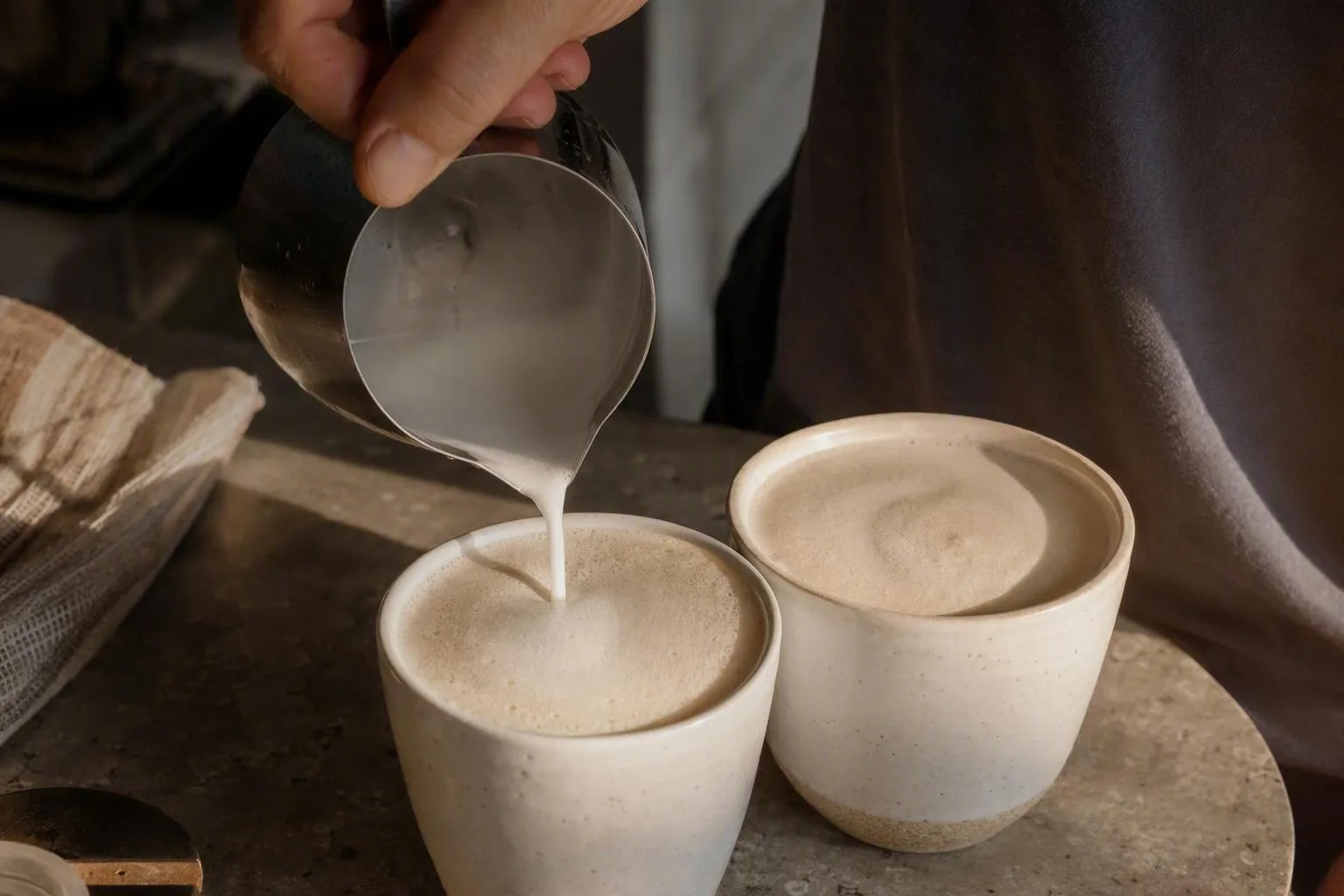
For a controlled home target, steam the milk to roughly 55–65°C. The pitcher should feel hot but still manageable, and the milk should pour as a smooth ribbon. Once the milk moves much beyond about 70°C, home brewers commonly report flatter sweetness and cooked flavours; the extra heat is not a reliable way to make either drink taste richer.
The mechanism is straightforward. Air introduced at the surface creates bubbles, while heat changes the milk proteins. That process is called denaturation: proteins unfold from their original shape and can help stabilise the boundary between air and liquid. Good steaming introduces enough air for body, then rolls the pitcher so larger bubbles are broken down and the foam becomes glossy.
In the flat white build, that foam is thin and integrated with the milk, so the espresso and milk arrive together instead of in separate layers. The latte build contains more milk and may show a more distinct foam layer at the top. Latte art can appear on both drinks; the pattern is a pouring result, not the definition of either beverage.
If you want to study the mechanism beyond the recipe, milk foaming chemistry is the useful subject: bubble size, protein behaviour, and the way heat changes flow all matter more than the shape drawn on the surface.
Two weighed builds from the same double shot
Run the comparison as a small kitchen experiment. Hold the espresso constant, then change only the milk mass and the size of the receiving cup. Put the cup on the scale, tare it, and watch the milk number rather than trying to judge the pour by eye.
- Pull the baseline shot. Dose 18 g of ground coffee and aim for 36 g of espresso. That is a 1:2 espresso brew ratio: the beverage mass is twice the dry coffee dose. Use roughly 25–35 seconds as a starting extraction window, not as a flavour guarantee. If you are scaling the coffee recipe, the coffee to water ratio calculator can handle the dose-to-yield arithmetic, but taste still decides whether the shot needs a grind change.
- Build the flat white. Steam enough milk to deliver 100–130 g to a 150–180 mL cup. Keep the foam glossy and integrated rather than piling a dry cap on top. Swirl the milk before pouring so the liquid and foam arrive together, then pour steadily into the espresso.
- Build the latte. Steam enough milk to deliver 180–220 g to a 240–300 mL cup. Use the same general texture target, but allow the larger milk volume to create the softer, less concentrated balance associated with a latte. If the pitcher retains milk, weigh the cup during the pour rather than assuming every gram left the pitcher.
- Compare before changing the shot. Taste the two drinks at the same point after pouring. Ask whether the coffee flavour disappears, whether the milk feels airy or silky, and whether the espresso itself tastes sour, bitter, or dry.
If your espresso yield is not 36 g, scale the milk from the liquid espresso mass. A flat white starting point is roughly 3–4 times the espresso mass in milk; a latte starting point is roughly 5–7 times. For example, a 30 g shot would pair with about 90–120 g milk for the smaller drink or 150–210 g for the larger one.
Holding the shot constant matters because it keeps extraction, espresso strength, and coffee dose from changing at the same time as the milk. You are then testing dilution and texture, not comparing two unrelated recipes.
Three tests that expose a mislabeled or badly balanced drink
When a milk drink disappoints, start with strength, then texture, then espresso extraction. Do not correct a bitter shot by simply adding milk; that can make the bitterness less obvious while leaving the extraction problem untouched.
The strength calculation is simple. Ignoring the small effect of foam, 36 g espresso plus 120 g milk gives 156 g of beverage, with espresso making up about 23% of the mass. The same shot plus 200 g milk gives 236 g, with espresso at about 15%. That is why the larger build can taste dramatically weaker without containing less espresso.
| What you taste or see | Look here first | Make one change | Why it works |
|---|---|---|---|
| Coffee disappears under the milk | Milk load is too high for the shot, or the drink has too few shots | Remove 20–40 g of milk while keeping the shot unchanged | Less milk raises the espresso fraction and reduces dilution |
| Harsh, drying, or aggressively bitter | Espresso may be over-extracted | Keep the milk mass and adjust the grind slightly coarser for the next shot | Milk changes concentration, but it does not reverse over-extraction |
| Sharp, sour, or hollow | Espresso may be under-extracted | Keep the milk mass and adjust the grind slightly finer for the next shot | More extraction can add soluble material that is missing from the shot |
| Thin, airy, or filled with large bubbles | Air was added unevenly or the foam was not integrated | Add a small amount of air early, then roll the pitcher to smooth the bubbles | Smaller, better-distributed bubbles give the milk more body |
| Cooked, flat-tasting milk | The milk was heated too far | Stop steaming earlier and use the same ratio for the next test | Lower heat avoids pushing the milk past its more pleasant flavour range |

For a watery latte, reducing the milk is the cleanest first move because it tests the ratio directly. For sourness or bitterness, leave the milk alone and correct the espresso with one grind adjustment at a time. A larger latte can be balanced with another shot, but that is a new espresso-to-milk recipe rather than proof that the original ratio was correct.
Ordering rule: choose the flat white for coffee presence, the latte for more milk
For a clear use case, choose the flat white when you want a smaller drink in which the espresso remains easy to taste. Choose the latte when you want more milk, a softer coffee impression, and a larger serving. That is the most useful distinction even when a café uses different names or cup sizes.
At an unfamiliar café, ask three practical questions: How large is the drink? How many espresso shots does it contain? Is the milk load closer to the small, concentrated build or the larger, milkier one? You may not get a gram measurement at the counter, but cup size and shot count usually reveal where the drink sits on the ratio spectrum.
A flat white is not defined by latte art, a ristretto shot, or one fixed international recipe. Those can be choices layered onto the drink. The defining practical signal is the relationship between espresso, milk, and foam: less milk with integrated microfoam tastes more coffee-forward; more milk creates the latte’s softer balance.
Is a flat white always made with two espresso shots?
No. A café may build it with one shot or more than one, so shot count must be checked rather than assumed. If you use one shot at home, keep the milk near three to four times the liquid espresso mass if you want to preserve the smaller drink’s coffee presence instead of filling a large latte cup.
Does a flat white require a ristretto shot?
No. A standard espresso can work. A ristretto is a shorter liquid yield, so recalculate the milk from the actual espresso mass rather than treating ristretto as the defining feature of a flat white.
Can you make a flat white with oat milk?
Yes, although plant-milk formulations foam differently from dairy milk. Use a formulation intended for steaming, stay within the milk-temperature range described above, and adjust how much air you add. Protein, oil, and dissolved solids change how stable and glossy the foam becomes.
Does a flat white have more caffeine than a latte?
Not inherently. If both drinks use the same espresso dose and shot, their caffeine content will be broadly similar; the flat white usually tastes stronger because less milk dilutes the espresso. Bean choice, dose, and extraction can still change the amount in the cup, so milk ratio is not the right variable for predicting it.
The most reliable order is therefore simple: ask about the shot, estimate the milk load, and judge the foam separately. Once you weigh those variables at home, the names on the menu become useful shorthand rather than a source of confusion.
Frequently Asked Questions
Is a flat white always made with two espresso shots?
No. Shot count varies by café and region; if using one shot, preserve the drink’s character by keeping the milk near 3–4 times the espresso mass rather than filling a large latte cup.
Does a flat white require a ristretto shot?
No. A normal espresso can work. Ristretto produces a smaller liquid yield, so the milk amount must be recalculated instead of treating ristretto as the defining feature.
Can you make a flat white with oat milk?
Yes, although plant-milk formulations foam differently. Use a formulation designed for steaming, keep the milk around 55–65°C, and expect to adjust air incorporation because foam stability and sweetness depend on the milk’s proteins, oils, and solids.
Does a flat white have more caffeine than a latte?
Not inherently. With the same espresso dose, the caffeine content is broadly similar; the flat white usually tastes stronger because less milk dilutes the espresso.