Espresso Drinks Explained: 12 Café Classics by Ratio
An 18 g dose can produce roughly 20 g of ristretto, about 36 g of espresso, or 54 g of lungo. Those are not three names for the same drink: the yield changes concentration, extraction progress, and how milk or water will read in the finished cup.
That is the useful way to get espresso drinks explained: start with the coffee dose and yield, then weigh every addition. A café label is a clue; a ratio is a recipe you can reproduce.
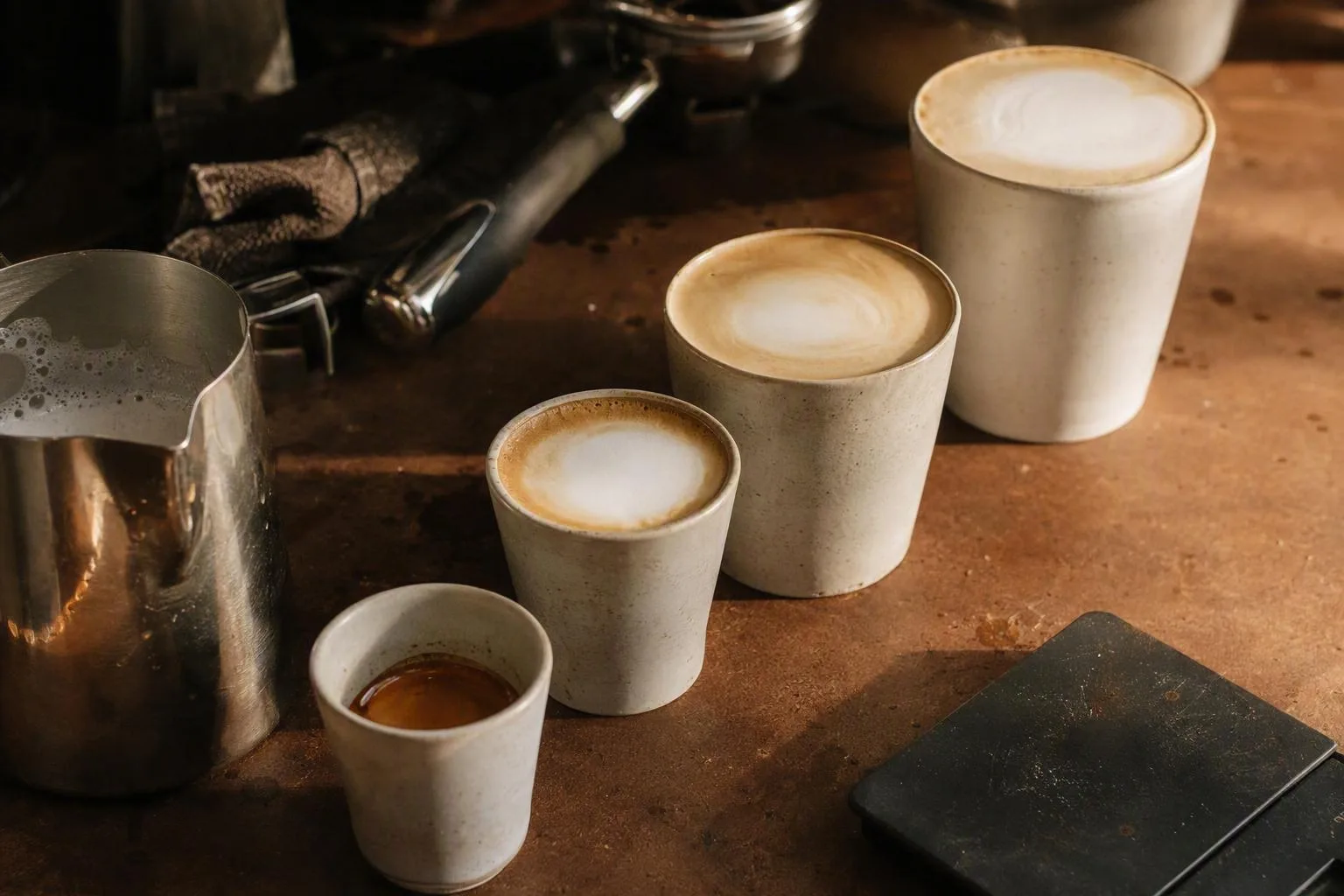
Start with grams: the ratio language behind every café name
Espresso brew ratio is the relationship between the dry coffee dose and the brewed espresso output. If 18 g of ground coffee produces 36 g in the cup, you have a 1:2 ratio: one part dry coffee to two parts liquid espresso.
For home troubleshooting, 18 g in and 36 g out is a useful anchor because it gives you a stable middle point. A ristretto pulls less liquid from the same dose; a lungo pulls more. You can change the drink without changing the amount of coffee in the basket.
Use a scale rather than a measuring cup. Crema is a layer of gas-filled bubbles, so two shots with the same mass can occupy noticeably different volumes. Mass also lets you weigh milk, chocolate, and water instead of guessing from a cup that may be a different size.
Milk and water additions are serving ratios, not espresso extraction ratios. The 1:2 figure describes coffee dose against espresso yield; 36 g of espresso plus 100 g of milk is a drink recipe built on top of that extraction.
If you want the wider menu map, the site's espresso drinks guide starts from the same principle: name the dose, yield, and additions before arguing about the label.
The 12-drink map: from 18 g of coffee to 300 g of milk
The heading runs to 300 g because a finished café drink can weigh several times more than its espresso base once milk or water enters. The narrower ranges below are more useful as repeatable home starting points. They are not universal definitions; basket size, cup size, and local café language all move the boundaries.
| Drink | Starting build | What the ratio describes |
|---|---|---|
| Ristretto | 18 g coffee → 18–27 g espresso | Extraction ratio |
| Espresso | 18 g coffee → 30–45 g espresso, with 36 g as an anchor | Extraction ratio |
| Doppio | 2 × 18 g coffee → 2 × 30–45 g espresso | Quantity plus extraction ratio |
| Lungo | 18 g coffee → 45–60 g espresso | Extraction ratio |
| Macchiato | 30–40 g espresso + 5–15 g foamed milk | Serving convention |
| Cortado | 30–40 g espresso + 35–45 g warm milk | Serving convention |
| Cappuccino | 30–40 g espresso + 80–120 g textured milk | Serving convention |
| Flat white | 30–40 g espresso + 90–120 g microfoamed milk | Serving convention |
| Latte | 30–40 g espresso + 160–200 g steamed milk | Serving convention |
| Mocha | 30–40 g espresso + 15–30 g chocolate + 160–200 g milk | Serving convention |
| Americano | 30–40 g espresso + 90–180 g hot water | Serving convention |
| Long black | 30–40 g espresso + 90–180 g hot water, poured in reverse order | Serving convention |
The first four rows describe what happened inside the puck. The other rows describe the final drink. That distinction matters: a latte does not have an espresso extraction ratio of 1:6 simply because the finished cup contains six times as much milk as coffee. It has an espresso ratio, then a milk-to-espresso serving convention.
One dose, four shot styles: ristretto, espresso, doppio, and lungo
Hold the dose at 18 g and change only the yield. At roughly 1:1 to 1:1.5, you finish at 18–27 g for a ristretto. The cup is more concentrated because less water becomes part of the final drink, and the extraction stops earlier.
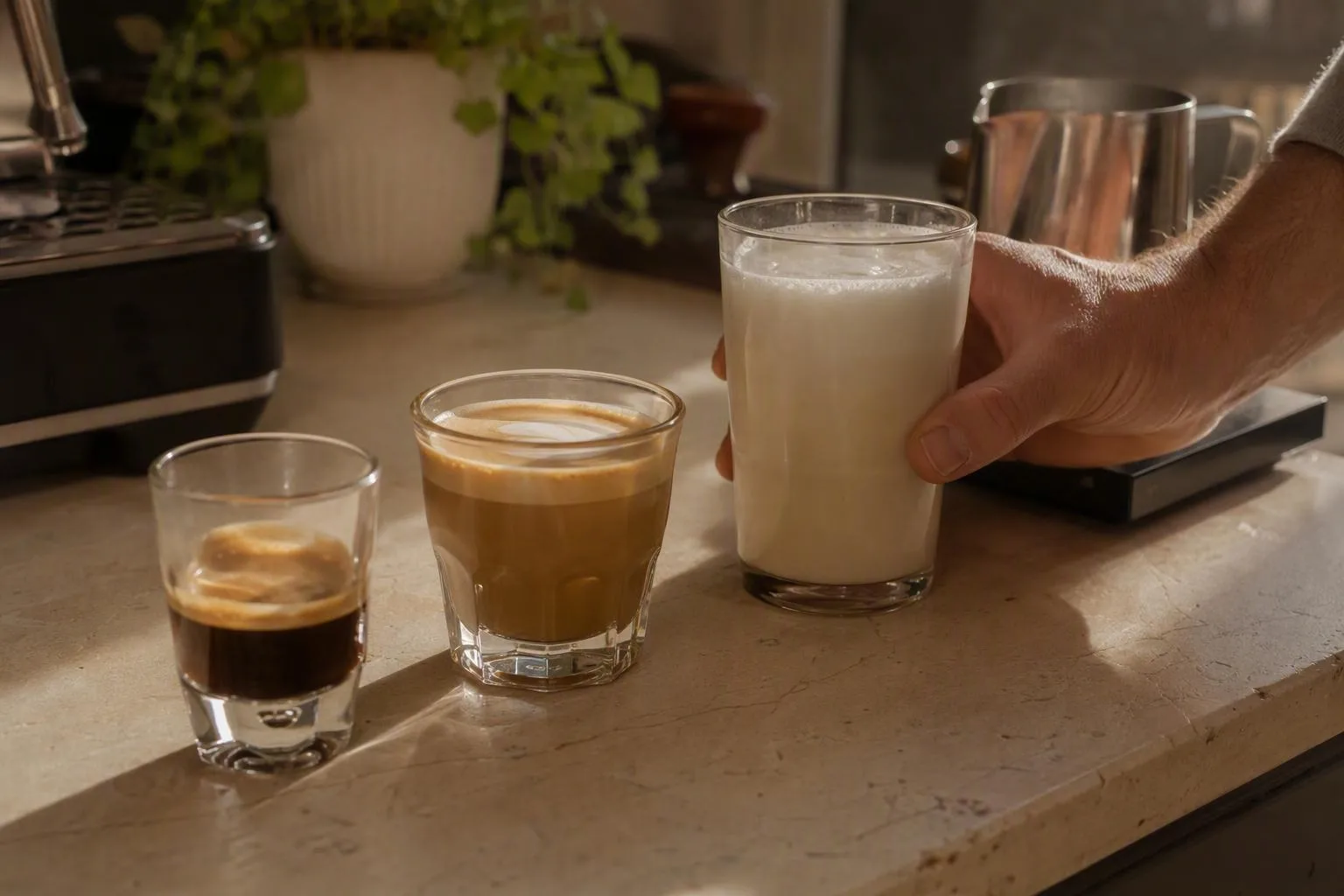
A common espresso range is about 1:1.5 to 1:2.5, or 30–45 g from that dose. The 36 g middle point is a practical starting target, not a law. It gives enough liquid for milk drinks without making the shot as dilute as a long pull.
A lungo extends the yield to roughly 45–60 g, or 1:2.5 to 1:3.5. More water lowers concentration, while the later part of the flow continues extracting the puck. That can make the cup more open and less syrupy; if the shot runs too far or too unevenly, drying bitterness can appear.
A doppio is usually a quantity change rather than a special extraction ratio. Two 18 g doses pulled at the same 1:2 target give about 72 g of espresso in total, although a café may use one larger basket or two separate shots.
If an 18 g dose reaches 36 g in 16 seconds and tastes sharp, start with a finer grind before changing the ratio. The coffee grind size chart is useful here because yield tells you how much liquid you made, while time and flow tell you how the puck released it.
A little milk changes the drink: macchiato and cortado at 1:1-ish
An espresso macchiato is a 30–40 g espresso marked with roughly 5–15 g of foamed milk. The milk is there as a small cap or mark, so the coffee remains the dominant mass and flavor.
A cortado uses much more milk: pair 30–40 g of espresso with 35–45 g of warm, lightly textured milk. With a 36 g shot, that is close to a 1:1 mass relationship, although the milk range gives you room to adjust the drink without changing the shot.
The mechanism is dilution. Milk lowers the perceived intensity of espresso, while the cortado's low foam volume keeps the texture dense rather than airy. If you add the same milk mass but whip in much more air, the cup may look larger without containing much more liquid, which makes the name harder to reproduce by sight alone.
Cappuccino, flat white, or latte? Milk mass and foam settle it
All three can start with the same 30–40 g espresso base. The useful difference is how much milk you add and how much air you incorporate, not a rigid one-third rule that treats foam volume as if it were liquid mass.
Milk changes the denominator. For the canonical 36 g shot used in this guide, use 80–120 g of textured milk for a cappuccino, 90–120 g of microfoamed milk for a flat white, and 160–200 g of steamed milk for a latte.
A cappuccino carries more visible foam and a lighter, airier texture. A flat white keeps the milk denser and the foam layer thinner, so the espresso remains more present at the same milk mass. A latte uses the largest milk addition in this set, which makes the drink smoother and less concentrated even when the shot is identical.

Foam adds volume without adding much mass. That is why weighing milk is more useful than filling a cup to a visual fraction. The bubble structure also matters: heating and stretching milk lets its proteins stabilize smaller bubbles, while excessive air leaves a bulky, dry foam that can make a latte seem lighter than its actual milk mass.
For the short version of this comparison, the site's flat white vs latte article uses the same decision rule: hold the espresso steady, then change the milk denominator and texture.
Mocha is a latte with a third ratio to control: chocolate
A mocha becomes easier to diagnose when chocolate is weighed rather than added as an undefined squeeze. Start with 36 g of espresso, 15–30 g of chocolate syrup or melted chocolate, and 160–200 g of steamed milk.
Chocolate adds sweetness and viscosity, and it can cover bitterness or acidity that would be obvious in the espresso alone. If the finished drink tastes cloying but the shot tastes balanced by itself, reduce the chocolate toward 15–20 g before changing the grind or pulling a longer shot.
That order matters. Changing the espresso first can make the underlying coffee harder to evaluate, while reducing an oversized chocolate addition tests the more direct cause.
Americano versus long black: same ingredients, different pour order
The difference is the pour order. Both drinks can use 30–40 g of espresso and 90–180 g of hot water, but the first sip does not have to taste the same when those ingredients meet in a different sequence.
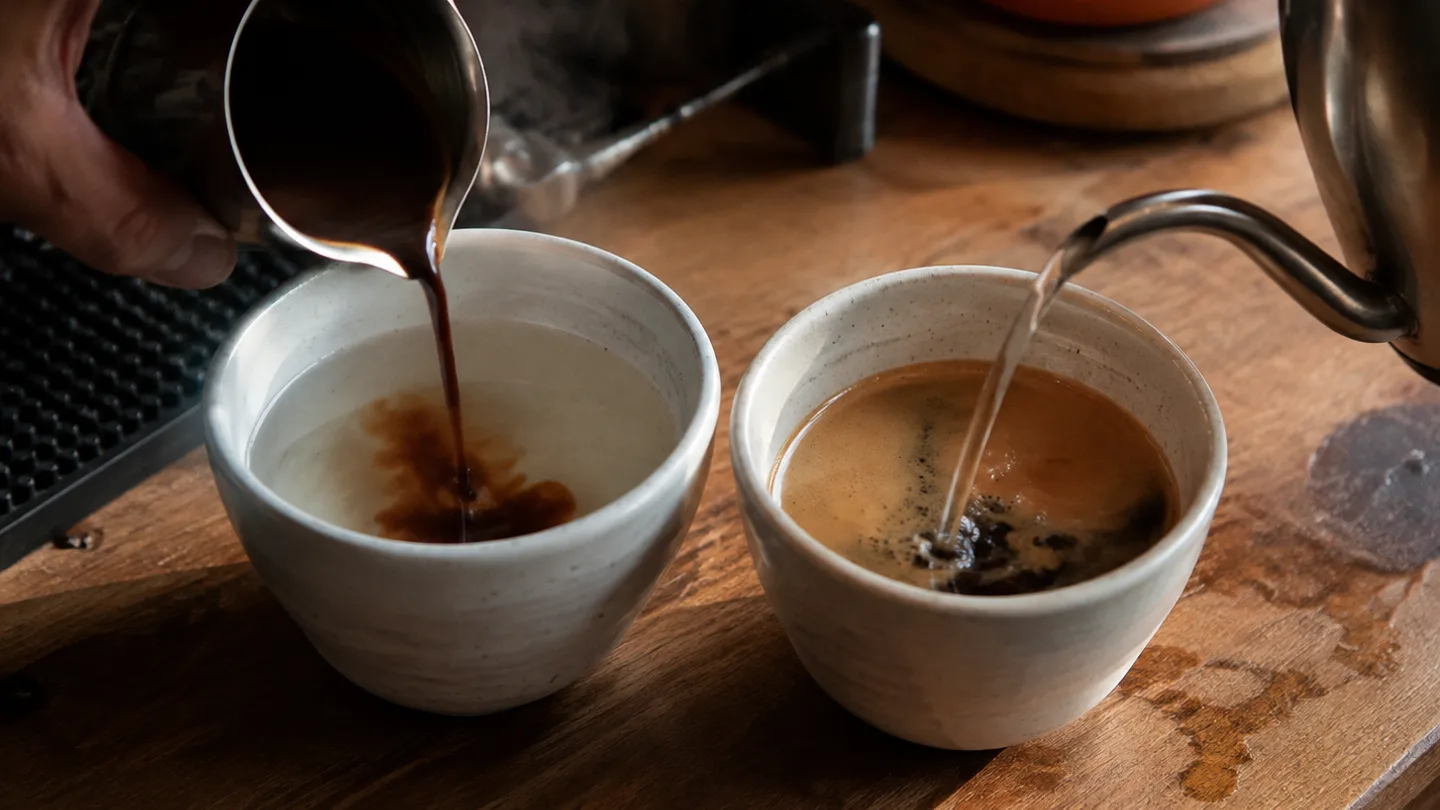
- Americano: pull the espresso, then add 90–180 g of water.
- Long black: add 90–180 g of water first, then pour the espresso onto it.
Putting espresso onto water can preserve more of the crema at the surface and gives the drink a different opening texture. The final mass may be nearly identical, so this is a serving construction difference rather than a new extraction method.
For dilution, 85–95°C is a workable starting range for the water. If the water is much cooler, the drink can lose heat quickly; if it is extremely hot, the first sip can feel harsher even though the espresso recipe has not changed.
Turn the café label into a recipe: dose, yield, milk, water
At home, ignore the cup name long enough to write the recipe. Lock the espresso at 18 g in and 36 g out, then weigh the additional ingredient. A café name is a label; mass is a recipe.
One shot, five builds:
- Cortado: 36 g espresso plus 35–45 g warm, lightly textured milk.
- Cappuccino: 36 g espresso plus 80–120 g textured milk.
- Flat white: 36 g espresso plus 90–120 g microfoamed milk.
- Latte: 36 g espresso plus 160–200 g steamed milk.
- Americano: 36 g espresso plus 90–180 g hot water.
For a mocha, keep the same 36 g espresso base, add 15–30 g chocolate, and use 160–200 g milk. For a long black, keep the 90–180 g water range but put it in the cup before the espresso.
Scaling the dose means preserving the ratio, not blindly doubling the finished drink. A 20 g basket can start at 20 g in and 40 g out; a smaller single basket might start near 9 g in and 18 g out. Because puck depth and basket geometry change with dose, re-dial the grind rather than assuming the old timing will follow.
When the cup is wrong, read the ratio first
Ratios turn a vague complaint such as weak or harsh into a short checking order. Change one variable first, taste again, and only then decide whether the drink recipe itself needs to move.
| What you taste | First adjustment | Mechanism |
|---|---|---|
| Sharp and thin at 1:2, finishing under about 20 seconds | Grind finer | Likely under-extraction: water has not removed enough soluble material evenly. |
| Bitter and dry, taking more than about 35 seconds | Grind coarser | Extended contact or uneven flow can push the cup toward harsh, drying extraction. |
| Milk drink tastes weak but the shot is balanced | Reduce 200 g milk toward 160 g, or add another shot | The milk denominator is diluting a sound espresso. |
| Americano tastes watery | Reduce 150–180 g water toward 90–120 g | The dilution ratio is too high for the shot's concentration. |
| Milk foam is large, bubbly, or dry | Introduce less air and texture briefly | Too much air creates a bulky foam layer instead of fine, stable microfoam. |
Steam milk around 55–65°C as a practical starting window, then judge the texture rather than chasing a number. If the espresso tastes sour before milk is added, fix extraction first. If the espresso is balanced but disappears in the finished drink, adjust milk or water before touching the grind.
What is the difference between an espresso macchiato and a latte macchiato?
An espresso macchiato is espresso marked with a small amount of foamed milk, commonly 5–15 g in the starting map above. A latte macchiato reverses the emphasis: it is mostly steamed milk marked by espresso, so it contains substantially more milk. Names and serving sizes vary by café.
Is a flat white stronger than a latte?
It can taste more concentrated because the same espresso dose is paired with less milk: 90–120 g for the flat white starting range versus 160–200 g for the latte. Caffeine, however, mainly follows the coffee dose and number of shots rather than the drink name.
Are espresso drink ratios fixed in every café?
No. Regional traditions, basket doses, cup sizes, and house recipes change the numbers. For naming disputes, a professional espresso and milk-beverage terminology guide or the Istituto Nazionale Espresso Italiano guidelines can be useful reference points, but neither should replace checking the café's actual build.
Save this build: start with 18 g of coffee and 36 g of espresso. Add 35–45 g milk for a cortado, 80–120 g for a cappuccino, 90–120 g for a flat white, 160–200 g for a latte, or 15–30 g chocolate plus 160–200 g milk for a mocha. For an Americano or long black, use 90–180 g water and change the pour order.
Frequently Asked Questions
What is the difference between an espresso macchiato and a latte macchiato?
An espresso macchiato is espresso marked with a small amount of foamed milk, commonly about 5–15 g; a latte macchiato is mostly steamed milk marked by espresso, so it contains substantially more milk and has the opposite emphasis. Names and serving sizes vary by café.
Is a flat white stronger than a latte?
Usually, the same espresso dose tastes more concentrated in a flat white because it is paired with less milk, but caffeine mainly follows the coffee dose and number of shots rather than the drink name.
Are espresso drink ratios fixed in every café?
No. Regional traditions, cup sizes, basket doses, and house recipes change the numbers. The ranges in the article are reproducible home starting points, not universal legal definitions.