Espresso Drinks Without Milk: 7 Orders Worth Knowing
Put 20 g of coffee in, stop the shot at 40 g out, and you have the reference point for a practical modern espresso recipe. Add 120 g of hot water and the drink becomes an Americano; pour the same shot over brewed coffee and you are in red-eye territory. The useful way to sort espresso drinks without milk is not cup size. It is where the water did its work.
Once you separate espresso extracted through a puck from water added afterward, seven café orders become much easier to decode.
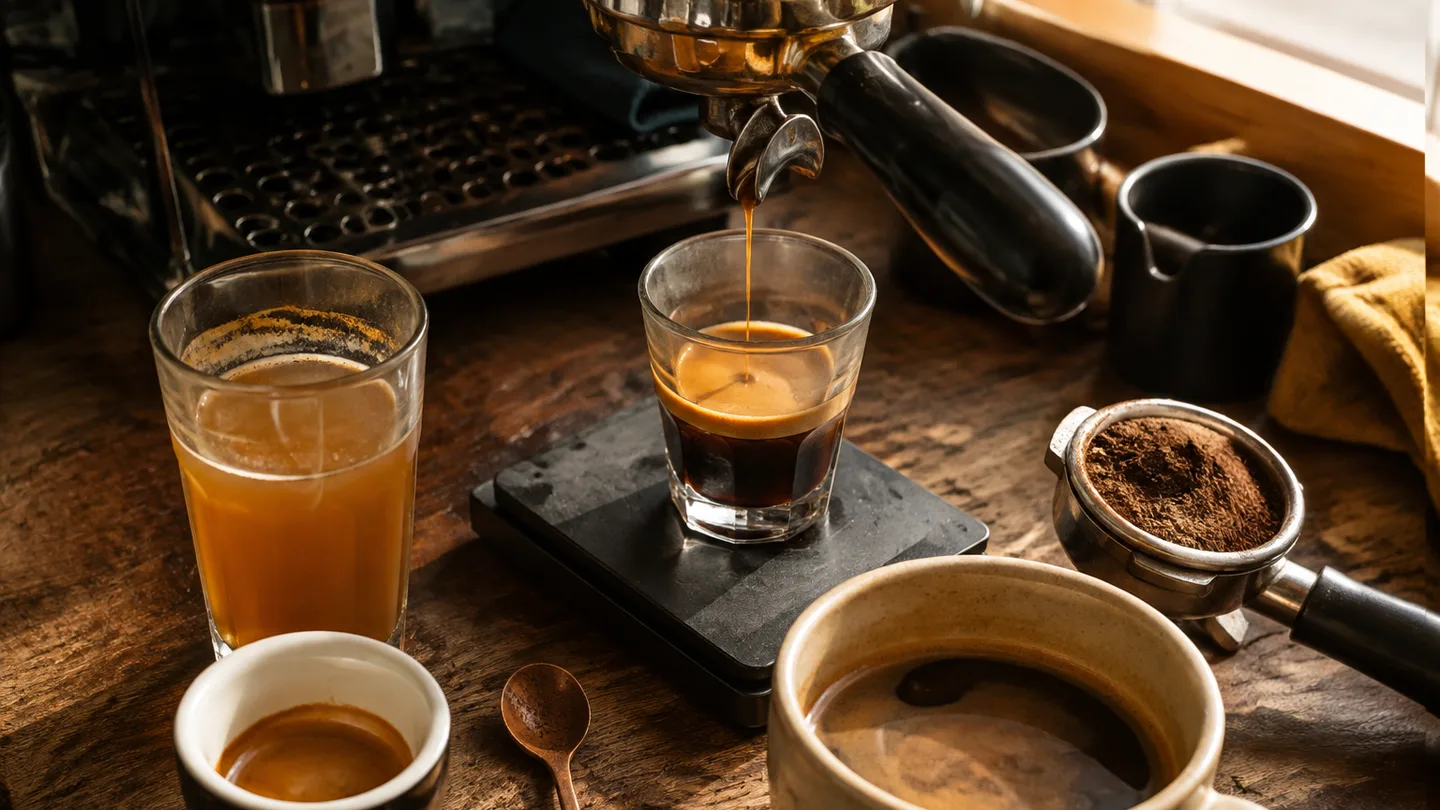
30 g, 120 g, or 220 g: sort espresso drinks without milk by what fills the cup
Start with dose and yield. Dose is the dry coffee placed in the basket; yield is the liquid espresso collected in the cup. Here, brew ratio means beverage output divided by dry coffee dose. An 18 g dose stopped at 36 g out is a 1:2 ratio.
The useful split is by what fills the cup: espresso alone, espresso plus water, or brewed coffee plus espresso. The following are working ranges rather than rules every café follows.
| Order | What fills the cup | Useful starting point |
|---|---|---|
| Espresso | Espresso only | 18–20 g in, 30–40 g out for a double |
| Doppio | A double espresso | 14–20 g in, 28–40 g out |
| Ristretto | A shorter espresso | 18–20 g in, 18–30 g out |
| Lungo | A longer espresso | 18–20 g in, 45–80 g out |
| Americano | Espresso plus hot water | 30–40 g espresso plus 90–180 g water |
| Long black | Hot water plus espresso | 90–180 g water plus 30–40 g espresso |
| Red eye | Brewed coffee plus espresso | 180–240 g brewed coffee plus a 25–40 g shot |
For example, 18 g in, 36 g out, and 120 g of added water gives a 156 g drink. That final cup is much less concentrated than the espresso itself, even though the espresso extraction remained 1:2.
That distinction matters more than the name printed on the menu. A large cup can be a long extraction, a post-shot dilution, or a brewed coffee carrying one concentrated shot.
The four concentrated orders share one puck—but not one yield
Espresso, doppio, ristretto, and lungo all begin with water passing through a compact coffee bed. The practical variables are dose, output, grind resistance, and contact time; the Italian-sounding label is only a shortcut for the intended build.
Espresso: the reference order at roughly 1:2
A single espresso can start around 7–10 g in and 14–20 g out. A double commonly uses about 18–20 g and yields roughly 30–40 g. For a home recipe, 20–35 seconds is a useful starting window, not a pass-or-fail score.
Put the cup on a scale, dose 18 g, and stop the shot around 36 g. If the cup is sour and the flow finishes quickly, move the grind finer and repeat the same target. If it is bitter, dry, and slow, move coarser. The coffee grind size chart is useful for orientation, but the taste and beverage weight decide the next move.
Doppio: two shots, usually 14–20 g in and 28–40 g out
Doppio means a double espresso build, not necessarily a shot pulled for longer. A café may make it with one double basket or serve two smaller shots, so the exact dose can differ.
Choose a doppio when you want more espresso in the cup while keeping a concentrated profile. If the dose and yield increase together, the drink contains more total coffee without automatically becoming more dilute. Choose it instead of a lungo when the goal is more espresso, not a larger black drink.
Ristretto: 1:1 to 1:1.5 for a shorter, heavier shot
Ristretto means stopping the espresso earlier. With 18–20 g in, a useful target is about 18–30 g out, or roughly a 1:1 to 1:1.5 ratio.
At the same dose, cutting the output raises concentration. It can also reduce extraction because less water has passed through the puck, so a ristretto that is cut too far may taste sharp rather than rich. A practical starting test is 18 g in and 24 g out; if that tastes sour, extend the yield slightly before deciding that the bean is naturally intense.
Lungo: 1:2.5 to 1:4 when the puck runs longer
A lungo keeps the basic espresso dose but runs to a larger output, often around 45–80 g from 18–20 g of coffee. That places the recipe near 1:2.5 to 1:4.
More water travels through the puck, so the final drink is less concentrated and the extraction moves further. The extra contact can bring a dry, bitter, or woody finish when the shot is pushed past the point where the coffee tastes sweet. Order a lungo for that longer-shot profile, not simply because you want a bigger cup.
Adding water is not the same as pulling a longer shot
The important extraction distinction is what happens to water. An Americano or long black uses water that does not pass through the coffee puck, while a lungo keeps sending water through it. Two drinks can therefore finish at a similar volume while carrying different amounts of extracted material and different bitterness.
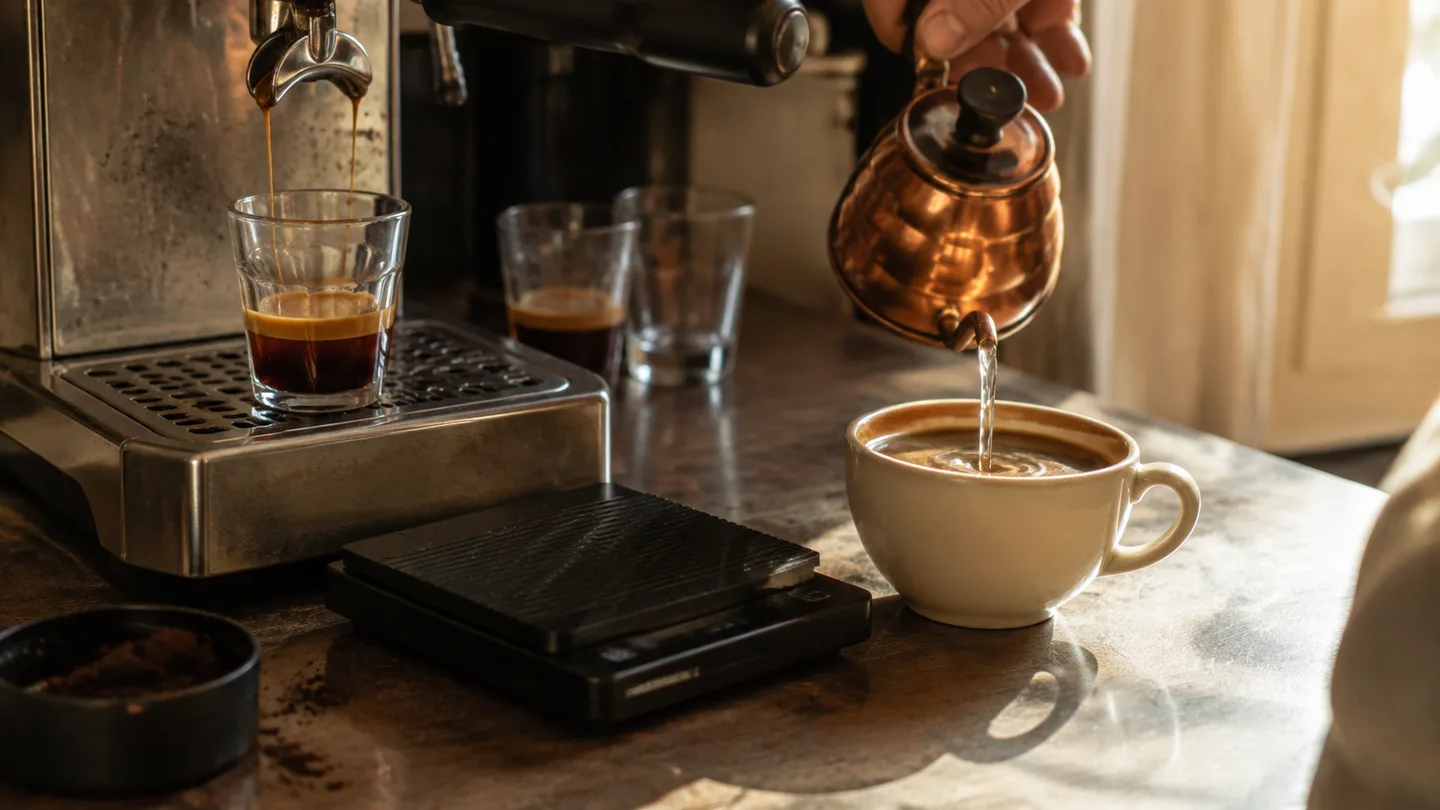
Americano: 30–40 g espresso plus 90–180 g hot water
A double Americano can start with 30–40 g of balanced espresso and 90–180 g of hot water. Use the lower end for a denser, more espresso-led cup and the higher end for a longer, gentler drink.
At home, try 18–20 g of coffee, stop the espresso at 30–40 g, then add 100–150 g of hot water. If the shot itself tastes balanced but too intense, change the water amount before changing the grind. The coffee to water ratio calculator can show how that added water changes the final dose-to-beverage ratio, but keep the espresso ratio and the dilution step conceptually separate.
Long black: similar ingredients, water first and espresso on top
A long black uses the same basic ingredients as an Americano but puts roughly 90–180 g of hot water in the cup first, followed by a 30–40 g double espresso. The order is the defining practical difference.
Pouring espresso onto water can leave more crema and aromatic material at the surface, creating a layered first sip. Stirring narrows that serving difference, so choose a long black when the espresso-led top layer matters. Choose an Americano when you want the easiest control over dilution and mixing.
Red eye: 180–240 g brewed coffee with one espresso shot
A red eye combines brewed coffee with espresso rather than extracting a larger drink through an espresso puck. Start with 180–240 g of filter coffee and add a 25–40 g shot; the brewed coffee supplies the large cup and its own extraction profile, while espresso adds a concentrated roasted or aromatic layer.
Shot in the dark often means brewed coffee with one shot, while black eye may signal two, but those labels are not universal. If the name is unfamiliar at a café, order by components: brewed coffee, one espresso shot, no milk.
Yield is the dial: 1:1.5, 1:2, and 1:3 explain most of the flavor gap
The cleanest mental model uses two axes. Extraction describes how much soluble coffee material the water removes from the puck; concentration describes how much of that material remains in the finished water. A ristretto changes both by stopping early. An Americano mainly changes concentration after the espresso has already been extracted.
A lower ratio usually makes the espresso denser, but it is not automatically more extracted. A higher ratio usually makes it less concentrated and can extract further. That is why a ristretto can taste powerful and sour at the same time, while a lungo can taste thinner and drier than a shorter shot.
| What you taste | Trace to this mechanism first | Make one change |
|---|---|---|
| Sour and thin | Under-extraction or too little concentration | Grind finer and keep the target yield steady |
| Bitter and dry | Too much contact or a late, high-yield extraction | Grind coarser or stop at a lower yield |
| Thin but not sour | Dilution or an excessively high shot yield | Reduce added water or stop the shot earlier |
| Balanced but too intense | Extraction is acceptable; concentration is high | Add water instead of running the puck longer |
Thin but not sour deserves its own diagnosis. Dilution lowers concentration, and a higher yield also lowers concentration, so first check whether water was added or the espresso ran well past its target. Do not change the grind until you know which of those two variables moved.
The useful one-change rule is simple: if the espresso tastes sour, bitter, or thin because the shot is wrong, fix grind or yield before adding water. If the espresso tastes balanced but is too forceful, dilute it. Water can change intensity; it cannot repair a badly extracted puck.
For a red eye, diagnose the brewed coffee and espresso separately before changing the combined drink. Otherwise, a harsh espresso shot can make you blame the filter coffee, or a hollow brewed base can make you keep shortening an espresso that was already sound.
The word “macchiato” is the trap: check every milk-adjacent name
An espresso macchiato is not a dependable milk-free order. In common café usage, the word describes espresso marked with a small amount of milk or milk foam, so it fails a strict no-milk request even though the milk portion is small.
- Cortado: espresso combined with a modest amount of warm milk.
- Flat white: espresso with steamed milk and a thin, fine-textured foam layer.
- Cappuccino: espresso with steamed milk and a more prominent foam component.
- Latte: espresso with a larger quantity of steamed milk and a light foam cap.
- Espresso con panna: espresso topped with whipped cream, so it is not dairy-free by default.
The flat white vs latte distinction is useful menu literacy, but neither drink belongs in a milk-free order. Café recipes vary, so say “no milk and no cream” rather than relying on a name that may be interpreted differently.
If you want a terminology cross-check, the Italian Espresso National Institute is a useful outside reference. For describing aroma and flavor without inventing tasting notes, the Specialty Coffee Association’s Coffee Taster’s Flavor Wheel is more useful than memorizing a long list of menu adjectives.
Three scripts that get the cup you mean at any café
The cleanest way to order is to name the build, then the size of the espresso, then the amount of water or brewed coffee. If the café does not use a term consistently, the components are more reliable than the label.
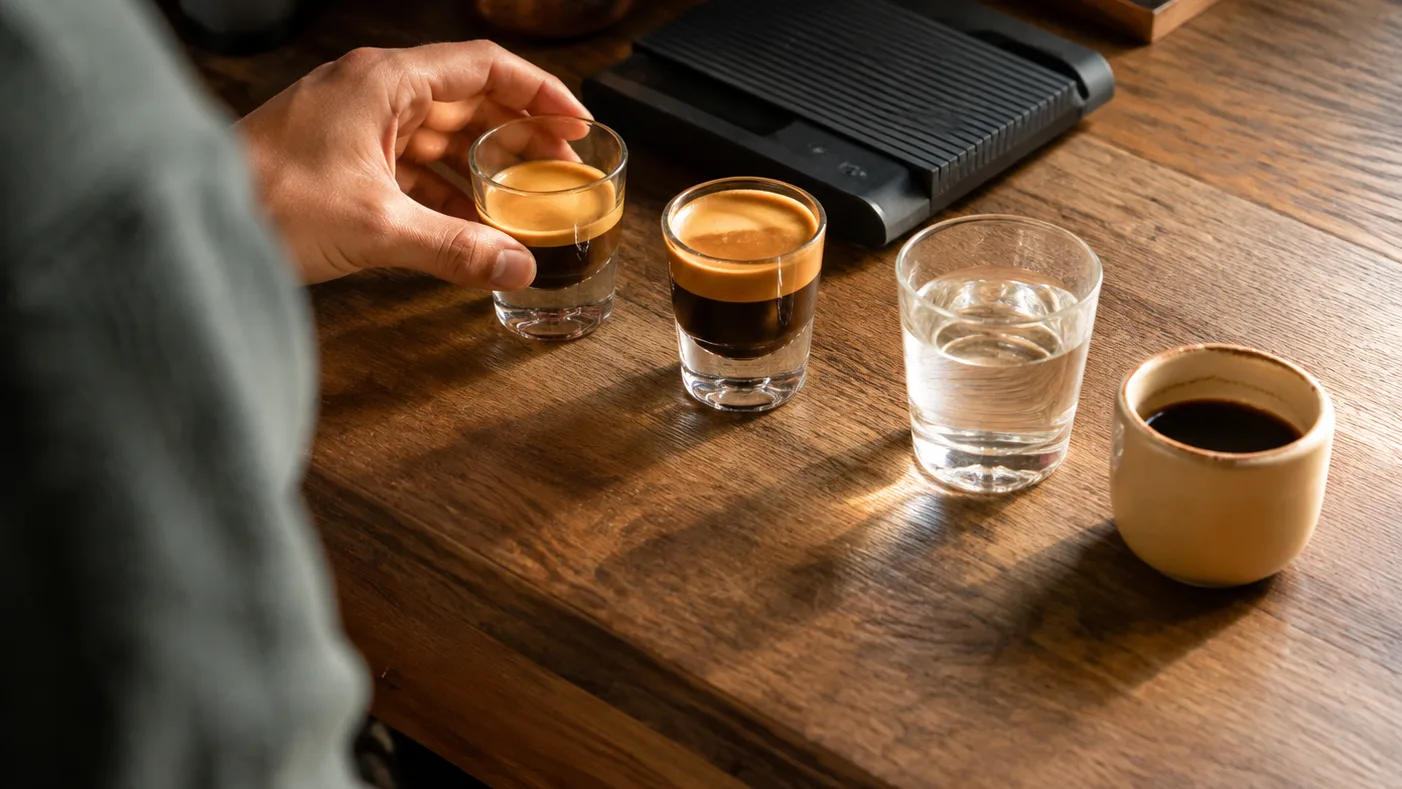
- For a small, concentrated drink: say, “A double espresso, please.” If you want the shorter, denser style, say, “A double ristretto.” Specify single or double if the barista asks; the dose changes the amount of coffee in the cup.
- For a longer espresso-based drink: say, “A double Americano with about 120 g of water,” or ask for a long black with a similar amount. If the café cannot measure water by weight, ask for a small Americano or request the hot water on the side.
- For a brewed-coffee-led drink: say, “A red eye with one espresso shot, no milk.” If the café calls it a shot in the dark, confirm that it means one shot before ordering.
At home, the three builds are easy to separate. Pull 18 g in and 36 g out, then add 120 g of water for an Americano. Put 120 g of water in the cup first and add the same shot for a long black. Brew 200 g of filter coffee separately, then add a 30–40 g espresso shot for a red eye.
The editorial verdict is straightforward: Americano is the best default when controllable dilution matters, long black wins when crema and a layered first sip matter, and red eye wins when brewed-coffee flavor should lead. Ristretto is the choice for a short, concentrated profile; lungo is the choice for a longer extraction; doppio is the choice for more espresso without necessarily more dilution.
Pull espresso to fix extraction. Add water to fix concentration. That is the rule worth keeping beside your scale, because it tells you which dial to turn before a menu name does.