Vietnamese Iced Coffee: The Phin Ratio That Works at Home
Start with 25 g coffee, 100 g water, 30 g sweetened condensed milk, and 150 g ice. That 1:4 phin ratio is deliberately stronger than a pour-over because the coffee has to stay present after milk and melting ice join the glass.
This is a dependable starting point for Vietnamese iced coffee at home, not a claim that every café uses one fixed recipe. The useful target is a concentrated, clean drip that still tastes like coffee after dilution.
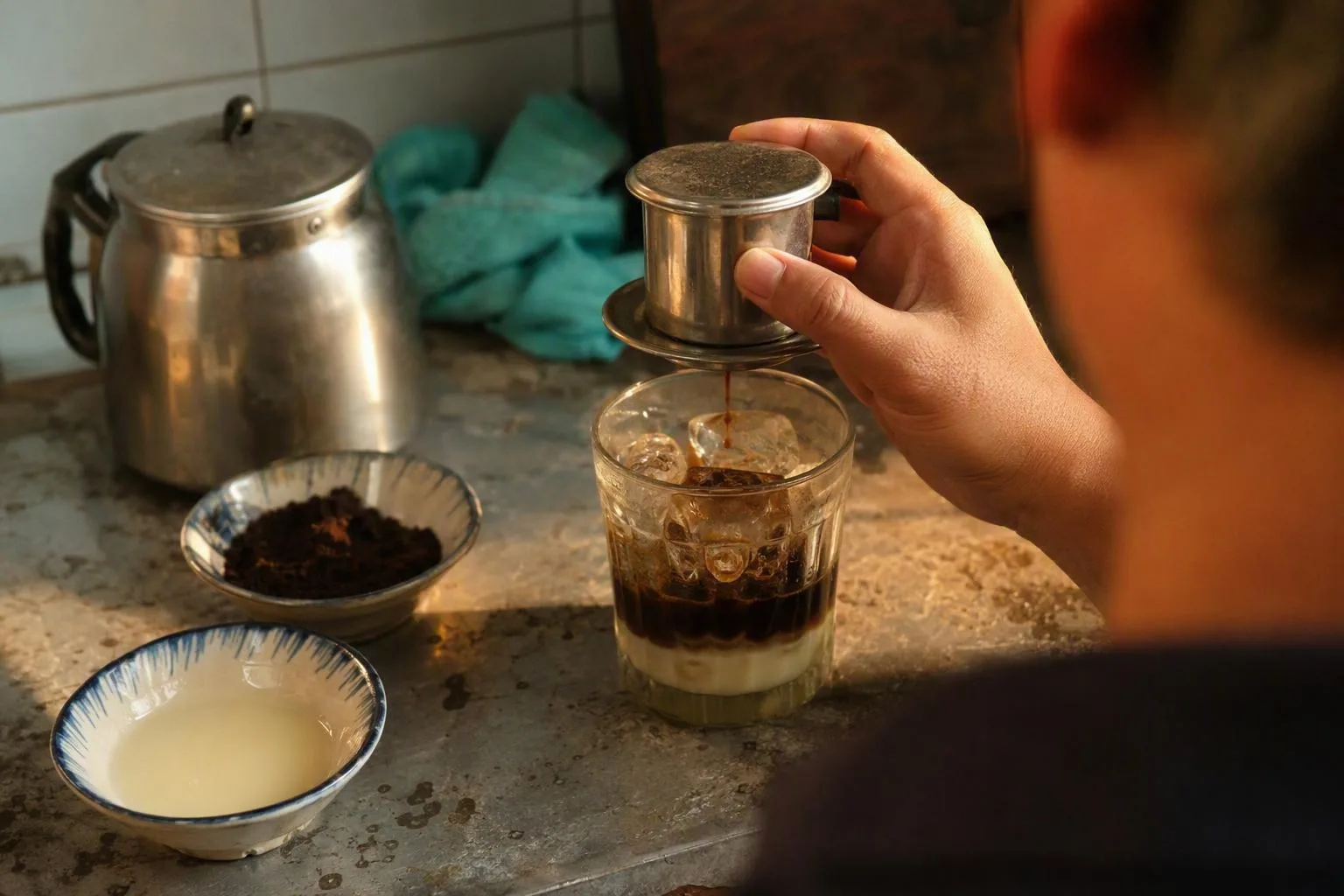
The dependable baseline is 20–25 g coffee, 100–120 g water, and 120–180 g ice
For one serving, weigh the ingredients rather than counting spoonfuls or ice cubes. Use the following as a starting range:
| Ingredient | Starting amount | What it controls |
|---|---|---|
| Ground coffee | 20–25 g | Concentration and intensity |
| Phin brew water | 100–120 g | The input brew ratio |
| Sweetened condensed milk | 25–40 g | Sweetness and body |
| Ice | 120–180 g | Cooling and dilution |
Your brew ratio is the dry coffee mass divided by the brew-water mass. It does not use the mass of the finished drink. So 25 g of coffee and 100 g of water is a 1:4 ratio, even after the drink gains condensed milk and melting ice. The grounds retain some water, but that does not change the ratio you used to brew.
That distinction matters because phin coffee is built to be diluted at the end. A pour-over may taste balanced at a much larger water input, while a phin serving needs enough concentration to survive 25–40 g of milk and a substantial bed of ice. For scaling, the coffee to water ratio calculator is useful because you can change the serving size without quietly changing the strength.
For menu language, cà phê sữa đá means the sweetened-condensed-milk version in this guide. The black iced version is generally described as cà phê đen đá in the same practical distinction. A quick reference on Vietnamese iced coffee terminology can help you read those names in context rather than treating an English café menu as a complete definition.
A 120–180 mL phin needs a medium-fine bed, not an espresso tamp
A phin sits between an immersion brewer and a small percolation brewer. Water passes through a perforated metal filter, so the coffee bed needs enough resistance to slow the flow, but it does not need the dense, mechanically compressed puck used in espresso.
For a nominal 120–180 mL phin, start with 20–25 g of medium-fine coffee. The grind should be finer than a typical French press setting and usually a little coarser than espresso. The label on the grinder is less useful than what the water does: phin holes, insert shape, bed depth, and grinder fines vary considerably.
Level the coffee gently. Let the insert rest on the bed or apply only light pressure if your filter design requires contact. A hard tamp compresses the bed, raises resistance, and gives fine particles more opportunity to migrate into the holes. That is how a recipe that looked correct can stop dripping.
Use flow as your calibration rule. With this starting dose and water range, aim for first drops around 30–60 seconds and a total drain around 3–5 minutes. Those are working windows, not quality scores: a coffee that finishes in four minutes can still taste sour if the bed is channeling, while a slow cup can taste harsh because the grind is too fine.
Build the drip around a 30–45 second bloom and a 3–5 minute finish
Once the dose and grind are close, repeat the same sequence so you can tell which adjustment changed the cup. Keep a scale under the glass and the phin if its shape allows it.
- Warm the equipment if you want a steadier start. Pour 20–30 g of hot water through the empty phin, let it warm briefly, and discard that water. This is optional, but it reduces the amount of heat taken by a cool metal filter and glass.
- Add the milk. Weigh 25–40 g of sweetened condensed milk into the serving glass. Starting with the milk gives the hot coffee somewhere to land and makes the final stirring easy.
- Dose and level. Add 20–25 g of ground coffee to the phin. Shake or tap the brewer lightly to flatten the bed. Do not press it as if you were preparing espresso.
- Set the water temperature. Begin around 92–96°C. Use the lower end for a very dark roast that already tastes roasty or bitter; use the higher end for a lighter roast that needs more heat to dissolve its less-soluble material.
- Bloom the bed. Pour 25–30 g of water over the coffee, aiming for an even wetting rather than a jet in the centre. A coffee bloom is the short first wetting period in which trapped gas escapes and the grounds absorb water. Wait 30–45 seconds. You can read more about that step in the guide to coffee bloom, but the practical rule here is simple: wet the bed evenly and leave it alone.
- Finish the pour slowly. Add water until the scale reads 100–120 g in total. Pour in a controlled stream, keep the surface from digging a channel, and fit the insert without pressing hard. Unnecessary stirring can move fines toward the filter holes and make the finish slower and muddier.
- Record the flow. Note when the first drops appear and when the drip has nearly stopped. If the first drops arrive at 35 seconds and the last useful drip arrives at four minutes, that timing becomes a useful reference for the next brew.
- Mix and chill. When the phin finishes, stir the coffee and condensed milk for roughly 10–15 seconds. Pour it over the weighed ice. Stir again briefly if you want the ice melt and milk sweetness distributed from the first sip.
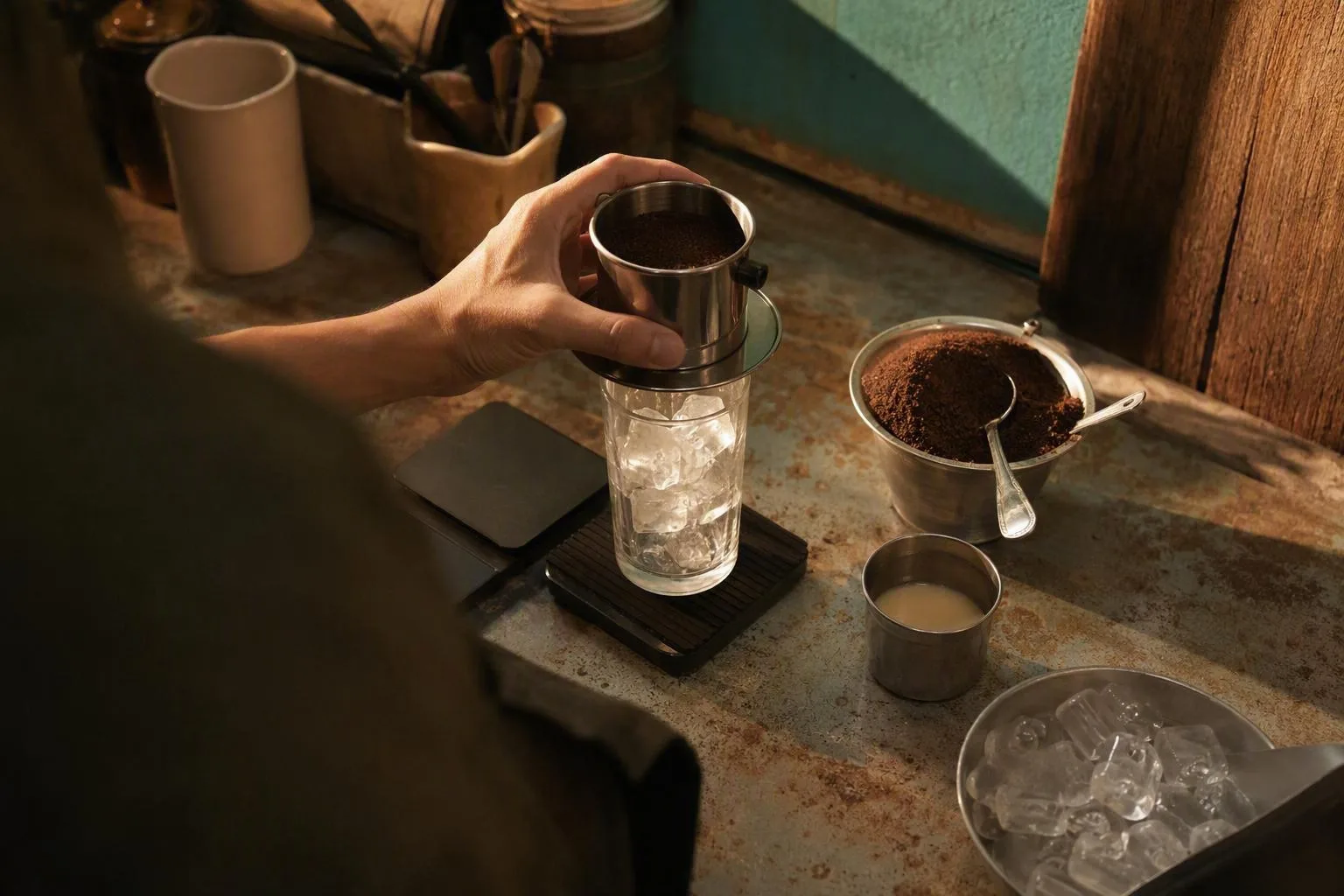
The key movement is gentle control, not force. Blooming deals with uneven wetting; the slow finish manages the water path; the lack of a hard tamp protects the filter from a compacted, fines-heavy bed.
When the phin takes 2 minutes or 6 minutes, change the grind first
The clock tells you about resistance, not whether the drink tastes good by itself. Use it to choose where to look, then use taste to confirm the diagnosis. Make one change per brew so you can identify the cause instead of creating a new variable pile.
| What you observe | Likely mechanism | First adjustment |
|---|---|---|
| Finishes under about 2–3 minutes and tastes thin | Low bed resistance from a coarse grind, a loose insert, or channeling | Move one grind step finer |
| First drops do not appear by about 60 seconds, or the brew runs past 6 minutes | Excess resistance from a fine grind, hard pressure, or fines blocking the holes | Move one step coarser and remove tamping |
| Water spurts from one side or forms a fast stream | Channeling, meaning water has found a shortcut through an uneven bed | Level the bed and pour more evenly |
| The cup is muddy even when the time looks reasonable | Fines migration or agitation has pushed small particles through or against the filter | Stop stirring and move slightly coarser if needed |
If the result is sour and thin while the drip is fast, start with a slightly finer grind. Under-extraction leaves acidic material ahead of the fuller flavours you wanted. If the result is bitter, dry, or hollow while the drip is slow, start with a slightly coarser grind; a lower water temperature is the next test if the grind change does not help.
Do not correct a thin iced coffee by automatically adding more water. More brew water can make the final drink weaker, and a larger liquid volume does not guarantee more extraction if the coffee bed is still too coarse or the flow is bypassing it. Fix the path through the bed first.
Treat 25–40 g condensed milk and 120–180 g ice as part of the final ratio
The water entering the phin is the brew-ratio variable. Condensed milk and ice are post-brew ingredients, but they decide how concentrated the finished glass tastes. Keeping those roles separate makes the adjustment much easier.
Sweetened condensed milk adds sugar and milk solids, so it can soften the perception of bitterness and add weight to a concentrated brew. It cannot extract flavour that the water failed to remove. A sour coffee hidden under more milk is still under-extracted; it is simply sweeter.
Consider a concrete glass: 25 g coffee, 100 g brew water, 30 g condensed milk, and 150 g ice. If all of that ice eventually melts, it contributes roughly 150 g of additional water to the drink. It does not all melt at once, which is why the first sip can taste stronger than the last, but the mass balance explains why a small handful of large cubes can dilute a phin brew more than expected.
If the iced cup tastes weak, reduce the ice by 20–30 g before changing several other things. If the coffee is already at 20 g, increasing the dose toward 25 g is a cleaner correction than randomly cutting brew water. If the result is too intense, add ice gradually or use the upper end of the ice range; do not change the coffee ratio and the dilution at the same time.
Weigh the ice when you are dialing in. Two scoops can hold very different masses depending on cube size, air gaps, and how much has already melted.
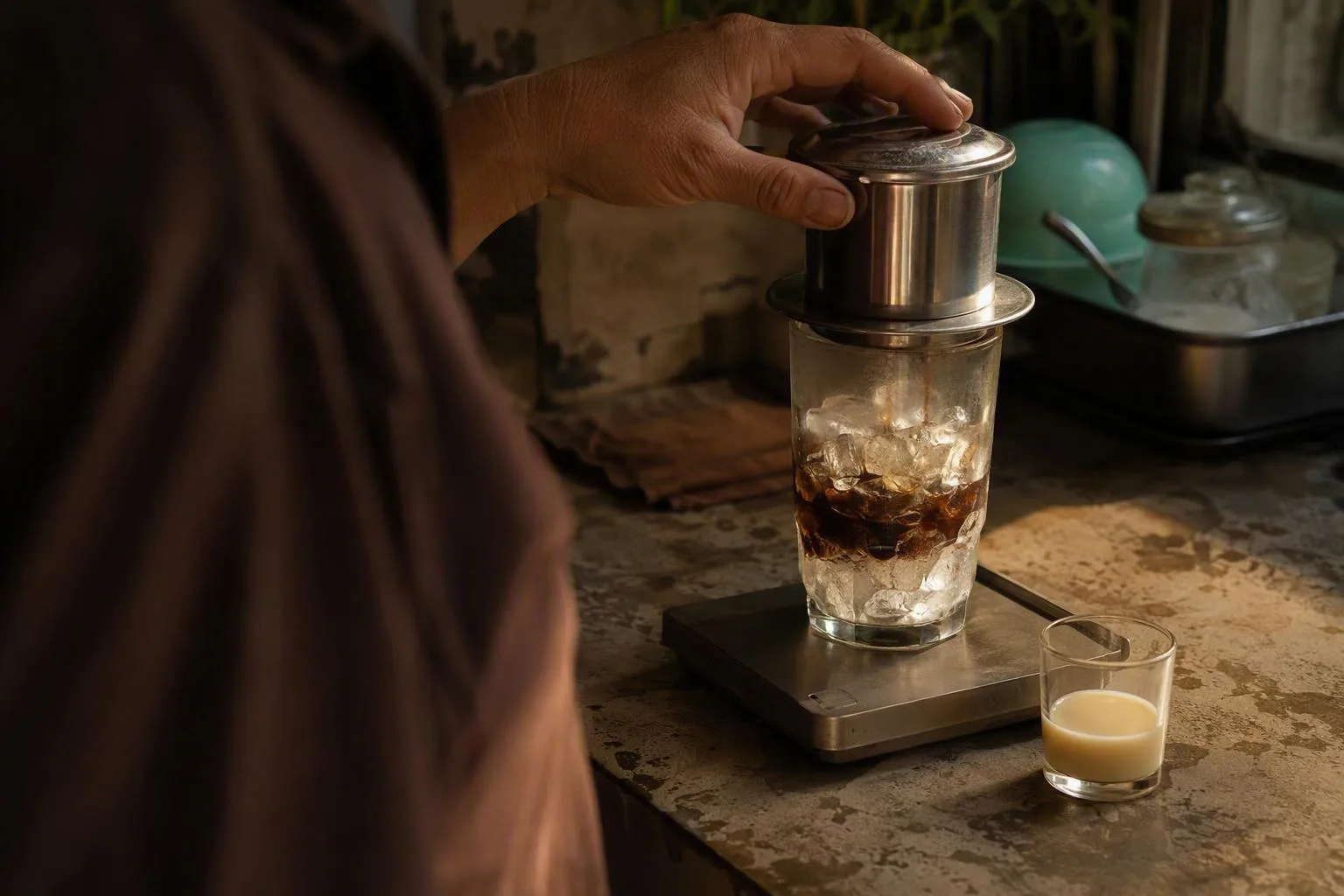
Use 1:4 for the classic milked concentrate; move toward 1:5 only with a reason
For a classic sweetened cà phê sữa đá built around a dark roast or robusta blend, the strongest starting recommendation is 25 g coffee to 100 g water, or 1:4. That concentrate has enough presence to stand up to 25–40 g of milk and 120–180 g of ice without requiring a huge dose.
Move toward 1:5 when the use case changes: 20–22 g coffee with 100–110 g water suits a lighter roast, a less intense black iced coffee, or a serving with less ice. The extra water can help carry extraction through the bed, but only if the grind and contact time let the water interact with the coffee. Ratio changes strength directly; they do not automatically solve a flow problem.
For temperature, test within roughly 90–96°C. A very dark roast can become more bitter and drying at the top of the range, so 90–92°C is a reasonable correction. A light roast may need 94–96°C, especially if the cup is sour and the phin is draining quickly. These are starting directions, not roast laws.
Keep a small log: dose, brew water, temperature, bloom water, bloom time, first drip, final drain, milk, ice, and taste. Change one entry at a time. A useful note might read: 25 g, 100 g, 94°C, 30 g bloom, 40-second bloom, first drip 42 seconds, finish 4:10, 30 g milk, 150 g ice, sweet but slightly dry. The next test could change only the grind one step coarser.
Three practical questions outside the main dial-in
What is the difference between cà phê sữa đá and cà phê đen đá?
As a menu shortcut, cà phê sữa đá is phin coffee served with sweetened condensed milk and ice. Cà phê đen đá is black phin coffee served over ice. The brewing method can be the same, but black coffee has no milk to add sweetness or body, so it may need less ice or a more concentrated serving ratio. The distinction is about the finished build, not a different extraction machine.
Can I brew two servings in one small phin?
Do not simply double the dose in a small 120–180 mL filter. A deeper bed increases the path length and resistance, and the brew can stall before the added coffee receives even flow. Use two small phins or a larger brewer, keep the same coffee-to-water ratio, and aim for the same flow window rather than forcing one filter to carry twice the bed.
Can I make Vietnamese iced coffee ahead of time?
The freshest result comes from brewing and mixing close to serving, then adding ice at the end. If you need to prepare it ahead, keep the coffee or coffee-and-milk mixture sealed and chilled. Leaving it exposed to air gives aroma compounds more opportunity to fade, and adding ice early gives dilution more time to continue.
The phin's clock is a resistance alarm, not a taste verdict. Start at 25 g coffee, 100 g water, a gentle 30–45 second bloom, and weighed ice; then let the cup tell you whether the next single move is grind, temperature, milk, or dilution.
Frequently Asked Questions
What is the difference between cà phê sữa đá and cà phê đen đá?
Cà phê sữa đá is phin coffee served with sweetened condensed milk and ice; cà phê đen đá is black phin coffee served over ice. The same brewing method works for both, but black coffee may need less ice or a different ratio because there is no milk to add body and sweetness.
Can I brew two servings in one small phin?
Do not simply double the dose in a single-serving filter because the deeper bed and higher resistance can stall the brew. Use two 120–180 mL phins or a larger phin, keeping the same coffee-to-water ratio and aiming for the same flow window.
Can I make Vietnamese iced coffee ahead of time?
For the freshest flavor, brew and mix the coffee close to serving, then add ice at the end. If you need to prepare it ahead, keep the coffee or coffee-and-milk mixture sealed and chilled, and avoid leaving it exposed to air because oxidation dulls aroma.