Turkish Coffee in Sand: Why the Sand Changes the Brew
For a 60–70 g Turkish coffee brew, the sand can decide whether the foam rises slowly enough to catch or surges into a flat boil. The coffee, ratio, and cezve may stay identical; what changes is the route heat takes into the vessel.
That makes sand a heat-control tool, not a secret ingredient. It changes the warming curve, which changes how easily you reach the foam endpoint without overshooting into harsh, dry extraction.
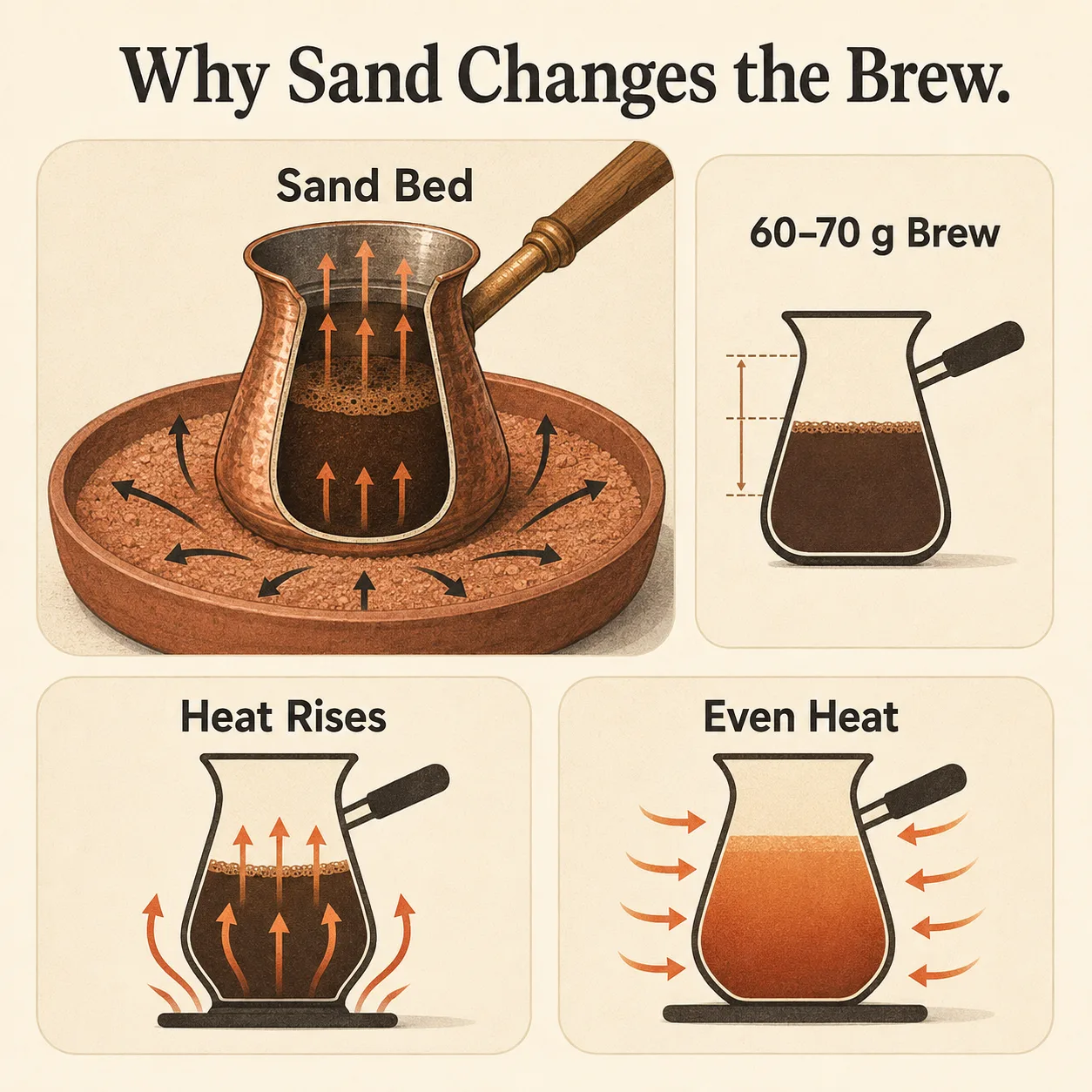
The sand changes the heat path, not the ingredients
Think of a sand bath as a packed contact layer around the lower part of the cezve. A direct flame concentrates energy under one section of the base. Sand spreads that contact around more of the vessel, including part of the lower wall, so the coffee warms through a broader surface.
The heat still starts at the burner. It passes into the pan, through the grains and their contact points, and then into the metal cezve. Because that route includes more material than a direct flame-to-metal setup, the bed can buffer sudden changes while redistributing heat around the vessel.
This is why the same Turkish coffee recipe can behave differently in sand. Foam formation depends partly on how quickly the mixture warms and whether one small area gets much hotter than the rest. A sand bath does not flavor the coffee or automatically make it stronger; it changes the conditions under which the coffee extracts.
The effect is easiest to see at the surface. A gradual rise gives you time to lift the cezve as the foam swells. A concentrated hot spot can push the liquid from quiet heating to a rolling boil before the foam has been preserved.
A direct burner versus a hot sand bed: two temperature curves, not two kinds of coffee
Put the same cezve, dose, and water on two heat sources and watch the control problem rather than the stopwatch. A direct burner gives fast feedback: turn the flame down, move the pot, or lift it, and the heat input changes quickly. A sand bed keeps delivering heat from the stored warmth of the pan and grains, so adjustments arrive more gradually.
For a small 60–70 g brew, use roughly 2–5 minutes as a working window once the cezve is on the heat. That is not a rigid recipe time. A thin copper or steel vessel, a strongly heated bed, and a high burner setting move you toward the short end; a thicker vessel, cooler sand, or shallow immersion moves you toward the long end.
- Direct burner: faster response and an easier reset between cups, but more concentrated heating at the base.
- Sand bed: slower response and broader contact, with depth in the bed acting as an extra heat-control lever.
- Best endpoint: the first strong foam rise, not a number on the timer.
Changing depth is the sand bath’s practical control. Nest the cezve deeper when the bed is too cool or the foam is taking too long. Lift it higher, or bury less of it, when the foam is surging and the surface is close to boiling.
Why the cup can taste rounder—or flatter—when the ramp changes
Turkish coffee extraction begins quickly because the grind is powder-fine. Smaller particles expose more surface to the water, so soluble material starts moving into the brew as soon as the mixture warms. That is useful for body, but it also means a fast, uncontrolled heat ramp can carry the brew past its useful endpoint before you react.
A sensible starting point is 6–7 g of coffee with 60–70 g of water, which is close to a 1:10 coffee-to-water ratio. If your grinder has no Turkish setting, use the coffee grind size chart as a starting reference, then judge the result by texture and sediment rather than trying to match a picture perfectly.
At sea level, the liquid can approach the local boiling point, usually somewhere in the low-to-upper 90s Celsius as the foam rises, without needing a sustained rolling boil. The exact reading varies with altitude, vessel shape, and where a thermometer measures. In practice, the foam gives you a more useful stopping signal than chasing one temperature number.
Separate texture from extraction. The heavy, syrupy feel comes mainly from suspended fines and coffee oils because the brew is not passed through a paper filter. Sand only changes the heating path. A smoother ramp may let you stop before violent boiling and can produce a cup that home brewers commonly describe as rounder, but it cannot guarantee that result if the grind, dose, or coffee itself is unsuitable.
For broader definitions of extraction, brew ratio, and temperature, Specialty Coffee Association resources on extraction, brew ratio, and temperature can provide useful background. The important point here is narrower: sand changes the rate and distribution of heating, not the identity of the coffee.
The three sand-bath dials: a 3–5 cm bed, vessel depth, and starting heat
Build the bath in a heavy, stable pan that can support the cezve without wobbling. A 3–5 cm layer of clean, dry, untreated sand is a practical home starting point. The lower third to half of the cezve should be surrounded, while the rim, pouring lip, and handle stay clear.
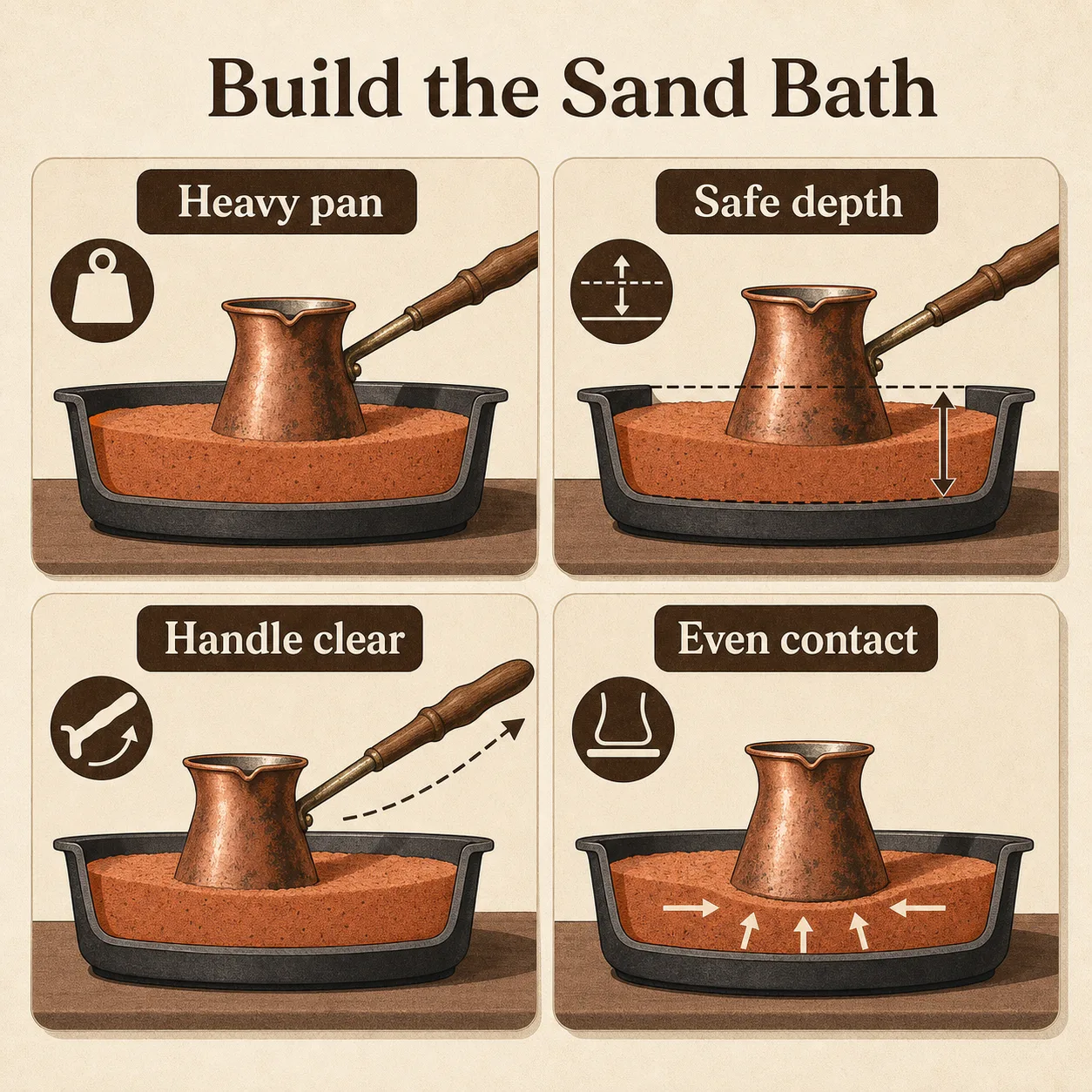
Deeper immersion gives the sand more vessel surface to contact. That generally increases heat transfer and makes the bed more influential. Shallow placement leaves more of the cezve exposed to air, so the brew responds more slowly and the top of the vessel may stay noticeably cooler.
Use material with an identifiable composition and no added fragrance, coating, or unknown treatment. Avoid damp beach sand, construction fill, and decorative material that may contain salt, organic matter, or additives. Moisture trapped in hot sand can turn into steam and spit unexpectedly.
Heat the bed evenly before putting the cezve into it. Cold sand absorbs part of the initial heat, making the first brew slow and difficult to compare with the next one. A preheated bed gives you a more stable starting condition, but it does not remove hot spots; a pan that heats unevenly can still scorch one side of the vessel.
Keep the handle away from the hottest area and use a dry cloth or suitable heat protection when lifting the cezve. Do not pour water onto hot sand. Treat the bath as a hot cooking surface, not as a decorative bowl that happens to contain a pot.
Foam, sediment, and bitterness: a three-symptom diagnostic
Use one correction at a time. If you change the grind, ratio, bed depth, and burner together, you will get a different cup but no clear explanation for it.
| What you notice | Likely mechanism | First change to make |
|---|---|---|
| Foam rises slowly; cup tastes thin or sharp | Cool bed, shallow contact, or removal before the brew has developed | Preheat the bed more fully or increase immersion slightly |
| Foam surges into a rolling boil; foam collapses; cup tastes dry | Heat input is too strong, or the cezve stays hot after the useful endpoint | Lower the starting heat and lift the cezve at the first strong rise |
| Texture feels excessively gritty or muddy | Normal unfiltered sediment has been kept suspended by stirring or immediate drinking | Stop stirring after heating and let the cup rest for 1–2 minutes |
Some sediment is part of the method. The goal is not a clear cup. The goal is to keep the grounds settled enough that the first mouthful has weight without becoming a mouthful of loose powder.
Foam is an endpoint signal, not a certificate of perfect extraction. You can produce a tall foam cap with a weak, poorly extracted brew if the bed is cool, and you can flatten good coffee by boiling it aggressively. Read the foam together with the taste and the heat behavior.
If your goal is repeatability, the low burner wins; if it is gentle surrounding heat, sand wins
For one small cup made regularly, the low direct burner is my choice for repeatability. Its heat source resets more predictably, and you can make a small adjustment without waiting for a hot bed to cool. This is especially useful while you are still finding the right grind and endpoint.
Sand earns its place when the point is a slower, broader heat path, a traditional sand-brew presentation, or a shared bed holding several small cezves. The bed makes the setup less about a single flame contact point and more about how much of each vessel is surrounded.
That is a method comparison, not a claim about cultural superiority. Sand is a heating and serving setup, not a requirement that defines Turkish coffee, and it is not inherently tastier in every kitchen. If you want the cultural side separated from the mechanics, UNESCO documentation on Turkish coffee culture and tradition is a better reference for ritual and service than a shortcut that says sand is mandatory.
The useful question is not whether sand is more authentic in the abstract. Ask what you want to control. Choose the burner for a fast, repeatable single-cup workflow. Choose sand when the surrounding heat and presentation are part of the experience you are trying to reproduce.
A repeatable 6–7 g / 60–70 g sand-brew for tonight
Use this as a baseline, then change only one variable on the next cup. The recipe is deliberately simple because the sand is already adding another control layer.
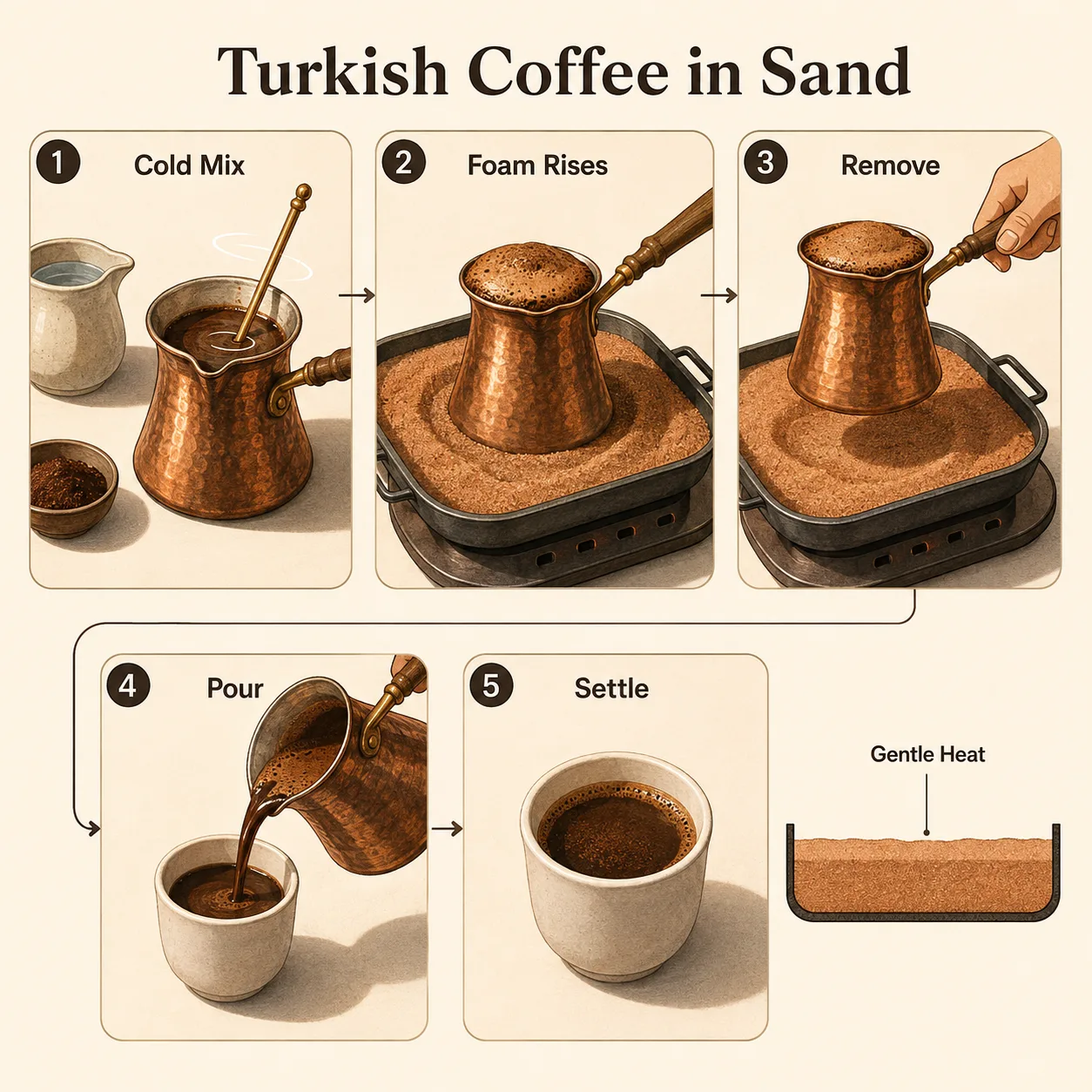
- Warm the bed. Spread the clean sand across the pan and heat it gradually until the bed is evenly hot. You are preparing a stable contact surface, not trying to make the top layer smoke or glow.
- Weigh the water and coffee. Add 60–70 g of cold water and 6–7 g of powder-fine coffee to the cezve. This keeps the starting ratio near 1:10.
- Add optional ingredients before heating. Put in sugar or spices now if you use them. Stir while the mixture is cold so the coffee is fully wetted and the additions are distributed.
- Nest the cezve. Set the lower third to half of the vessel into the sand. Keep the rim and handle unobstructed, and make sure the cezve stands upright.
- Watch the foam, not just the clock. As the surface darkens and the foam begins to climb, reduce the heat or lift the cezve slightly if the rise is too fast. Expect the brew to take roughly 2–5 minutes depending on the bed and vessel.
- Remove at the first strong rise. Lift the cezve before the mixture reaches a sustained rolling boil. If there is no meaningful foam after the long end of the timing window, treat that as a heat or grind problem rather than baking the coffee indefinitely.
- Pour and wait. Pour slowly so the heavier grounds stay in the cezve as long as possible. Let the cup rest for 1–2 minutes before drinking, especially if the sediment feels aggressive.
For scaling beyond one cup, the coffee to water ratio calculator can keep the starting proportion consistent while you change the number of servings. It will not tell you how deep to place each cezve, so record that separately; depth is part of the sand method, not part of the ratio.
What the sand cannot rescue: grind, dose, and the 1:10 starting ratio
Sand is a secondary dial. The powder-fine grind, the coffee-to-water ratio, the water itself, and the foam endpoint still determine most of what reaches the cup. A sand bath cannot compensate for a grind that is too coarse to create the expected body, a dose that is too low, or a brew left at a boil too long.
If the cup is clean but weak, move from a dilute starting point such as 1:11 toward 1:9 rather than changing everything at once. More coffee relative to water increases concentration; it does not repair a burnt or uneven heat path.
If the cup is harsh or bitter, lower the bed heat and remove the cezve earlier before touching the grind. The same order of checks used in why is my coffee bitter applies here: first look at excess heat and contact time, then change the recipe. Coarsening the grind immediately can reduce body and create a different problem.
If the cup is muddy, allow more settling time and stop stirring after the foam has formed. If it is still too heavy, change agitation or the grind only after you know the endpoint is controlled. Water composition also changes how coffee extracts and tastes, so use the same water while tuning the method.
The surprising part of Turkish coffee in sand is that the sand is not doing the extracting by itself. It is shaping the heat curve that tells you when to stop. Control the bed, but give the final attention to grind, ratio, and foam.