Turkish Coffee: The Fine Grind, Ratio, and Heat Explained
Put 8 g of coffee and 64 g of water on a kitchen scale, then lift the cezve when the foam swells—not when the brew reaches a rolling boil. That small choice explains much of Turkish coffee: the powder-fine grind controls texture, the ratio controls concentration, and the heat decides whether the foam survives or the cup tastes scorched.
Turkish coffee is easier to repeat once you stop treating the demitasse scoop as a recipe. Measure the coffee, water, and heating window separately, then change one dial at a time.
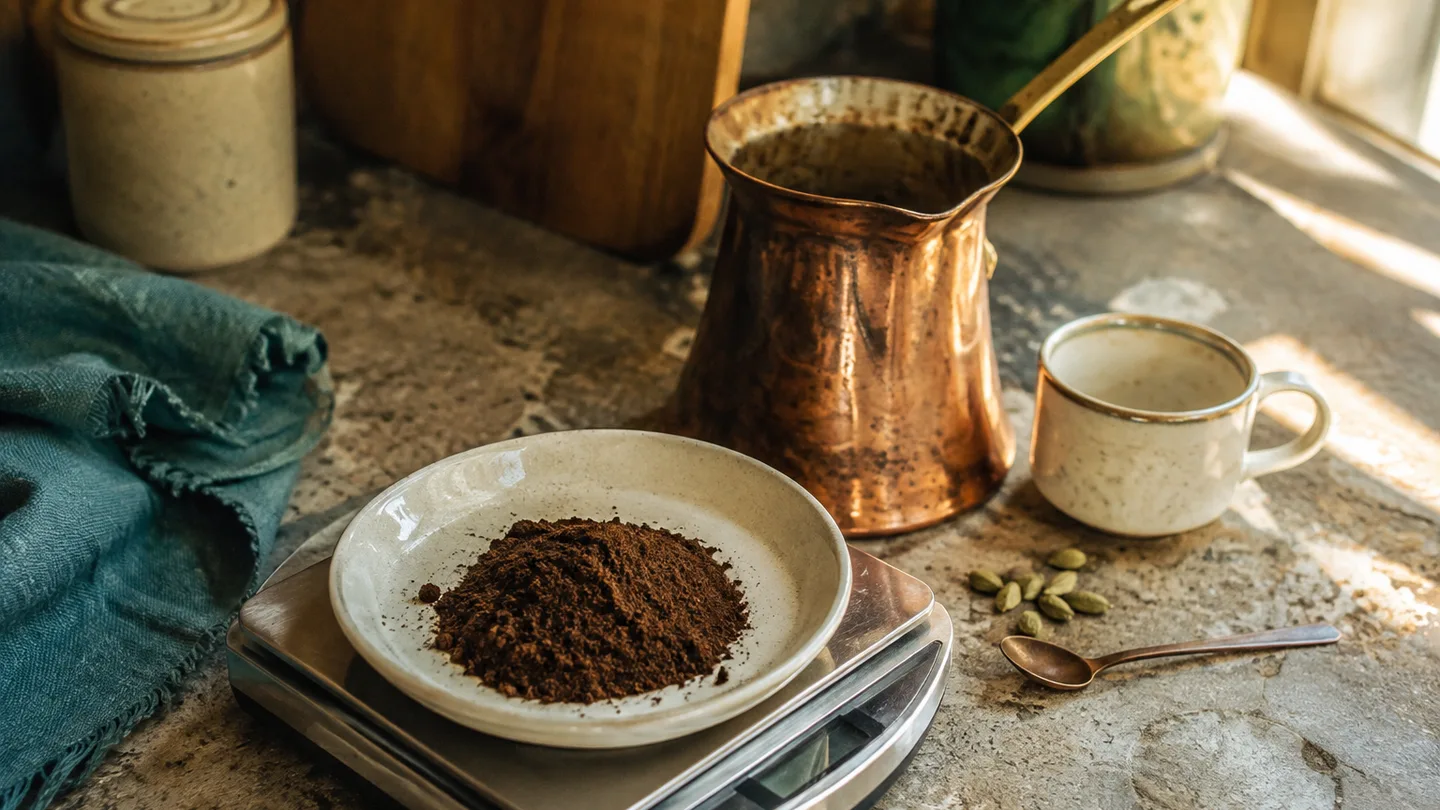
Start with 7–8 g of coffee and 60–70 g of water, not a vague demitasse scoop
For a repeatable one-cup baseline, use 7–8 g of extra-fine coffee with 60–70 g of water. That gives a practical coffee-to-water ratio of roughly 1:8 to 1:10 by mass, where 1:8 means one gram of coffee to eight grams of water.
At this serving size, volume is a poor measuring tool. A spoon can be loosely filled or compacted, and the powder density changes with roast and grind. Weigh both ingredients because a small error becomes a large share of a small cup. Sixty-four grams of water and 72 grams of water are not interchangeable if you are trying to diagnose strength.
Sugar is optional and belongs in the cezve before heating if you want it dissolved through the brew. Treat sugar and serving size as recipe choices, not fixes for sourness or bitterness. Start unsweetened, or keep the sugar amount steady while you adjust the coffee.
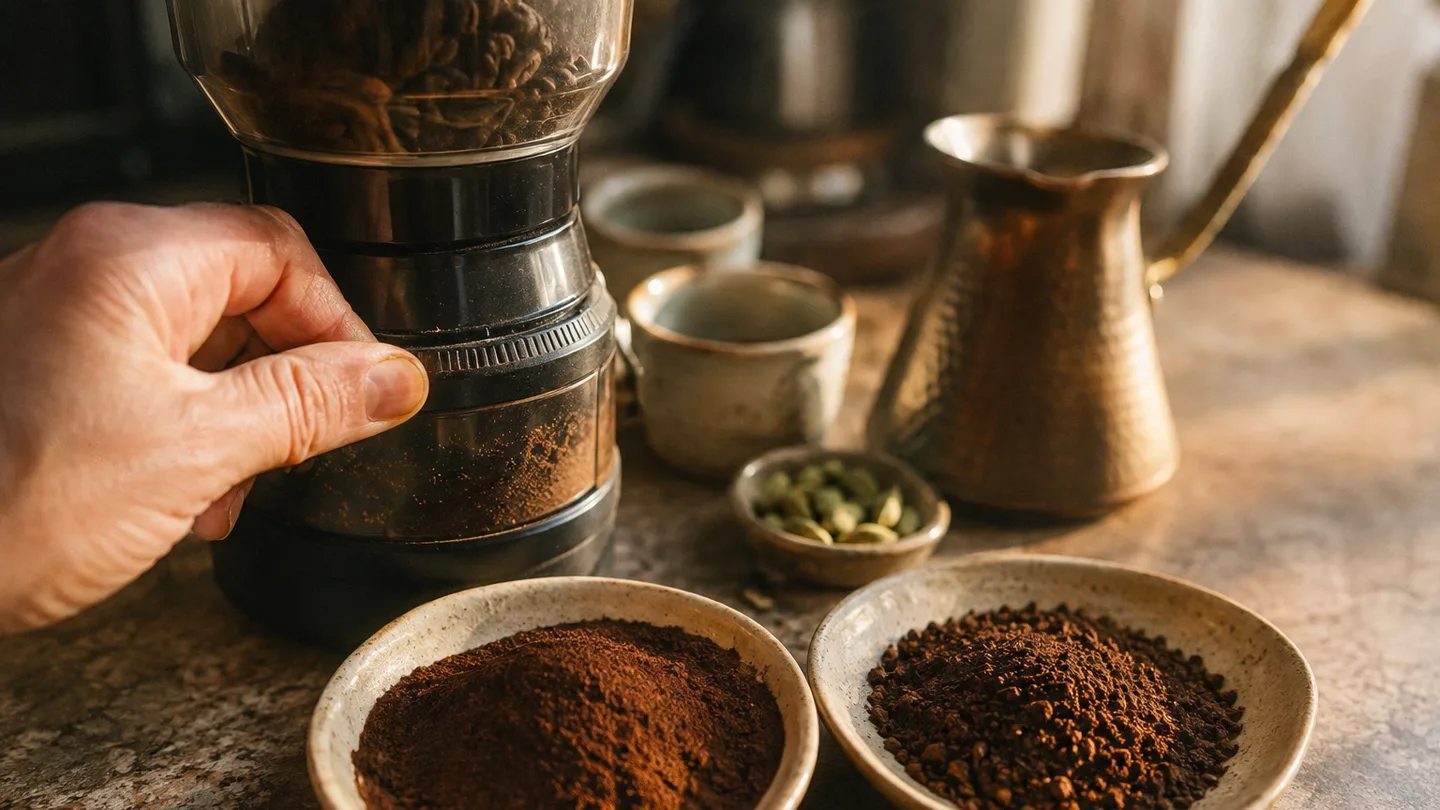
Fine enough to behave like powder: where Turkish grind sits below espresso
Turkish grind is best judged by function: it should look and feel like powder, with no obvious gritty crystals between your fingers. Do not chase an invented universal micron number. Burr geometry, roast development, and bean density all affect how a grinder reaches the same practical texture.
Espresso grind can look fine while still being too coarse for this method. Turkish coffee is unfiltered, so the smallest particles remain in the drink. Those fines, meaning the smallest fragments produced during grinding, add body and create the sediment that settles at the bottom of the cup. They also provide much more surface area for water to contact during the short heating cycle.
If the grind is too coarse, larger particles settle faster and less of the coffee stays suspended. The result can be a thin cup, weaker foam, and a sharp or hollow flavour caused by uneven extraction. On a burr grinder, use the finest setting that produces a fairly even powder without leaving many visible flakes. A coffee grind size chart is useful for learning the vocabulary, but the cup and the texture matter more than a label on the dial.
The cezve is a heat-control tool: narrow walls, foam rise, and a 2–4 minute climb
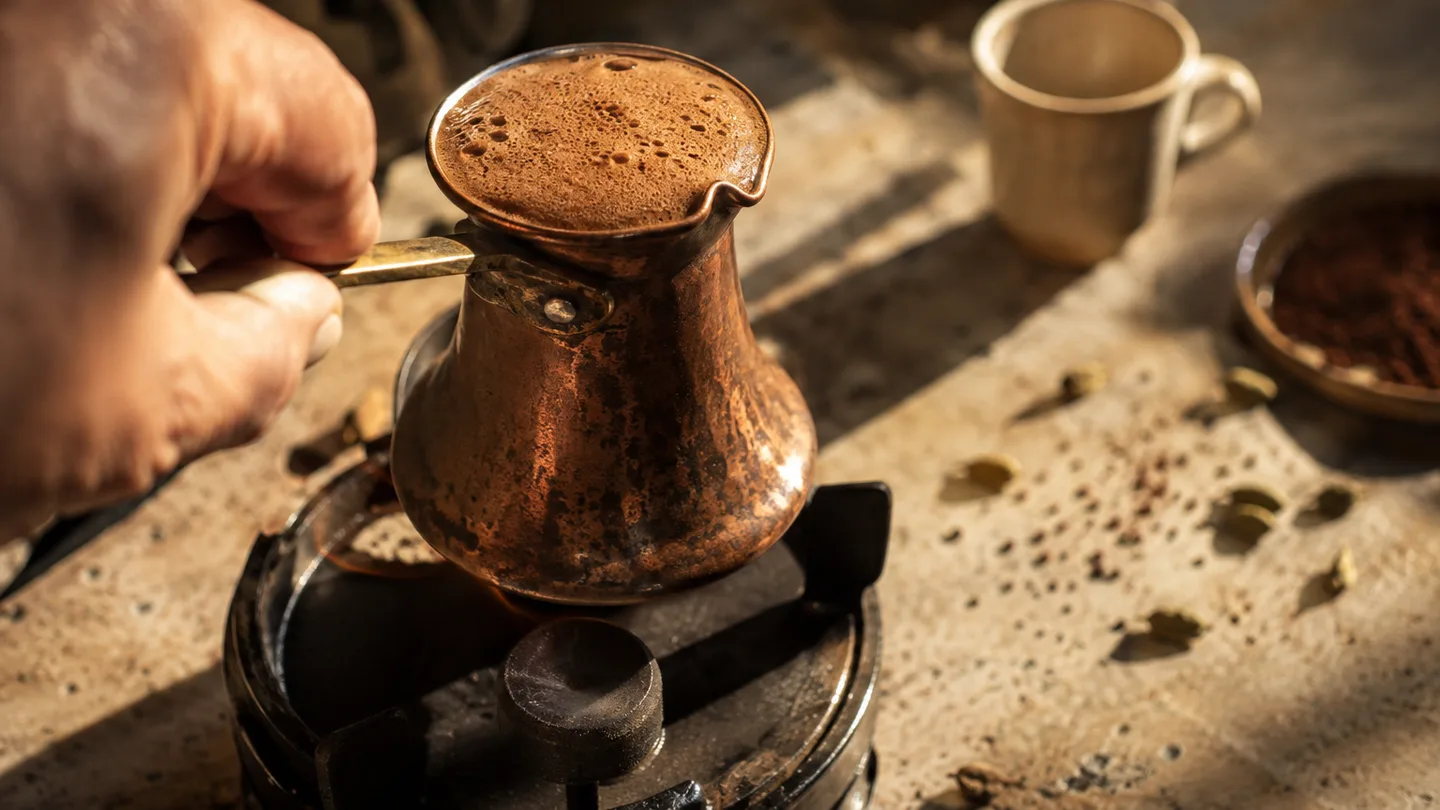
The cezve is less a magic pot than a heat-control tool you can see. Its small volume warms quickly, while the narrow upper section gives the foam a place to gather and rise before it spills. That geometry turns the surface into a useful visual thermometer, even though it does not give you an exact brewing temperature.
For a 60–70 g one-cup batch, use 2–4 minutes as a starting window over low to medium heat. Burner output, vessel material, and starting-water temperature can move that timing. A small copper pot on a strong gas flame may climb faster than a thicker steel pot on a modest electric hob.
Gentle heating lets the grounds wet, warm, and release soluble material progressively. Aggressive heat can create local hot spots, scorch the coffee at the base, and make the foam rise too abruptly to control. If the brew reaches its endpoint in well under two minutes, lower the heat before changing the ratio.
Ratio changes concentration first: compare 1:8, 1:9, and 1:10
Ratio changes the concentration of the finished drink before it changes anything else. Keep the coffee at 8 g and compare 64 g of water at 1:8, 72 g at 1:9, and 80 g at 1:10. The 1:8 cup starts thickest and most concentrated; 1:9 softens the intensity; 1:10 gives more drinking volume with lighter body.
Those three brews can still all be under-extracted or scorched. Adding water does not repair a coarse grind, and using less water does not make burnt coffee taste balanced. If a 1:10 cup tastes weak but clean, move toward 1:9. If it tastes sharp and drying, check grind and heat before adding more coffee.
The practical starting point is 1:9 because it gives enough volume to taste the coffee without making the cup excessively dense. Once that brew is behaving, the coffee to water ratio calculator helps scale the recipe without returning to spoon measurements. Change the ratio after the extraction is reasonably sound, not as a substitute for fixing it.
Lift before the rolling boil: the three heat stages that protect the foam
Watch for three stages. First, the coffee darkens as the grounds become fully wet. Next, a foam cap gathers across the surface. Finally, that cap swells and begins moving quickly toward the rim. The last stage is your removal cue for the gentler method described here.
Lift the cezve when the foam rises, then pour slowly. The foam is not a separate topping added after brewing; it is the visible result of air, oils, fine particles, and heated liquid moving together. It is also a warning that the brew is close to spilling and that another few seconds of strong heat may change the flavour more than it improves extraction.
A rolling boil is a poor stopping cue for a foam-focused cup. Vigorous bubbling breaks the surface structure, churns sediment, and exposes the coffee to harsher heating. The cup may become ashy, dry, or scorched. Some regional and household techniques deliberately allow a brief boil or repeat the rise, so this is not an authenticity test; it is a defined heat choice with a different result.
One 5–10-second stir is enough: why later agitation makes the cup grittier
Stir once after the water, coffee, and optional sugar are combined. Make that first stir thorough but brief—about 5–10 seconds is enough to break dry clumps and wet the powder evenly. The goal is a uniform slurry before heat begins, not constant movement throughout the brew.
After the initial stir, leave the cezve alone. Continued agitation keeps heavier grounds suspended, disrupts the foam cap, and sends more sludge into the cup during pouring. Turkish coffee is not meant to be perfectly clear: sediment is part of an unfiltered brew. Pour gently and allow 30–60 seconds for the grounds to settle before taking the first sip.
Use the symptom table: sour, bitter, thin, or flat each points to a different dial
Use the symptom you can actually taste to choose the first adjustment. Under-extraction means too little soluble material has moved into the water; over-extraction means the brew has taken on more harsh, dry material than the cup can carry.
| Symptom | Mechanism to check | First adjustment |
|---|---|---|
| Sour or sharp | Under-extraction from a grind that is too coarse or a heating cycle that is too weak. | Grind finer first; if already powder-fine, use gentler heat for a slightly longer rise. |
| Bitter, ashy, or dry | Scorching or over-extraction caused by aggressive heat or letting the foam boil over. | Lower the heat and remove the cezve sooner, keeping the ratio fixed. |
| Watery or thin | A dilute ratio, especially when a 1:10 brew is also clean and short on body. | Move toward 1:9 or 1:8 before adding more heat. |
| Flat or muted | Extended open heating can drive off aroma while leaving body behind. | Shorten the heating window or lower the flame before changing the ratio. |
| Excessive grit | Late stirring, uneven grinding, or drinking before the sediment settles. | Stir only at the start, pour slowly, and wait 30–60 seconds. |
Make one change per brew. The useful order is grind for sourness, heat for bitterness, and ratio for a cup that is simply too weak. The same decision logic appears in why is my coffee sour and why is my coffee bitter, but Turkish coffee adds sediment and foam as extra clues.
One-cup method, then scaling: 7–8 g per 60–70 g without overfilling the cezve
For a repeatable one-cup brew, use this sequence:
- Weigh 60–70 g of water and 7–8 g of extra-fine coffee.
- Add the water to the cezve, then add coffee and sugar if wanted.
- Stir thoroughly for 5–10 seconds, scraping any dry powder from the surface.
- Heat over low to medium heat and watch the foam rather than chasing a temperature number.
- Remove the cezve as the foam swells toward the rim, before a sustained rolling boil.
- Pour slowly into the cup and wait 30–60 seconds before drinking.
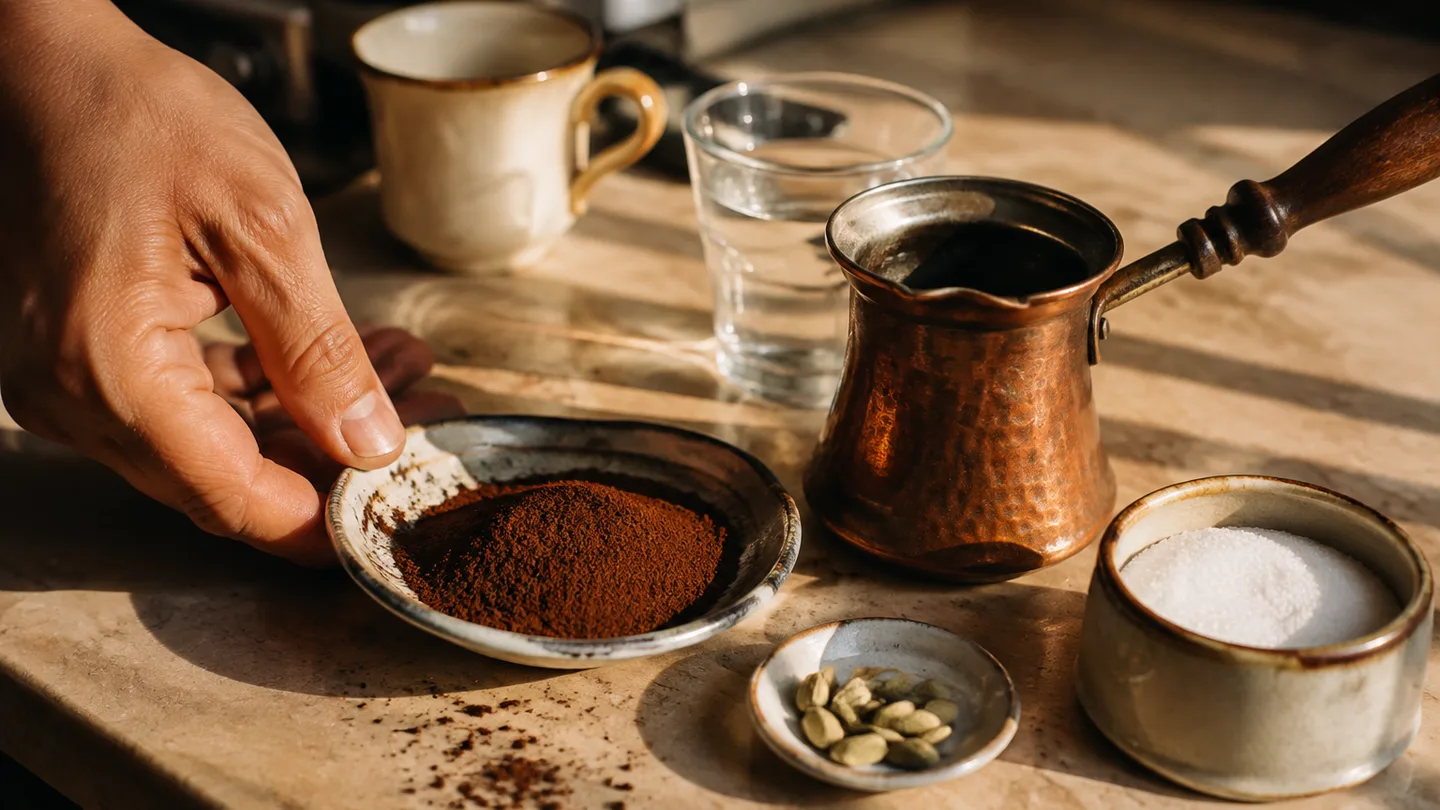
For two servings, use 14–16 g of coffee with 120–140 g of water. For three or four, multiply the one-cup dose while leaving clear headspace for the foam; do not fill the pot to its rim. A larger batch has more thermal mass, so it needs enough time to warm but not automatically more flame or a longer boil. The target is the same foam rise, not a proportionally more violent heating cycle.
Tradition and adaptation: what espresso grind, dark roast, and a saucepan change
For this guide, the defining structure of Turkish coffee is an editorial framing choice: extra-fine coffee and water are heated together in a small pot, there is no paper filtration, and the poured drink is allowed to settle with sediment in the cup. That structure explains the method better than treating a particular sugar level or cup size as the whole definition.
Espresso grind can produce coffee, but it generally leaves a less powdery, less sediment-rich texture because its particles are selected for pressure brewing and rapid flow. Darker or more developed roasts may release soluble material quickly and taste roasty under the same 2–4 minute heating window, so lower heat and an earlier foam rise can be sensible starting adjustments. A light roast can work too, but its acidity may stand out more.
A small, narrow saucepan is a workable adaptation when there is no cezve. A wide pan spreads the liquid into a shallower layer, changes the heating rate, and gives you a less distinct foam rise. Sugar levels, serving sizes, and repeated-rise practices vary across households and regions, so one recipe should not be used as an authenticity test. For respectful cultural background, read UNESCO's documentation on Turkish coffee culture and tradition. For extraction vocabulary, Specialty Coffee Association brewing references offer a useful comparison point.
Questions that come up at the stove
Can you make Turkish coffee without a cezve?
Yes. Use a small, narrow saucepan with the same 7–8 g coffee to 60–70 g water starting ratio. Expect less control over the foam if the pan is wide, and rely on the rising surface rather than a fixed time alone.
Can you use a light roast for Turkish coffee?
Yes. Keep the 1:8–1:10 ratio, avoid extending the heat unnecessarily, and taste before changing anything else. If the cup is sharply acidic, grind finer or lengthen the gentle rise slightly rather than adding a rolling boil.
Is Turkish coffee stronger than espresso?
Stronger mixes concentration, body, and serving size. Espresso is generally more concentrated by coffee-to-water mass, while Turkish coffee feels unusually dense because ultra-fine particles remain in the drink. Compare the ratio and poured volume, not taste alone.
Frequently Asked Questions
Can you make Turkish coffee without a cezve?
Yes. A small, narrow saucepan can reproduce the basic extraction with the same 7–8 g coffee to 60–70 g water starting ratio, but a wide pan heats differently and gives you less control over foam rise and pouring.
Can you use a light roast for Turkish coffee?
Yes, but expect more pronounced acidity and a less roasty profile. Keep the 1:8–1:10 ratio, avoid extending the heat unnecessarily, and adjust only after tasting because light-roast solubility and bean density vary.
Is Turkish coffee stronger than espresso?
The word stronger mixes concentration, body, and serving size. Espresso is usually more concentrated by mass, while Turkish coffee feels unusually dense because ultra-fine unfiltered particles remain in the drink; compare the two by ratio and volume rather than taste alone.