Turkish Coffee Recipe: Why the Grind Must Be Powder-Fine
A 1:10 Turkish coffee recipe uses 7 g of coffee and 70 g of water for a small cup. The part that makes it work is not the sugar or the shape of the pot. It is the grind: the grounds need to feel like flour, not fine beach sand.
Heat the mixture gently, let the foam climb once, and pour before a rolling boil. Use grounds that are merely espresso-fine and you can hit the same ratio yet still get a thinner body and less cohesive sediment.
The useful idea is simple: in Turkish coffee, the grind controls both extraction and the texture of what reaches your cup.
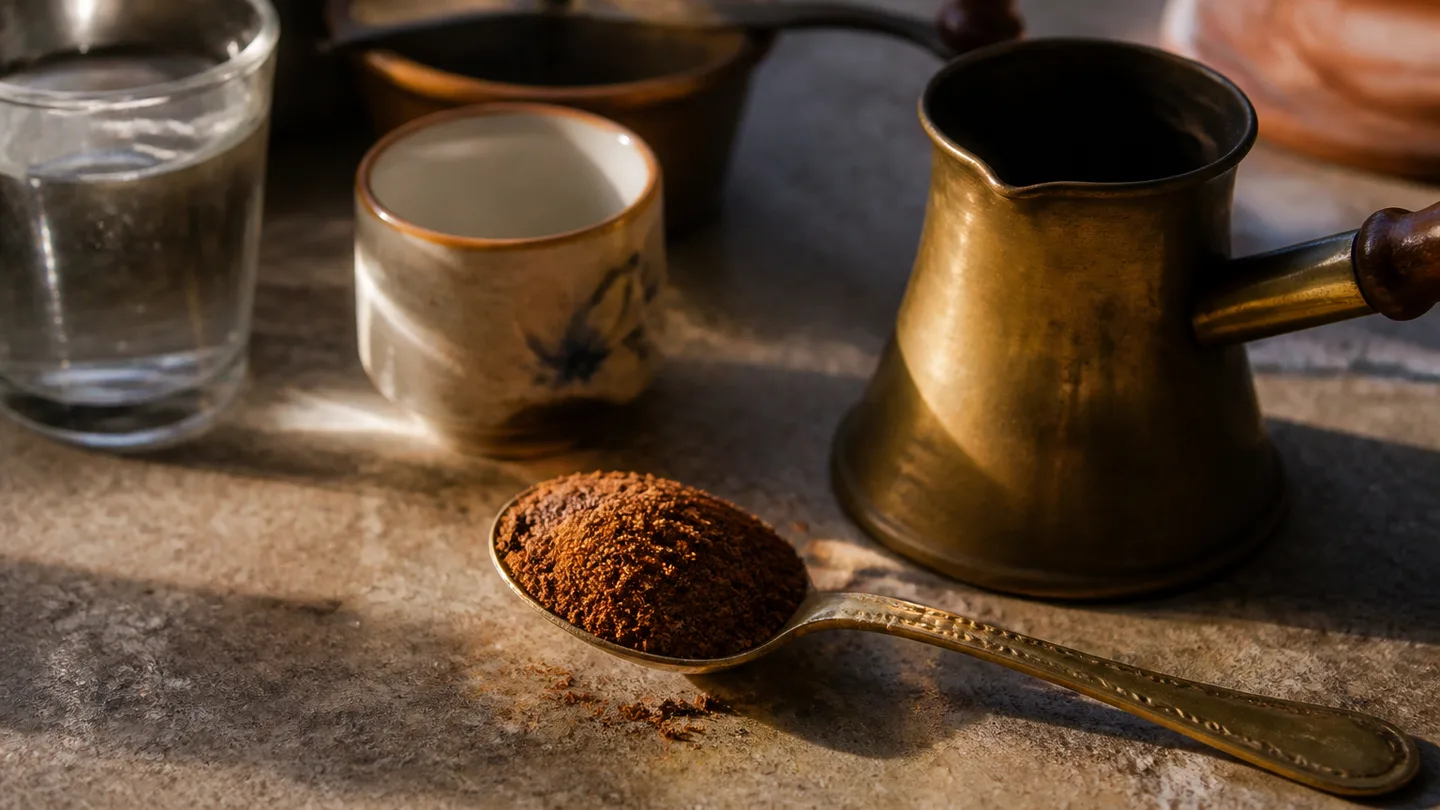
Start with the fincan: a 1:9–1:11 Turkish coffee recipe that foams without boiling
For one small 60–70 mL fincan, the starting recipe is 6–7 g of powder-fine coffee, 60–70 g of cool water, and anywhere from 0–6 g of sugar. A cezve is the small brewing pot; the fincan is the small cup used for serving. Use a 7 g dose and 70 g water first, because the middle of the range is easier to diagnose.
A brew ratio is the relationship between coffee mass and water mass. Seven grams to 70 g is 1:10. Six grams to 60 g is also 1:10, while moving toward 1:9 makes the cup stronger and moving toward 1:11 makes it lighter. If you want to check the arithmetic for different cup sizes, the coffee to water ratio calculator is useful here, but keep the first test small.
Put the water, coffee, and sugar into the cezve while it is still cool. Stir until there are no dry pockets and the mixture looks evenly wet. Do this mixing before the pot goes on the heat; once the foam starts to form, aggressive stirring works against the texture you are trying to keep.
- Weigh 7 g of powder-fine coffee and 70 g of cool water.
- Add 0–6 g sugar if you want a sweetened cup, then stir once until fully combined.
- Set the cezve over low heat and watch the surface rather than walking away.
- When the foam rises toward the rim, remove the pot and pour slowly into the fincan.
Let the cup rest for roughly 30–60 seconds before drinking. This is an unfiltered style, so the fine coffee solids remain in the liquid at first and settle toward the bottom. Pouring slowly also keeps the final, thickest sediment in the cezve instead of sending it all into the cup.
The no-filter serving is part of the point, not a missing step. For cultural background alongside the method, UNESCO's entry on Turkish coffee culture and tradition is a useful reference.
The grind is the filter: why larger particles make Turkish coffee weak and gritty
Most brewing methods use a paper, metal, or cloth filter to separate liquid coffee from the spent grounds. Turkish coffee does not use that separation step. The coffee is heated with the water and served with the solids still present, so particle size has to do two jobs at once.
Smaller particles expose more surface area relative to their mass. Water can reach their soluble material quickly during a short heated brew, and the resulting sediment can settle into a fine, cohesive layer. Larger particles expose less surface area, release soluble material more slowly, and remain noticeable as grains when you drink the cup.
That is why espresso-fine is not automatically Turkish-fine. Espresso grounds can look fine beside filter coffee while still feeling granular beside flour. In a 7 g coffee to 70 g water batch, that difference can leave the upper part of the cup thinner and the sediment less cohesive, even though the ratio is correct.
If a grinder gives a particle-size estimate, treat roughly 100–200 micrometres as a cautious orientation for powder-fine coffee, not as a universal pass-or-fail target. Burr geometry, the measurement method, and the spread of particle sizes all matter. Two grinders can display similar numbers while producing different mixtures of powder and larger pieces.
The more useful check is not the micron number on the dial. It is whether the grounds extract quickly in the short heated brew and then settle into a fine, cohesive bed. That is the central reason the grind must be powder-fine: it is acting as part of the extraction system and part of the filter system.
Powder-fine in practice: how to judge the grind when your grinder has no Turkish setting
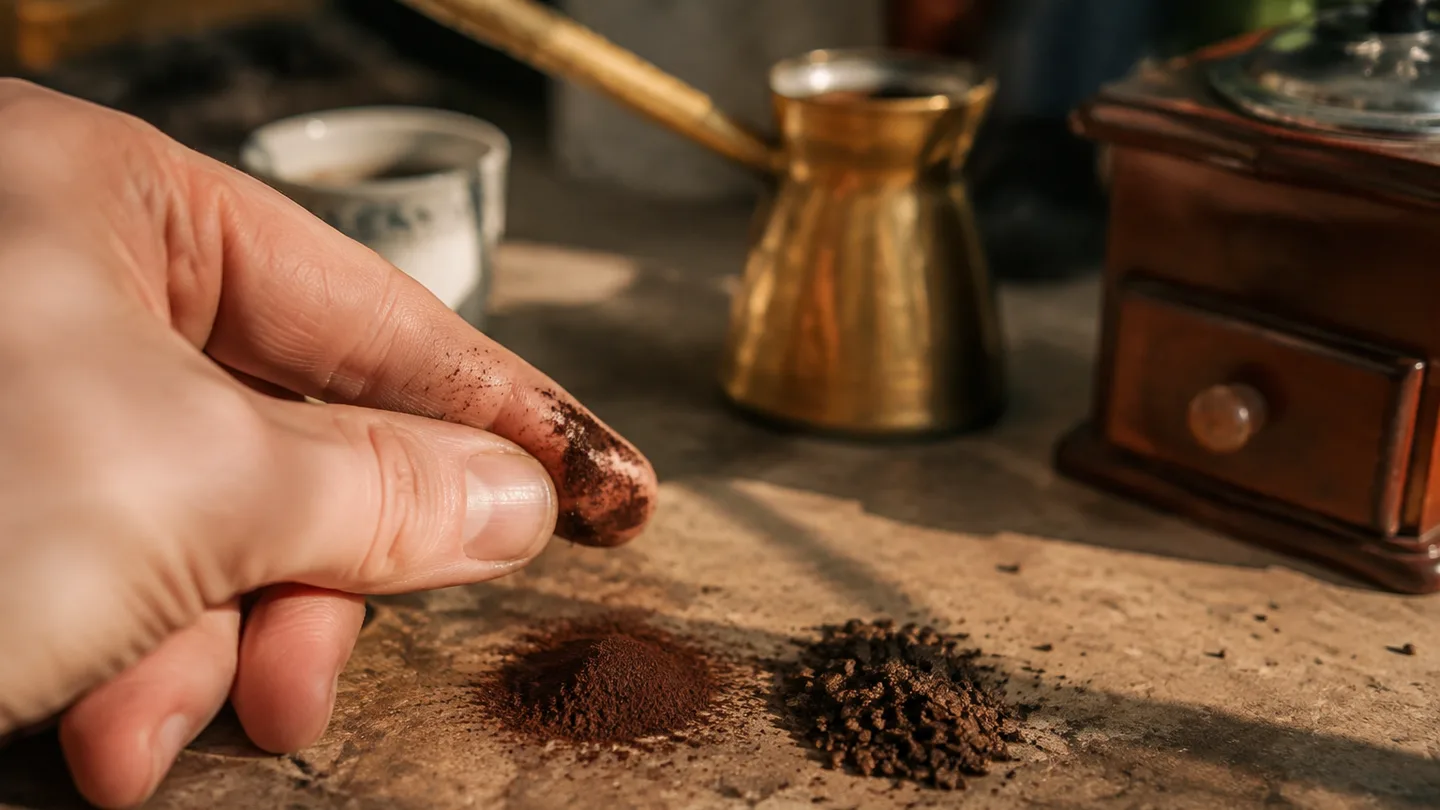
Start with your fingertips, not the setting label. Take a small pinch of dry grounds and rub it once between clean, dry fingers. Powder-fine coffee should feel like flour or very fine confectioner's sugar, with no obvious salt-like grains pushing back against your skin.
The comparison with espresso matters because many home grinders stop at a setting intended for pressurised brewing. Espresso-fine grounds are usually still visibly granular. Turkish-fine grounds should look more like a soft powder, although a few darker specks from the bean structure are not a problem.
A coffee grind size chart can show where Turkish coffee sits relative to espresso, moka pot, or filter coffee, but it cannot guarantee that your grinder reached the required texture. Use the chart for orientation and the tactile test for the decision.
A blade grinder is the difficult fallback. Its chopping action tends to create a broad mixture: larger pieces that extract slowly and very fine dust that extracts quickly. That uneven distribution can produce a cup that tastes light in the body while leaving muddy or gritty sediment at the bottom.
If a burr grinder cannot reach a Turkish setting, use the finest setting that still produces a reasonably uniform powder. With some grinders, reducing the batch size helps the coffee move through the burrs more evenly. A few short pulses and a gentle shake between pulses can improve distribution in a blade grinder, but they cannot make an uneven grinder produce a true Turkish grind.
Use a concrete kitchen test: brew 7 g with 70 g water for about three minutes, then let it sit for 45 seconds. If the cup tastes light but the last sip still feels sandy, the next move is finer, not hotter. If the grinder cannot go finer, record the result as an approximation rather than trying to force the texture with extra boiling.
Heat decides the foam: a 2–4 minute low-flame climb and the point to stop
A powder-fine grind extracts quickly, which makes heat exposure more consequential. For a 60–70 g batch starting with cool water, use a low flame and expect the climb to take roughly 2–4 minutes. The exact time changes with the burner, vessel, batch size, and altitude, so the clock is a guardrail rather than the finish line.
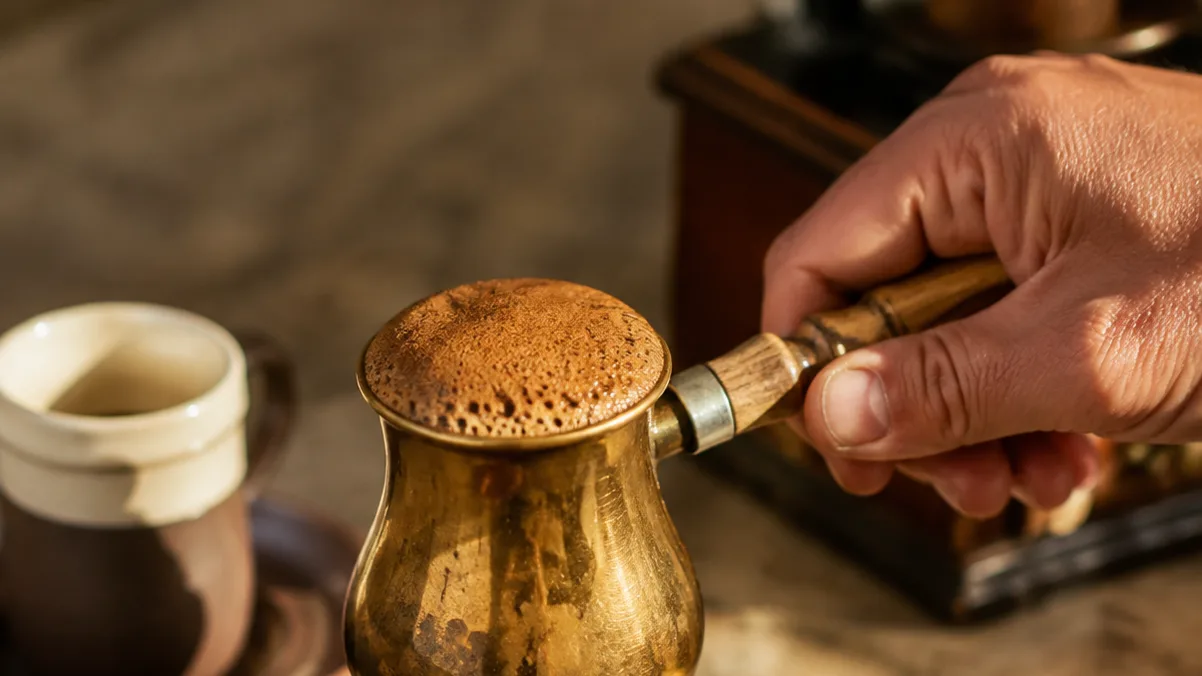
The foam should rise in the low-to-mid 90s Celsius, roughly 90–96°C in a typical kitchen. A thermometer can help you learn the cue, but the surface is more practical: the foam becomes glossy, gathers around the edge, and starts to dome upward. Remove the cezve at that first controlled rise, before the liquid breaks into a rolling boil.
For this recipe, one steady rise is the best baseline. Some traditional preparations use more than one heating cycle, but repeated hard boiling is a poor repair for a weak cup. It keeps the fine particles moving through hotter water, extends extraction, and can rupture the foam that formed on the first climb.
Once the foam reaches the rim, take the pot off the burner immediately. If you want more foam in the fincan, pour slowly and aim the first part of the pour at the surface. Do not put the cezve back on the heat just because the cup looks less dramatic than a café version; diagnose the grind and ratio first.
When the cup is weak, gritty, or bitter, change one variable first
Treat the first cup as a controlled test. Hold the dose, water, and sugar steady, then change either grind or heat exposure. Changing both at once can improve the drink while hiding which variable actually solved the problem.
| What you taste or see | Check first | Make this one change | Mechanism |
|---|---|---|---|
| Weak or watery | Grounds are not powder-fine, or the ratio is near 1:11 | Move finer; keep 1:10 for the next test | Larger particles release soluble material more slowly during the short brew |
| Harsh or bitter | The foam was allowed to boil or the pot stayed hot too long | Stop at the first rise | Extra heat extends extraction and pushes the cup past the intended balance |
| Excessive grit | Uneven particles, or the cup was tasted immediately | Let it settle for 30–60 seconds and inspect the grind | The fine slurry needs time to compact, while larger pieces remain easy to feel |
| Flat foam | Repeated stirring, repeated boiling, or a wide vessel | Mix once before heating and remove at the first rise | Agitation and boiling disturb the thin bubble layer at the surface |
| Strong but dull | Heat exposure and agitation are high even though the ratio is sound | Keep the ratio and shorten the heating | Fine grounds can produce intensity quickly; more heat does not necessarily add clarity |
Here is the decision rule worth saving: a weak, clean cup needs a finer grind before it needs more heat; a strong, harsh cup needs less heat before it needs less coffee. Grit that disappears after settling points to serving technique, while grit that remains throughout the cup points to particle uniformity.
Consider a 7 g dose with 70 g water that climbs for three and a half minutes. If the coffee was only espresso-fine, the upper cup may taste thin while the bottom remains sandy. The next test should keep the ratio and sugar unchanged, move as fine as the grinder allows, and stop at the first foam rise. I would expect a fuller body and a more cohesive settled layer; if neither changes, the grinder has not produced enough fine material and the vessel or ratio needs rechecking.
That is why the grind deserves the first adjustment. In Turkish coffee, it is not just a way to set extraction speed. It is also the thing standing between a silky settled cup and a mouthful of uneven particles.
FAQ: three practical edge cases
Can you make Turkish coffee with espresso-ground coffee?
Yes, as a fallback, but it will not have the intended powder-fine texture. Keep the 6–7 g coffee to 60–70 g water range, use the finest uniform setting available, and expect a thinner body with less cohesive sediment. Do not compensate by boiling the coffee repeatedly.
Can you make Turkish coffee without a cezve?
Use a small, narrow saucepan and follow the same ratio and heat cues. A wide pan spreads the foam across a larger surface, which makes the rise harder to read and can leave less visible foam in the cup. The vessel is a constraint, not a reason to change the grind logic.
Should Turkish coffee be filtered before serving?
No paper filter is needed for this style. Pour slowly, let the coffee rest for 30–60 seconds, and leave the last thick sediment in the cezve if you want a cleaner final sip.
Frequently Asked Questions
Can you make Turkish coffee with espresso-ground coffee?
Usually not to the intended texture: espresso grounds are generally coarser than Turkish grounds. Explain that the finest uniform setting available can work as a fallback, but the drink will be thinner and less cohesive than one made with powder-fine grounds.
Can I make Turkish coffee without a cezve?
Yes. A small narrow saucepan can use the same 6–7 g coffee to 60–70 g water starting ratio, although a wide pan gives the foam more room to spread and makes the rise harder to judge.
Should Turkish coffee be filtered before serving?
No. The grounds remain in the cup and settle at the bottom; pour slowly and leave the final sediment rather than straining it through a paper filter.