What Is a Good Coffee Cupping Score? 80+ Is Usually Good
Two coffees scored 79.75 and 80.00 can taste indistinguishable in the same cup. The boundary matters on a bag or offer sheet, but it is a filing line, not a sudden jump in sweetness, clarity, or complexity.
So, what is a good coffee cupping score? In the conventional 100-point specialty shorthand, 80+ is usually the practical answer. Read 80.00–84.99 as sound specialty coffee, 85–89.99 as notably strong, and 90+ as exceptional under the judging conditions. Then ask the more useful question: good for which palate, roast style, and brew?
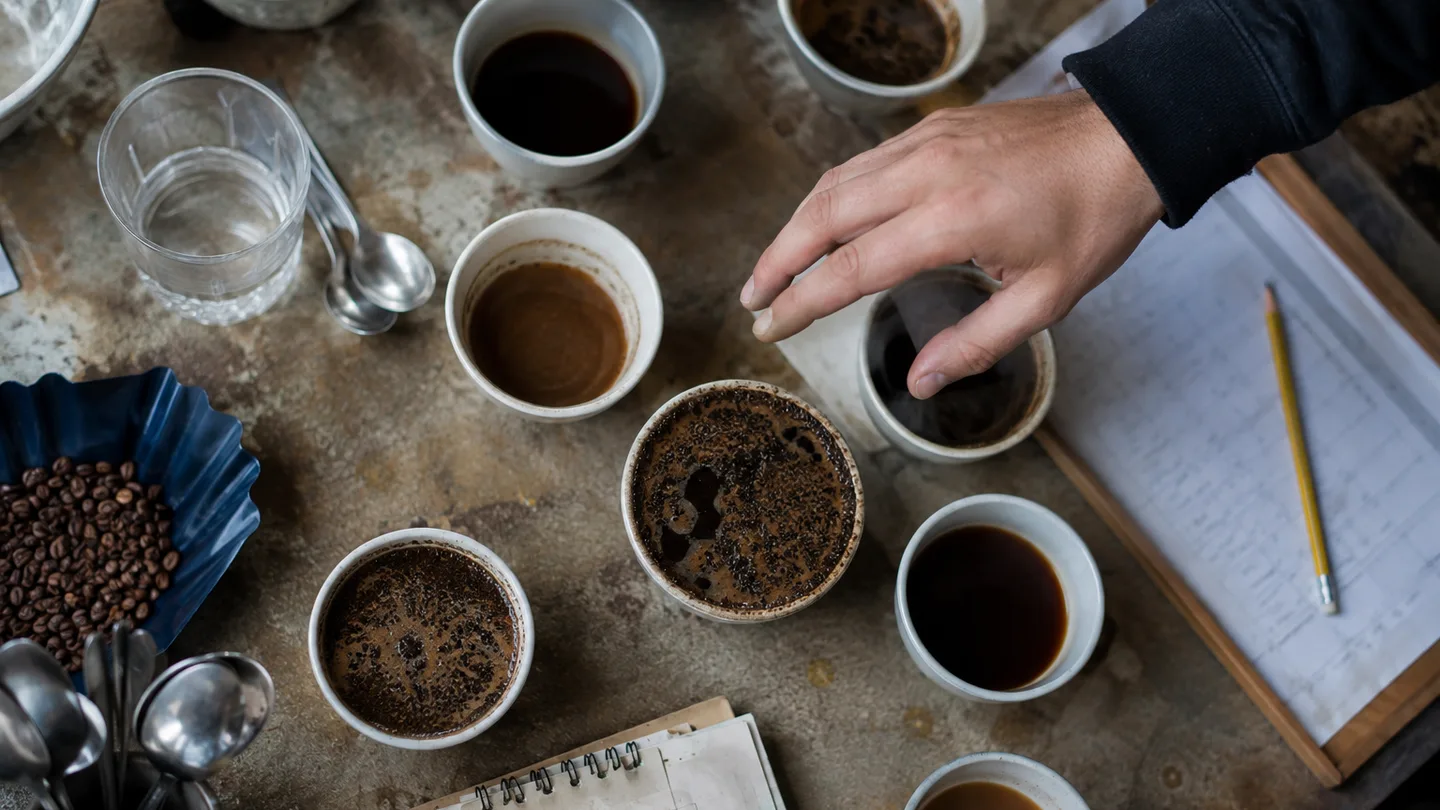
80.00 is the usual specialty cutoff—but it is not a sensory cliff
The 80-point line is useful because it gives you a quick way to sort coffees that have been judged on a structured sensory sheet. It does not mean that every 80-point coffee will taste impressive, or that every coffee below 80 is unpleasant. It means the published total has crossed a commonly used classification boundary.
- 80.00–84.99: generally a sound, clean and recognisable specialty coffee, with some limitations in complexity or persistence.
- 85.00–89.99: a stronger showing, often with clearer sweetness, more defined acidity, better balance or a longer finish.
- 90.00 and above: an unusually distinctive cup on the evaluator’s terms, often combining clarity, complexity and a memorable finish.
Those bands are labels applied after tasting, not flavour species. A score of 79.75 does not contain a different kind of coffee from one scored 80.00. A small shift in several category marks, a different roast sample, or a panel’s judgement at a different tasting temperature can move the total across the line.
The traditional single number also compresses two different questions: what did the tasters observe, and how much value did they assign to it? The SCA has described its Coffee Value Assessment, or CVA, in terms that make this split useful: descriptive observations should not be confused with an overall value judgement. For you, that means a note such as bright citrus acidity is information; whether you want to drink that acidity every morning is a separate decision.
From 79 to 83: where the 100-point total actually comes from
A cupping score is not a mysterious grade attached to the beans. It is a compressed record of several judgements. To read it properly, look for the attributes underneath the total rather than treating the final number as a direct measurement like weight or temperature.
A familiar traditional form presents a recurring group of sensory areas. The exact names and layout vary, but you may see:
- Fragrance and aroma: the smell of the dry grounds and the brewed coffee.
- Flavor: the main taste character and how clearly it comes through.
- Aftertaste: what remains after swallowing or spitting.
- Acidity: the quality and structure of brightness, not simply whether the coffee tastes sour.
- Body: the tactile weight and texture of the liquid.
- Balance: how the parts fit together rather than one feature dominating.
- Uniformity: whether the cups from one sample behave consistently.
- Clean cup: whether the coffee is free from distracting taints or faults.
- Sweetness: the presence and persistence of sugar-like flavour.
- Overall: the evaluator’s holistic judgement of the cup.
On forms that use them, uniformity, clean cup and sweetness can be checked across multiple cups from the same sample. That matters because one cup with a foreign taint or a noticeably different character can change the judgement of the lot. Defect deductions may also be recorded separately, so the final total is not simply the average of the most attractive flavours.
A full coffee cupping guide is helpful if you want to see how the observations are recorded, but do not assume that every roaster uses the same form or weighting.
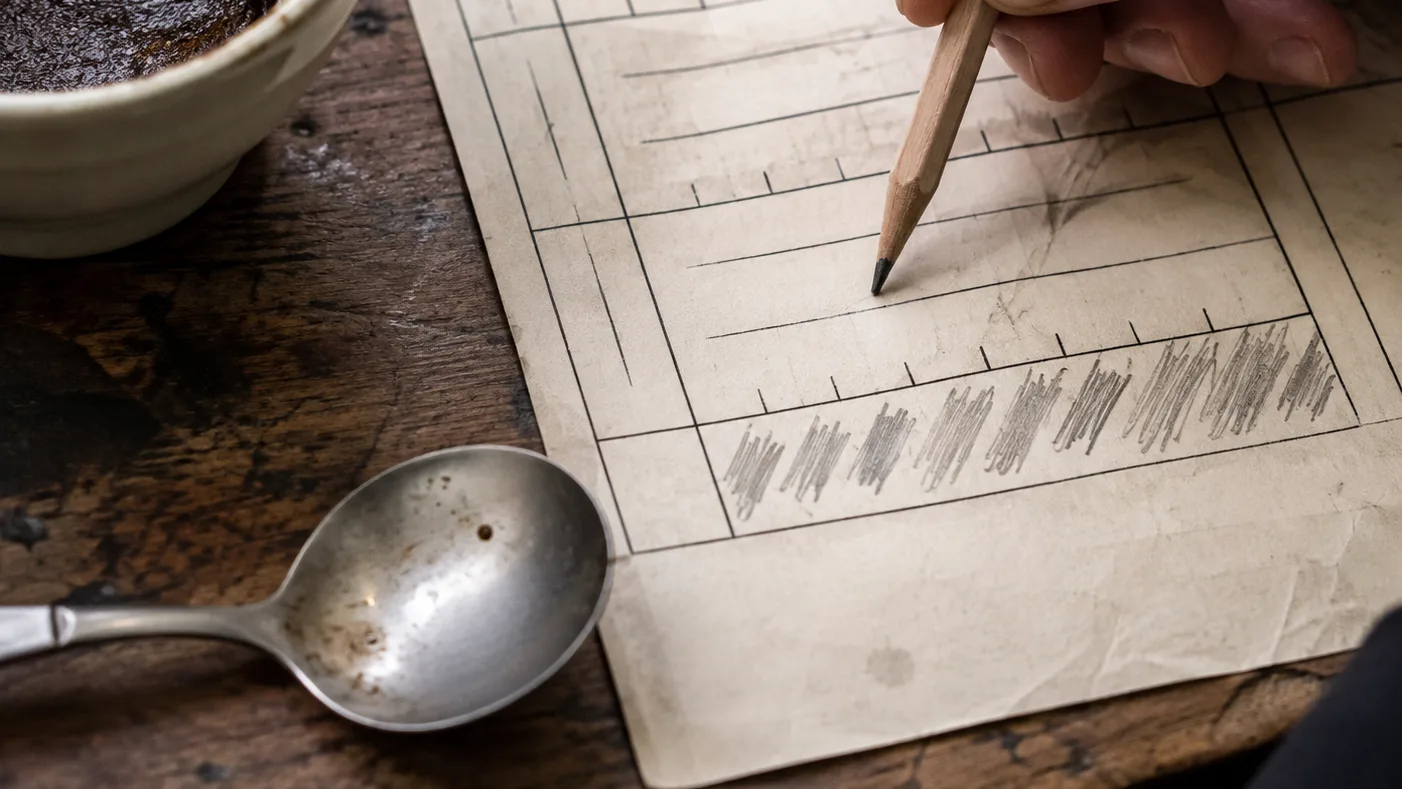
Imagine a hypothetical sheet whose descriptive marks add to 79.75. An illustrative 0.50 credit for consistent, clean cups brings the reported total to 80.25, provided no defect is deducted. If the panel lowers the flavor mark by 0.25 and the balance mark by another 0.25, that same illustrative total falls back to 79.75.
| Illustrative scoring move | Effect on total | What it shows |
|---|---|---|
| Descriptive marks combined | 79.75 | The cup is close to the classification line |
| Consistency and cleanliness credit | +0.50 | Repeated cups support the sample |
| Recorded defect deduction | 0.00 | No deduction is applied in this example |
| Reported result | 80.25 | The label changes even though the cup has not transformed |
This is an illustration of boundary sensitivity, not a universal calculation formula. Score-sheet versions differ, and the increments used by one evaluator may not match another. If a roaster does not publish its form, you can interpret the number but should not pretend you can reconstruct every point.
What 80, 85, and 90 usually signal in the cup
An 80-point coffee should give you a reasonable expectation of a cup that is sound enough to discuss in terms of origin, processing and flavour character. Look for cleanliness, some sweetness and a recognisable profile. Do not automatically expect a highly layered finish or a dramatic change from sip to sip.
At 85 or above, the useful expectation is not simply that the coffee will taste stronger. It may show more defined acidity, better integration between sweetness and body, a longer aftertaste, or a more unusual set of flavours. A washed coffee with floral notes may score well for clarity and separation; a natural coffee may be judged highly for fruit intensity and structure. Those qualities are not interchangeable, and the score does not tell you which one you will prefer.
A 90-plus score is a signal to look closely at the tasting notes, producer information and roast approach. It suggests that the coffee made a particularly strong impression under the evaluation conditions. It does not guarantee that the cup will survive a poor brew recipe, an unsuitable roast, or several months of oxygen exposure.
This is where score and enjoyment part company. A drinker who wants cocoa, toasted nuts and a heavy body may choose an 82-point coffee over a 90-point coffee with jasmine, citrus and a tea-like texture. The higher score can reflect nuance that the first drinker simply does not want in a daily cup.
A cupping score is a map of judged quality, not a GPS coordinate for your enjoyment.
Roast and brewing create another layer of separation. Grind too coarse and the brew may leave soluble material behind, producing a sharp, thin cup. Grind too fine, or agitate a fragile bed too aggressively, and fines can extract quickly while slowing the rest of the brew, giving you bitterness or astringency beside underdeveloped flavours. A published score belongs to the sample as evaluated; your cup also belongs to the extraction you created.
A score is comparable only when the cupping conditions match
An 82 from one roaster and an 86 from another look like comparable numbers because both fit the 100-point format. They may not represent the same test. A traditional-style cupping tries to control the coffee-to-water ratio, grind, water heat, vessel, tasting sequence and the number of cups used for checking consistency. Those are conventions for reducing variation, not natural laws that every form follows identically.
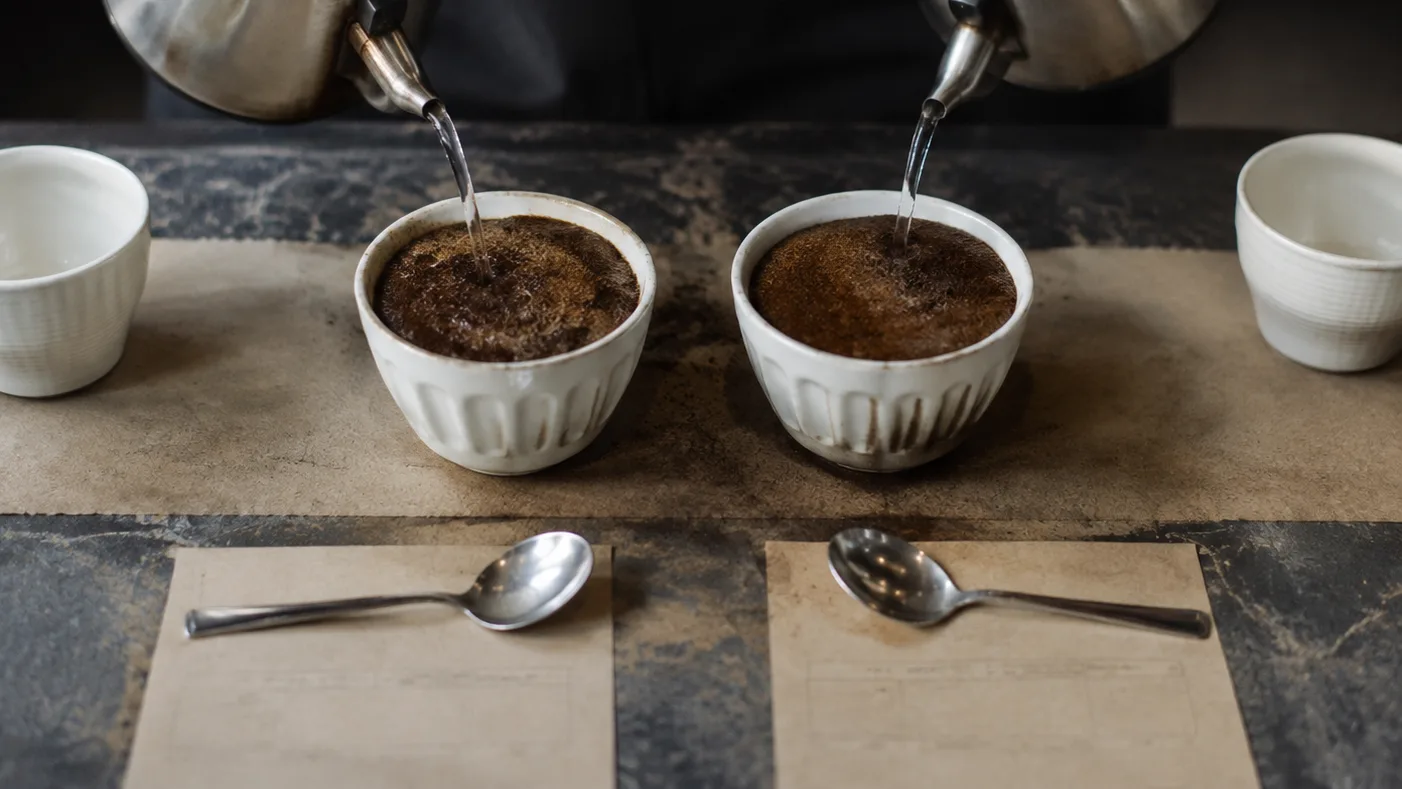
Use this checklist before comparing two published scores.
- Same scoring framework: Are both totals built from a similar sheet, or is one a roaster’s internal quality mark?
- Same roast purpose: Were both samples roasted for evaluation, or was one roasted as a finished brew product?
- Similar sample condition: Were the coffees at a similar stage after roasting, and were they stored in a way that protected aroma?
- Matched preparation: Did the evaluator use comparable grind, water, temperature and steeping time?
- Comparable panel: Was the result produced by one taster, a calibrated group or an unnamed internal panel?
- Same treatment of faults: Were taints, inconsistent cups and processing defects recorded in the same way?
Roast development changes how easily coffee compounds dissolve, so two samples can show different acidity, body and bitterness even when they come from similar green coffee. Coffee also releases carbon dioxide after roasting. Too much remaining gas can interfere with wetting and alter the aroma you perceive, while older coffee may have lost some volatile character. The score becomes harder to compare if the samples are at very different stages.
Water is part of the test, too. Its mineral content and buffering capacity affect extraction and can change how acidity and sweetness feel. Cooling changes the cup again: aromas may become easier to separate, while astringency or sharp acidity may become more obvious. A panel that tastes at one temperature is not judging exactly the same sensory experience as a buyer tasting a hot drink at home.
The Specialty Coffee Association’s Coffee Value Assessment is worth checking when a seller explains how it separates descriptive information from a broader value judgement. If a listing mentions the Coffee Quality Institute’s Q Grader program, treat that as context about evaluator training or calibration, not as proof that the score predicts your palate. Calibration can give tasters a shared vocabulary; it cannot make every drinker like the same acidity or fermentation character.
If the preparation details are missing, compare an 82 and an 86 directionally only. The gap may still tell you that one evaluator found the second sample more distinctive, but it does not prove a universal four-point difference in the coffees themselves.
Use the number as a filter, then let your own tasting decide
You can test the score without recreating a professional lab. The goal is not to award an official number. It is to separate the published judgement from your reaction and to make sure a bad grind or uneven pour does not decide the result for you.
- Choose three coffees. Include their published scores, but cover the labels with tape and mark the cups A, B and C. Three samples are enough to expose a pattern without turning the counter into a judging room.
- Fix one recipe. A 1:15 ratio is a workable home comparison: for example, 15 grams of coffee to 225 grams of water. Use the coffee to water ratio calculator if you want to scale that recipe, then keep the same ratio for every sample.
- Control the grind. Use one grind setting across the samples. The point is to compare the coffees, not to optimise each one before you have tasted it. A coffee grind size chart can help you choose a repeatable starting range.
- Control the brew. Use the same water, temperature, vessels and pour pattern. Start one timer for each cup. For a home test, inspect the crust at roughly four minutes, then taste around eight to ten minutes and again as the cups cool.
- Write before you look. Note aroma, sweetness, acidity, body, finish and any distracting taint. Give each coffee a personal enjoyment mark on your own scale, but keep that mark separate from the published cupping score.
Here is a concrete hypothetical result. Coffee A is published at 81 and tastes like cocoa with low acidity. Coffee B is published at 87 and gives you jasmine, citrus and a lighter body. Coffee C is published at 90 and has intense fruit with a wine-like fermented edge. If your blind notes rank A first, B second and C last, the score has not failed; it has told you what the evaluator rewarded, while your notes have told you what you want to brew.
The practical decision rule is simple. Use 80+ as a filter for coffees likely to have a coherent, judged quality baseline. Treat 85+ as a reason to investigate the tasting notes and preparation history, not as an instruction to buy. Treat 90+ as an interesting claim to verify with your own palate, especially if the coffee costs more or uses a flavour profile you rarely enjoy.
If all three cups taste thin, fix extraction before judging the score. Move one control at a time, usually grind size first: a slightly finer grind increases contact area and can add sweetness and body when the cup is under-extracted. If the cup becomes drying or bitter, reverse that change rather than blaming the coffee.
Record both numbers in your notes: the published score and your personal score. After several comparisons, you will have a buying filter built from your palate instead of borrowing someone else’s ranking. That is the point at which 80+ becomes useful: not as a promise, but as the first question in a better tasting conversation.