Cold Brew Coffee Ratio: 1:8 or 1:5 for Your Batch?
For a 100 g dose, 1:8 uses 800 g of water and 1:5 uses 500 g. Choose 1:8 if the filtered cold brew will go into the glass mostly as it is; choose 1:5 if water, a lot of ice, or milk will finish the drink.
These are coffee-to-water ratios by mass: 1 gram of coffee to 8 grams of water, or 1 gram to 5 grams. The useful answer is not that one ratio is universally better. They are starting points for different serving endpoints.
A recipe can call 1:5 a concentrate while another calls 1:8 ready-to-drink cold brew because the recipes may expect different dilution after filtering. Decide what will happen in the glass before you decide what happens in the jar.
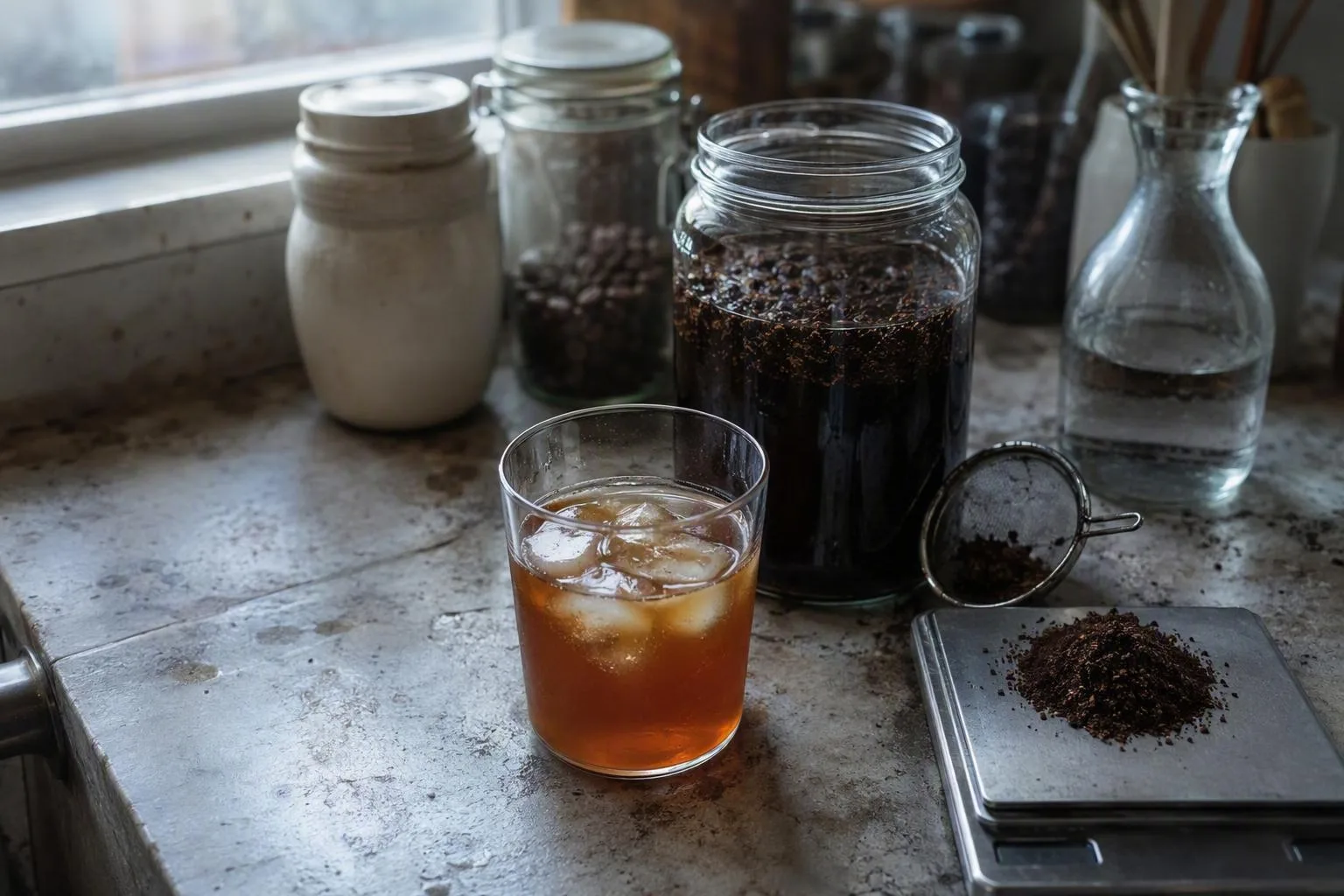
1:8 for ready-to-drink, 1:5 for concentrate: the useful answer
Use 1:8 when you want a batch that needs little added water. It gives you more brewing water for each gram of coffee, so the finished liquid is easier to pour over a small amount of ice or drink from the refrigerator without another calculation.
Use 1:5 when flexibility matters more than immediate convenience. The smaller water load makes a more concentrated base that can meet melting ice, still water, or milk without losing as much coffee presence.
That does not make 1:5 a stronger extraction in the technical sense. It makes the brew more concentrated by input design. A concentrate can still taste sour if the grind is too coarse or the steep is too short, and a ready-to-drink batch can still taste bitter if the grind is too fine or the steep runs too long.
My practical rule is simple: 1:8 wins for a batch served mostly as brewed, while 1:5 wins for a batch whose final strength will be adjusted in the glass. Treat the ratio as a serving decision, not a quality score.
The scale decides the batch: 100 g of coffee means 500 g or 800 g of water
The calculation is coffee dose multiplied by the water number in the ratio. For 1:5, water mass = coffee mass × 5. For 1:8, water mass = coffee mass × 8.
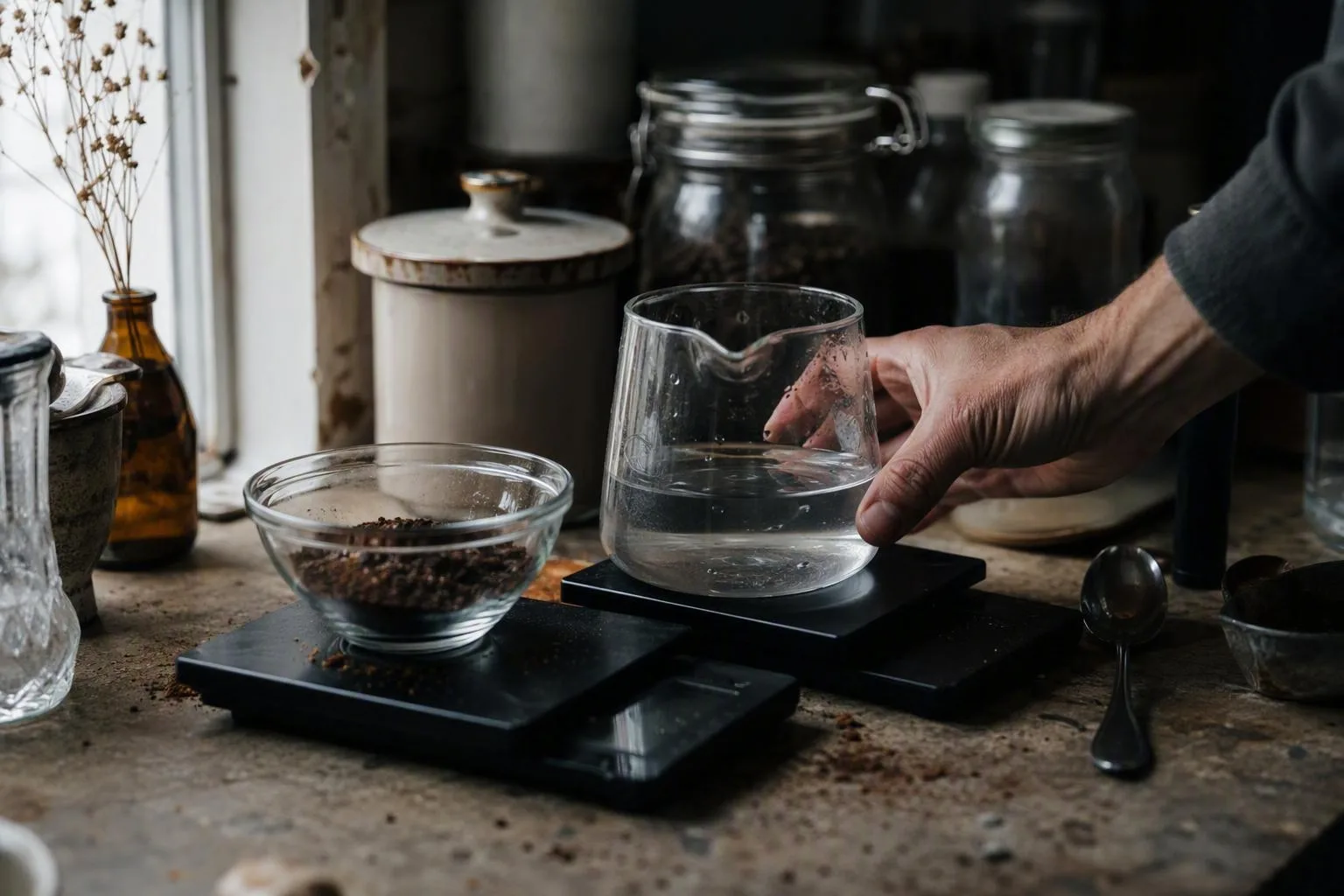
With 100 g of coffee, that gives 500 g of water at 1:5 and 800 g at 1:8. With 60 g of coffee, the same recipes become 300 g and 480 g of water. The arithmetic scales cleanly even when your jar does not.
Measuring cups and spoons introduce a second variable: how much ground coffee fits into that volume. Grind size, roast development, and the amount of air between particles change the mass in a scoop. Weighing the coffee removes that uncertainty, and weighing water lets you repeat the recipe without guessing where a liquid measure sits.
Input water is not the same as finished filtered yield. Wet grounds hold some of the brewing water, and the amount left behind changes with grind, agitation, steeping, and filtration. If a 100 g dose starts with 500 g of water, do not assume the jar will contain 500 g after filtering.
Weigh the filtered liquid before you dilute it. That number tells you how much concentrate you actually have, which is more useful than estimating from the volume of a slurry. For another batch size, the coffee to water ratio calculator can do the multiplication, but you still need to measure the filtered output yourself.
More coffee per gram of water changes strength, not automatically extraction
Strength and extraction describe different things. TDS means total dissolved solids, the amount of dissolved coffee material in the drink. Extraction yield means the share of the dry coffee dose that dissolved into the water, expressed conceptually as dissolved coffee mass divided by starting coffee mass.
A 1:5 recipe normally produces a more concentrated liquid than a 1:8 recipe when the coffee dose and brewing conditions are otherwise comparable. There is less water carrying the dissolved material, so the drink tends to have more intensity per sip. That is a concentration result, not proof that more of the coffee has dissolved.
Extraction depends on several other controls: grind size, contact time, water temperature, water chemistry, and agitation. Changing the ratio can influence extraction because the amount of water available relative to the grounds changes, but it cannot compensate neatly for a grind that is too coarse or a steep that is too short.
Picture two 50 g brews steeped for 16 hours with the same water and grinder. The 1:5 version may taste dense and forceful yet hollow if the coarse particles have not released enough soluble material. The 1:8 version may taste softer but still sour if its grind is equally coarse. Conversely, a fine grind and a long steep can push either batch toward bitterness or dryness.
High concentration also magnifies whatever extraction profile you created. A harsh 1:5 batch can seem especially bitter or astringent because the extracted compounds arrive in a denser drink; that harshness is not, by itself, evidence of a higher extraction yield. If you want formal vocabulary for strength and extraction, Specialty Coffee Association brewing terminology is a useful reference point, but the kitchen-scale distinction is enough to choose your next adjustment.
Ice, milk, or a clean glass: choose the endpoint before the ratio
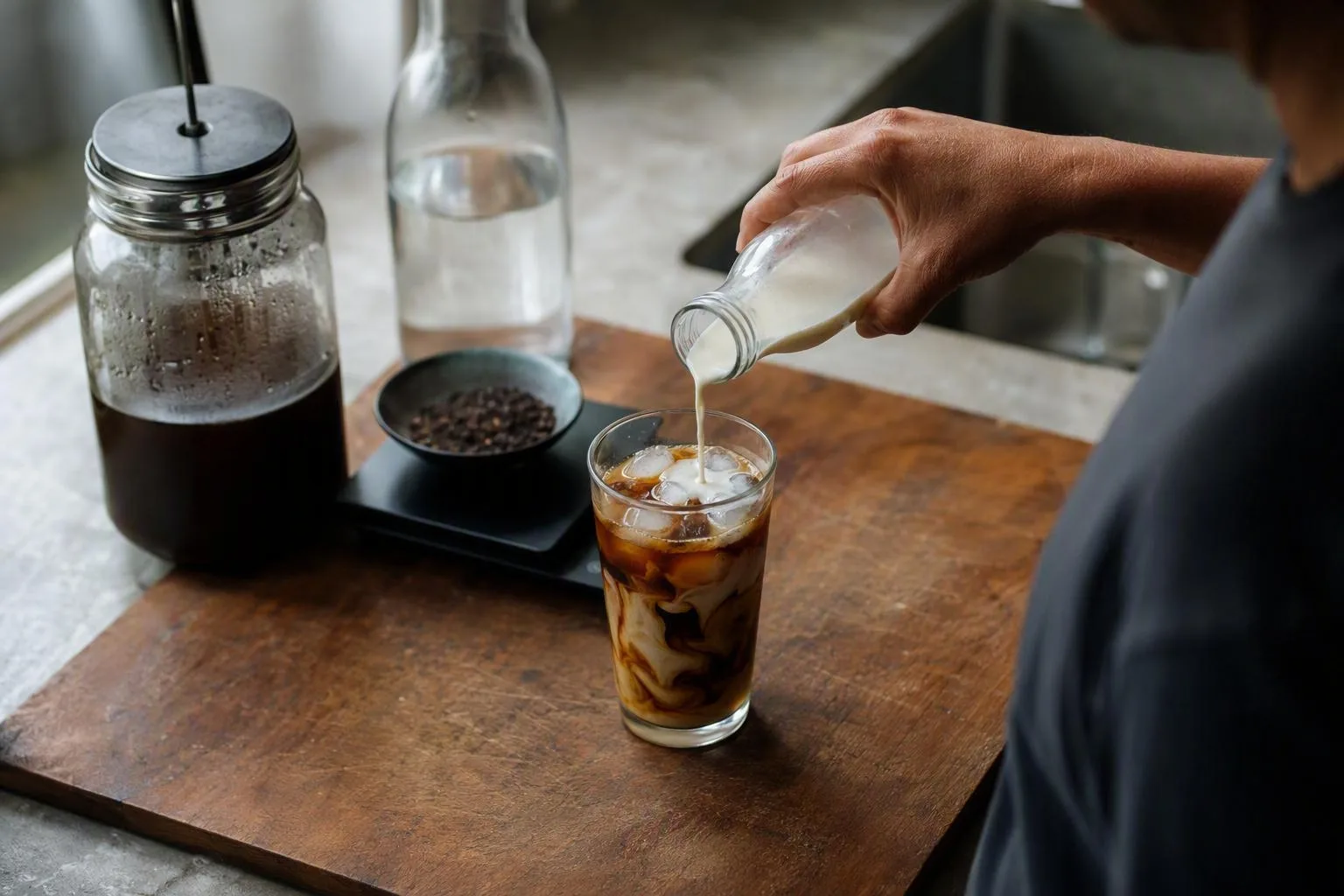
The ratio becomes a serving decision once you account for what enters the glass after filtration. Ice melts into water, milk adds liquid and changes mouthfeel, and a separate water dilution reduces coffee concentration. Those additions are part of the recipe even if they never touch the grounds.
| Serving plan | Starting ratio | Why it fits | First thing to check |
|---|---|---|---|
| Drink mostly as filtered | 1:8 | Less post-brew arithmetic and a softer starting concentration | Use less ice if the glass tastes thin |
| Pour over substantial ice | 1:5 | Melting ice can dilute the drink without erasing its coffee character | Weigh the finished liquid and watch how much ice melts |
| Mix with milk | 1:5 | The concentrate keeps the coffee present after milk is added | Adjust milk mass before changing the brew ratio |
| Keep dilution adjustable | 1:5 | You can serve a small concentrate or lengthen it with water | Record the amount of water added to each glass |
Here is the useful dilution arithmetic. A 100 g coffee batch at 1:5 begins with 500 g of brewing water. Adding roughly 300 g of water brings the original input total to 800 g, the same water-to-coffee arithmetic as 1:8.
That is an approximation for the served drink, not a command to pour 300 g into every jar. Some water remains in the grounds, and ice may add water gradually. If the filtered 1:5 liquid weighs 400 g, adding 300 g gives a different finished mass than adding 300 g to a batch that filtered to 450 g.
A 1:1 dilution of the original 1:5 input is also worth checking. Doubling its 500 g of brew water to 1,000 g gives a 1:10 input ratio, not 1:8. The practical winner stays clear: choose 1:8 for simple ready-to-drink service and 1:5 when the serving strength needs to stay adjustable.
Do not fix a bad ratio until 12–24 hours, grind, and filtration are under control
Before changing the ratio, run one controlled baseline. A useful starting window is roughly 12–18 hours at room temperature or 18–24 hours in a refrigerator. These are working ranges, not laws: choose one temperature, keep it stable, and change one variable at a time.
Start with a coarse or medium-coarse grind, adjusted for your grinder rather than copied from a photograph. Finer particles expose more surface area, so they release soluble material faster. They also create more loose sediment and can clog a filter, which is why a fine setting may taste intense while leaving a muddy finish.
Wet all the grounds before the full steep. You can borrow the logic of a coffee bloom by adding enough water to remove dry pockets, waiting a few minutes, and then topping up. With cold water, the useful part is even wetting rather than chasing the dramatic gas release seen in a hot pour-over. One gentle stir is usually a better starting point than repeated shaking, which can dislodge fines and make filtration harder.
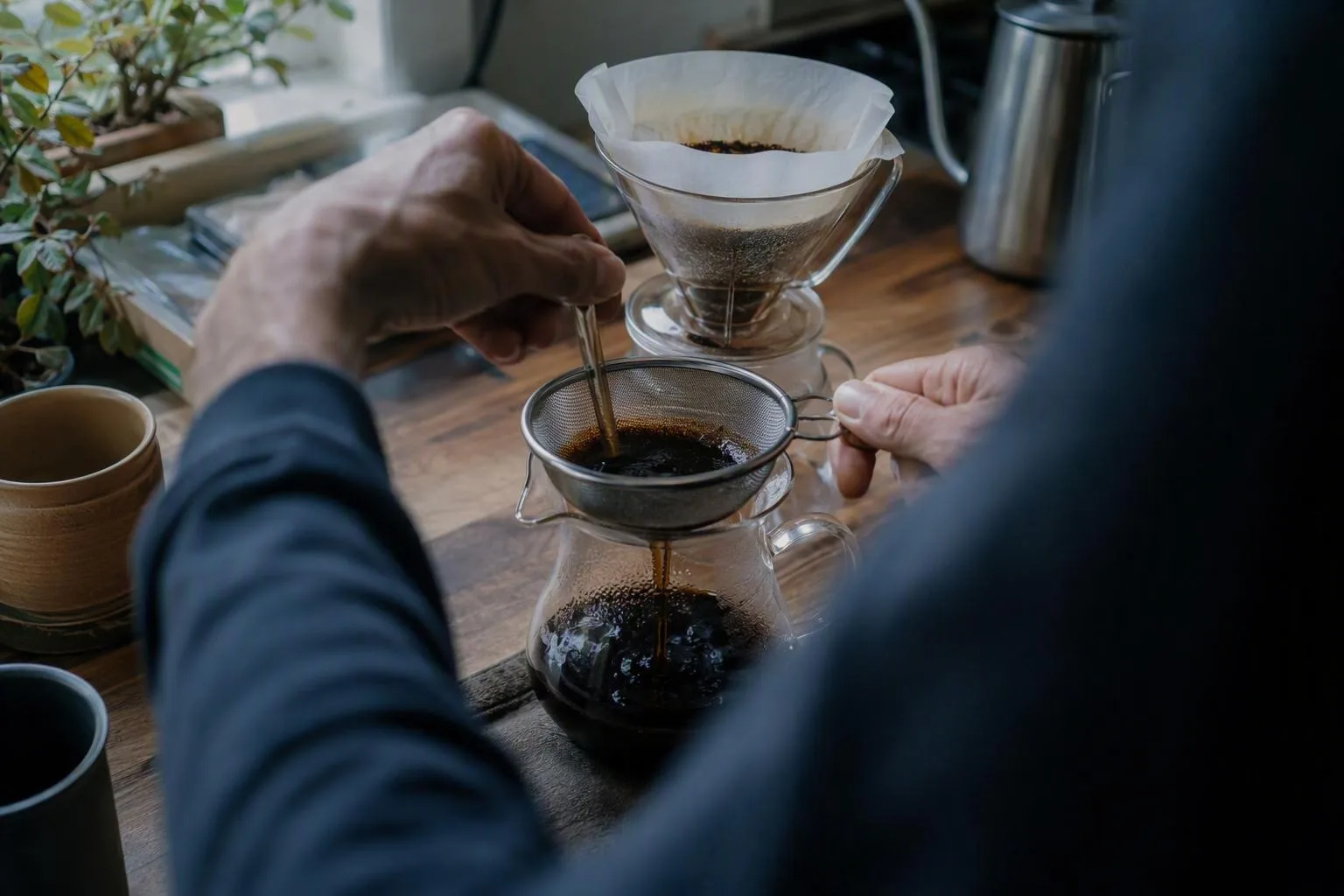
Filter through mesh if that is your normal setup, then let the liquid settle. If the texture is still gritty or dusty, run the settled brew through a paper filter afterward. Paper filtration removes more fine particles than mesh, although it can slow the process and change the amount of liquid you recover.
| What you taste or feel | Likely mechanism | Make one first change |
|---|---|---|
| Thin but clean | Excess dilution, melted ice, or a low-strength serving | Use less ice or add less serving water before changing the brew |
| Sour or hollow | Under-extraction from coarse particles or insufficient contact | Extend the steep by 2–4 hours; try slightly finer next time if timing is already long |
| Bitter, dry, or astringent | Over-extraction or an excess of fine particles | Shorten the steep by 2–4 hours; try coarser next time if fines are obvious |
| Muddy or silty | Fines passing through mesh or migrating into the liquid | Let it settle and add a paper-filter step after mesh filtration |
Ratio belongs later in this diagnosis. If both 1:5 and 1:8 taste sour, bitter, or hollow, changing the ratio can hide the problem without solving it. Keep the ratio tied to the serving plan, then correct extraction with time, grind, agitation, or filtration.
A 50 g split-batch test tells you which ratio belongs on your counter
When the recipes still seem interchangeable, split one coffee into two small batches. This isolates the ratio while keeping the beans, water, grinder, temperature, wetting routine, and filter method the same.
- Put 50 g of the same ground coffee into each of two identical containers.
- Add 400 g of water to one container for 1:8 and 250 g to the other for 1:5.
- Wet both batches in the same way, use the same 16-hour steep, and keep them at the same temperature.
- Filter both with the same equipment, then record the finished liquid mass from each container.
- Taste the 1:8 batch as served, the 1:5 batch undiluted, and the 1:5 batch after adding about 150 g of water to the filtered liquid.
The extra 150 g is a rough 1:8-equivalent comparison by input arithmetic: 250 g plus 150 g equals 400 g for the original 50 g dose. Because the grounds retain water, the two served drinks may not have identical concentration, so judge the cups rather than treating the calculation as laboratory precision.
Keep 1:8 if it tastes balanced without dilution. Keep 1:5 if its diluted, iced, or milk-based version gives you the better drink. If both versions share the same sour, bitter, or hollow fault, change grind or steep time instead of asking the ratio to repair extraction.
That is the test worth saving: ratio controls the serving path; grind and time control whether the coffee was extracted well enough to take that path.
Does 1:5 cold brew always have more caffeine than 1:8?
No, not automatically per serving. At the same water mass, a 1:5 recipe uses more coffee than a 1:8 recipe, but the amount in the glass also depends on the starting dose, extraction, filtered yield, serving size, and dilution. The ratio label alone cannot answer the question.
Can you scale a 1:5 or 1:8 recipe to a larger batch?
Yes. Multiply both coffee and water by the same factor: 50 g of coffee with 250 g of water at 1:5 becomes 200 g with 1,000 g of water. The arithmetic scales exactly, but a deeper slurry or more difficult filtration can change extraction slightly, so recheck the steep and finished yield.
How should you store cold brew after filtering?
Keep the filtered coffee covered and refrigerated as part of a consistent home routine, and store concentrate separately from water or milk if you want control over later dilution. Flavour changes with time, container, and handling, so avoid treating one universal shelf-life number as valid for every batch. For questions beyond flavour, check current refrigerated-storage guidance for prepared beverages.
Frequently Asked Questions
Does 1:5 cold brew always have more caffeine than 1:8?
Not automatically per serving. At the same water mass, 1:5 uses more coffee, but the final amount depends on dose, extraction, filtered yield, serving size, and how much the concentrate is diluted.
Can I scale a 1:5 or 1:8 cold brew recipe to a larger batch?
Yes: multiply both coffee and water by the same factor, such as changing 50 g coffee and 250 g water at 1:5 to 200 g and 1,000 g. Larger slurry depth and filtration can change extraction slightly, so recheck steep time and finished yield.
How should I store cold brew after filtering?
Keep it covered and refrigerated, and store concentrate separately from water or milk if you want control over later dilution. Flavor quality changes with time, so avoid treating one universal shelf-life number as valid for every recipe, container, and handling routine.