French Press Coffee Ratio: 1:15 or 1:17? Taste the Difference
Thirty grams of coffee at a 1:15 French press coffee ratio takes 450 g of water; the same dose at 1:17 takes 510 g. That 60 g difference is enough to make one cup feel broad and heavy and the other lighter, even if both brews use the same grind, 93°C water, four-minute steep, and stirring pattern.
That is the useful answer to the 1:15-versus-1:17 question: you are changing the amount of water carrying the coffee into your cup. The trick is knowing whether the cup is merely too concentrated or whether the brewing process has extracted the wrong material.
The 1:15-to-1:17 math: 60 g more water changes strength before it changes extraction
A brew ratio compares dry coffee mass with brewing-water mass. Written as 1:15, it means one part coffee to fifteen parts water; 1:17 means one part coffee to seventeen parts water. For 30 g of coffee, the arithmetic is 30 × 15 = 450 g and 30 × 17 = 510 g.
That extra 60 g is 13.3% more water than the 1:15 brew, not 17% more. This is a useful correction because the numbers look farther apart than they taste: the ratio moves by two points, but the water load rises by only about one-eighth.
TDS, or total dissolved solids, is a measure of the coffee material dissolved in the finished drink. You do not need a refractometer to use the idea. More dissolved material per sip usually reads as more intense; less dissolved material per sip usually reads as lighter.
Extraction is a different question. It describes how much of the soluble material has left the coffee grounds and entered the water. If the grind, temperature, agitation, and steep time stay similar, the 1:17 brew can taste less concentrated without automatically being less extracted. The extra water spreads the dissolved material through a larger drink, while the extraction process may remain broadly similar or shift only slightly.
That distinction is the reason ratio is a poor cure for every unpleasant cup. A 1:15 brew can be strong and hollow if the grind is too coarse or the contact time too short. A 1:17 brew can be light but bitter if the coffee is too fine, too hot, or stirred too aggressively.
For one litre of brewing water, the same calculation gives about 66.7 g of coffee at 1:15 and 58.8 g at 1:17. Round those to roughly 67 g and 59 g, then check that your press has room for the coffee, water, and expansion without forcing the plunger.
The vocabulary here is deliberately practical. If you want the formal terms in one place, the Specialty Coffee Association terminology glossary is a vocabulary reference, not a substitute for tasting the two cups. Readers who want a deeper technical trail can also look for technical research on immersion brewing; the controlled kitchen test below is enough to make the central comparison meaningful.
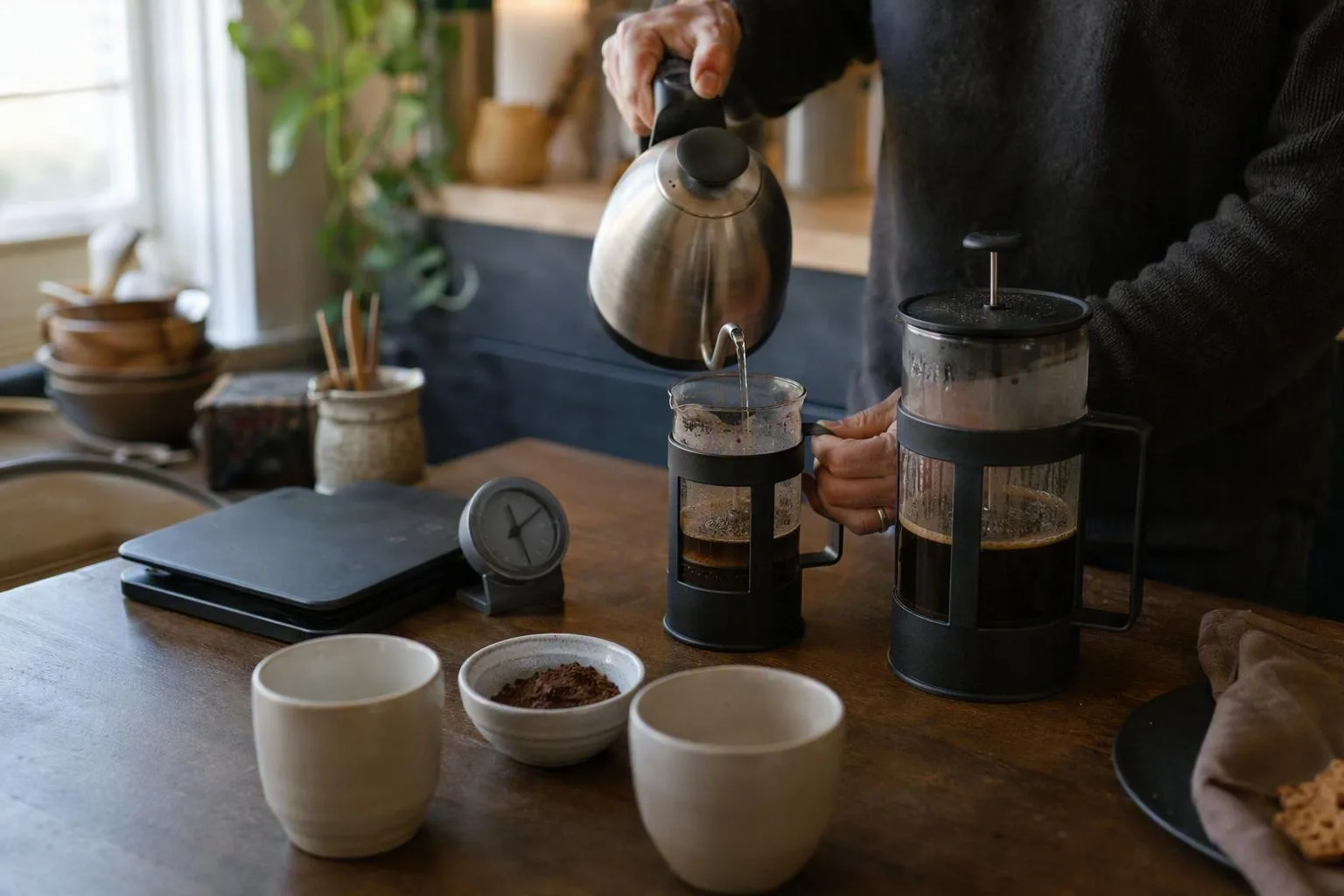
A fair kitchen test starts at 30 g coffee, 450/510 g water, and 93°C
Use two matching presses if you have them. If not, brew one after the other, rinse it thoroughly, and alternate which ratio comes first on a second run. The goal is not laboratory precision; it is to stop a grind or timing change from masquerading as a ratio result.
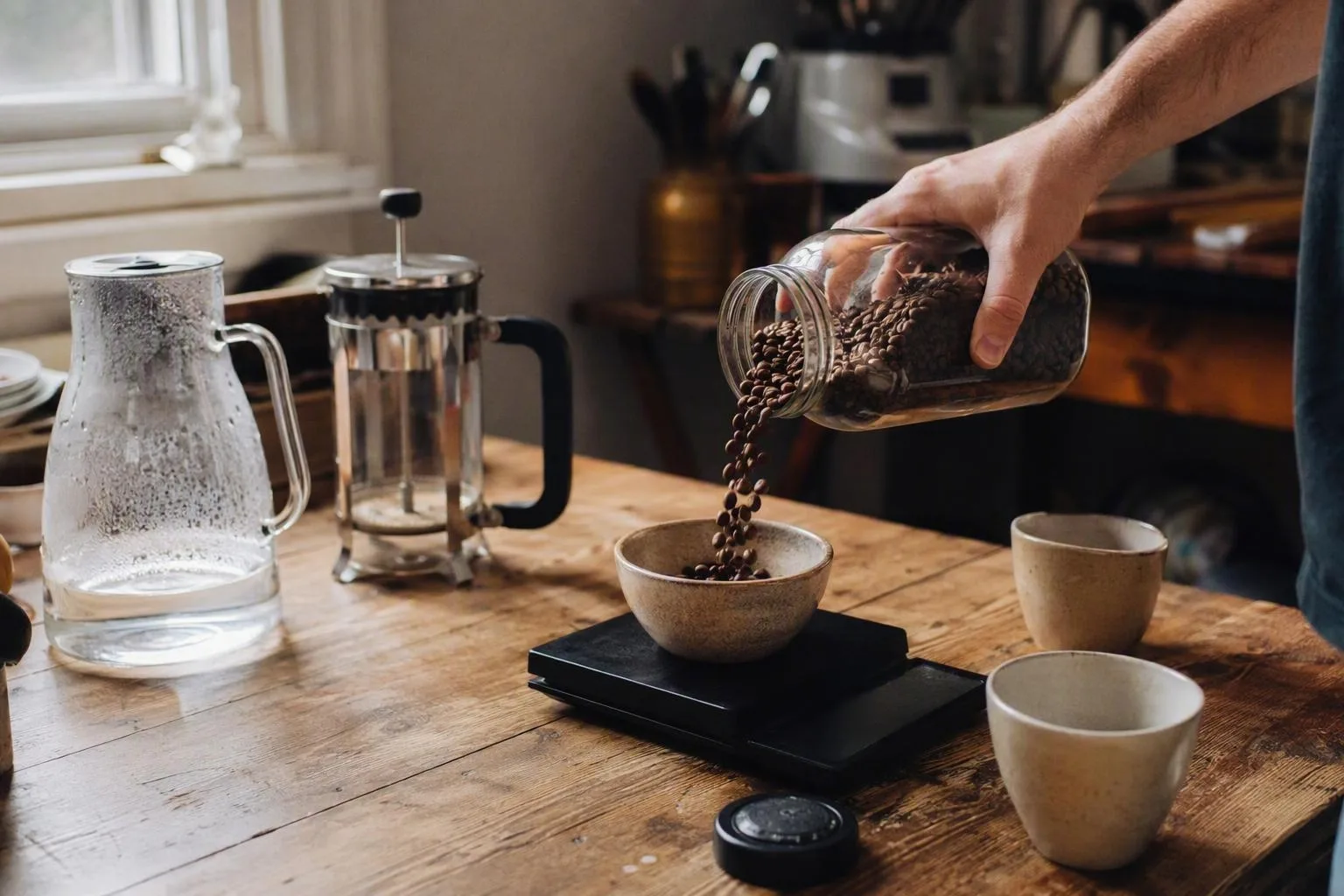
- Use one coffee batch. Weigh 30 g into each press from the same container. Grind both doses together if your grinder allows it, then divide the grounds. A medium-coarse setting is a sensible starting point for this test, but treat that description as a starting position rather than a universal grinder number.
- Measure the water by mass. Heat 450 g for the 1:15 brew and 510 g for the 1:17 brew. Set both to 93°C. A working range of 90-96°C gives you room to adjust later, but fixing the temperature for the comparison matters more than choosing a supposedly perfect number.
- Match the wetting and agitation. Pour all the water, start the timer, and make the same two gentle turns with a spoon in each press. If you use a short wetting pause called a coffee bloom, use the same pause in both brews. For the cleanest first comparison, skip it and keep the procedure simpler.
- Hold contact time at four minutes. At 4:00, press slowly with the same pressure and speed. Decant the coffee into separate vessels rather than leaving it above the grounds. Removing the bulk of the liquid reduces further contact while you taste.
- Compare equal samples. Pour about 60 g from each brew into identical cups. Let both samples reach a similar drinking temperature before judging them. A hotter cup will seem more aromatic and less obviously bitter, so temperature is a sensory variable as well as a brewing variable.
Water temperature deserves a range rather than false precision. If the 93°C comparison tastes harsh, test the same recipe at 90-92°C. If it tastes sharp and hollow, test a little hotter within the working range before changing several other controls.
Do not change the grind and water volume at the same time. If the 1:17 cup seems thin, moving finer while also moving to 1:15 leaves you unable to tell whether concentration or extraction caused the improvement. The value of this test is its restraint.
A tablespoon can make a rough kitchen measure, but it is not a fixed coffee mass. Roast density, bean shape, and grind size change how much coffee fits into the spoon, so a spoon-based 1:15-versus-1:17 comparison can blur the difference you are trying to taste. Use a scale for the main test; if you cannot, level the same spoon in the same way and treat the result as approximate.
This is also why a repeatable French press coffee routine starts with mass rather than a fill line. The line tells you volume, while the ratio depends on the relationship between two masses.
Taste it as a strength test first, then diagnose extraction
Begin with a simple blind move: ask someone to swap the cups, or taste them without looking at which press used more water. Smell both, take a small sip, and compare the way the coffee arrives before deciding which one is better.
Five sensations, five different clues
- Intensity is how forcefully the coffee flavour arrives. The 1:15 sample has more dissolved material per sip when the brews are otherwise comparable.
- Body is the tactile weight of the drink. A mesh filter permits oils and fine particles into the cup, so concentration and suspended material both affect that heavier impression.
- Acidity is the crisp, tart, or fruit-like part of the flavour. It can seem more obvious in a lighter drink because the darker, heavier notes occupy less space on the palate.
- Bitterness is a taste. It is not the same thing as strength, and increasing concentration does not tell you whether the bitter material was extracted appropriately.
- Astringency is the drying or puckering sensation that makes the mouth feel rough. Fine particles and an overly aggressive extraction can contribute to it, even when the coffee is not simply bitter.
At equal sample volume, the 1:15 cup should usually strike harder, feel fuller, and leave a longer impression. The 1:17 cup should usually feel less dense and may make fruit acidity easier to notice. Those are predictions, not quality scores: a lighter cup is not automatically cleaner, and a heavier cup is not automatically better.
Now separate intensity from extraction. A long, hot, fine brew can make either ratio taste bitter or drying because more soluble material and more fine particles enter the drink. A coarse grind combined with a short steep can leave either ratio sour, hollow, or cereal-like because the water has not reached enough of the soluble material.
One useful test is to dilute a small portion of the stronger sample with a measured splash of hot water. If the flavour becomes balanced while the unpleasant note stays controlled, concentration was probably part of the problem. If the cup remains sour or harsh after dilution, the brewing process needs attention rather than a new ratio.
That small dilution test is not a replacement for a scale or refractometer. It is a quick way to ask whether the problem follows the amount of coffee per sip or remains present after the drink is made weaker.
The formal vocabulary can be useful once you have this distinction in your hands. If you want to follow the terminology into technical reading, search for technical research on immersion brewing and compare how it discusses grind size, contact time, concentration, and extraction rather than looking for a single magic ratio.
A symptom-to-dial map for sour, bitter, thin, and muddy presses
Use the table as a checking order, not as a set of laws. Start with the first matching symptom, make one change, and brew again at the same dose and ratio. Changing three controls together may improve the cup, but it will not teach you which control mattered.
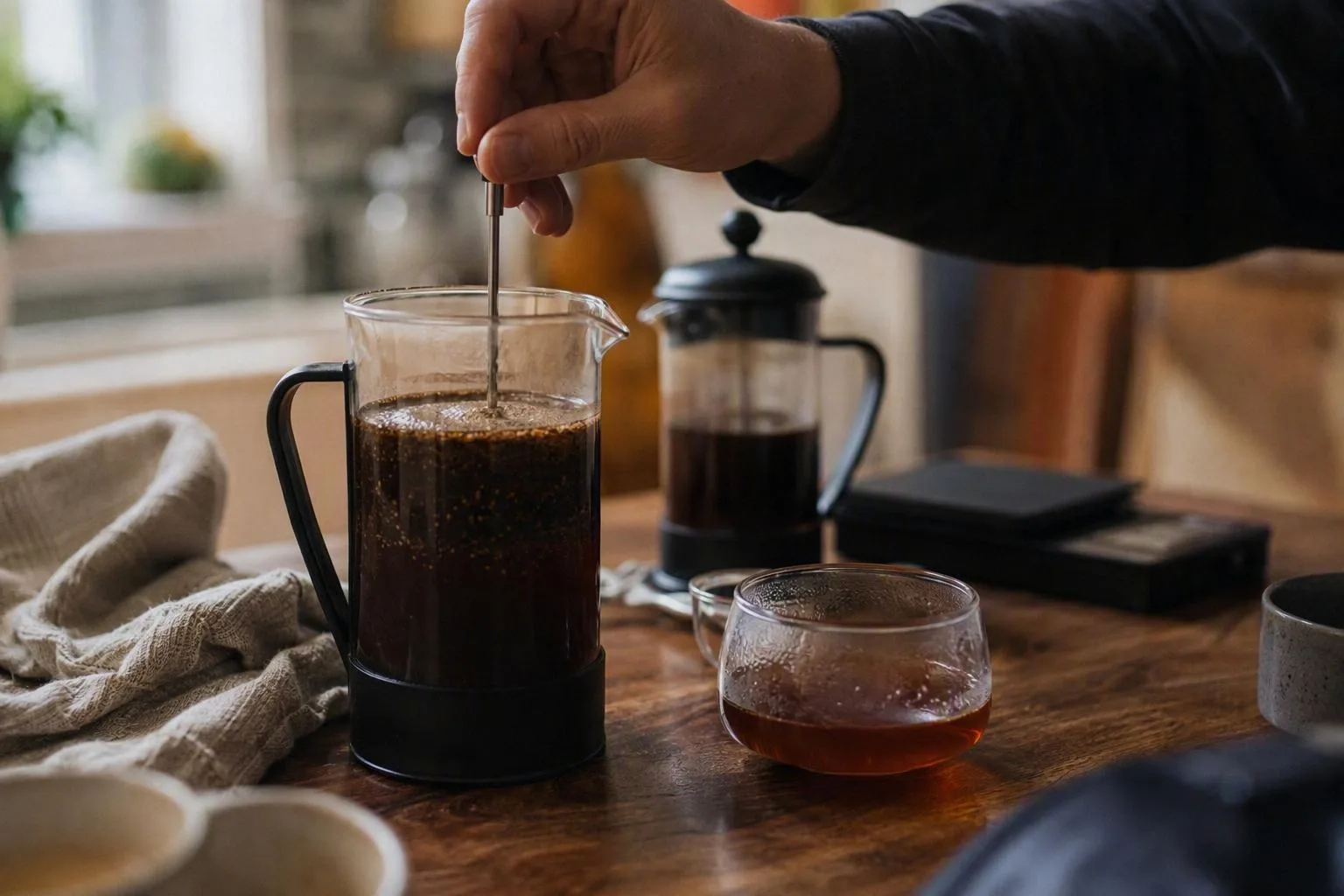
Muddy coffee is a different problem from a weak coffee. Tiny particles, called fines, can break away from the main bed and stay suspended; the French press mesh does not separate them as completely as a paper filter would. Vigorous stirring and a fast plunge keep more of that material moving through the drink.
| What you taste | Check first | Make one change | Why it may help |
|---|---|---|---|
| Thin, but clean and balanced | Concentration | Move from 1:17 toward 1:15 | The same dose is carried in less water, so each sip contains more dissolved material. |
| Thin, sour, or hollow | Under-extraction | Grind a little finer or move from 4:00 to 5:00 | More surface area or more contact time gives water longer access to soluble material. |
| Bitter, dry, or astringent | Excessive extraction, heat, or agitation | Go slightly coarser, shorten to 3:30, or test 90-92°C | Each change reduces one possible route to overdevelopment; test them separately. |
| Muddy, silty, or heavy in a dull way | Fines and turbulence | Stir more gently, plunge slowly, or go modestly coarser | Less movement leaves fewer fine particles suspended in the finished drink. |
Notice the first row. When the coffee is clean and balanced but simply lacks force, ratio is the appropriate dial. When the coffee is thin and sour, do not use more coffee to cover the fault; adjust the grind or time so the water can do more useful work.
For bitterness and dryness, choose only one intervention. A slightly coarser grind is a good first test if the cup feels overdeveloped; a shorter contact time is easier to reverse if your grinder is inconsistent; a lower temperature is useful when the same grind behaves harshly at higher heat.
For muddy coffee, changing from 1:15 to 1:17 may make the cup feel less dense, but it does not remove the suspended fines. Slow the plunge, avoid pressing hard at the bottom, and reduce stirring before you decide that the ratio is wrong.
Decaf can start at the same 1:15, 1:16, or 1:17 ratio as another coffee. Treat the actual cup as the evidence: if it is sharp and hollow, try a modestly finer grind or longer steep; if it is bitter and dry, reverse that direction. The label decaf is not a reason to change the ratio before tasting the brew.
Run the same diagnostic on a fresh coffee and on an older coffee, but do not compare them as though age, roast, and grind behaviour were identical. The point of holding one dial steady is to make the next change legible.
Pick the ratio by the mug: 1:15, 1:17, or the 1:16 midpoint
Scaling is multiplication, not a new recipe. Multiply the dry coffee dose by 15, 16, or 17 to get the water mass, then keep the grind, temperature, agitation, and contact time in the same neighbourhood as your tested brew.
For one litre of brewing water, the useful starting doses are about 67 g at 1:15, 62.5 g at 1:16, and 59 g at 1:17. The press must be large enough to hold the dose and water together, and a large batch may need a slightly longer pour or more careful wetting simply because the bed is deeper.
For a larger batch, multiply the coffee dose rather than guessing from a spoon. These are the corresponding starting masses:
| Coffee dose | 1:15 water | 1:16 water | 1:17 water |
|---|---|---|---|
| 15 g | 225 g | 240 g | 255 g |
| 20 g | 300 g | 320 g | 340 g |
| 30 g | 450 g | 480 g | 510 g |
| 40 g | 600 g | 640 g | 680 g |
Those water figures describe what you add to the press, not what ends up in the serving cup. The grounds retain some water, and the retained amount shifts with dose, grind, and how firmly you plunge, so the final beverage weighs less than the brewing water you measured.
The useful default is 1:16
The clearest starting recommendation is 1:16: 30 g of coffee to 480 g of water. It sits between the two requested extremes, giving you enough intensity to taste the coffee clearly without making the comparison hinge on a very heavy or very light cup.
Choose 1:15 when you want a fuller press, when the coffee will meet milk, or when a balanced 1:17 brew feels too quiet. Milk adds volume and softens the coffee's concentration, so starting with the denser brew gives the flavour more room to survive the addition.
Choose 1:17 when you drink the coffee black and prefer lower intensity, a lighter texture, or more separation between delicate flavours. If that setting tastes thin and sour rather than simply light, keep the ratio and address extraction first.
The coffee to water ratio calculator is useful for unusual doses, a large press, or a recipe that needs to be scaled without mental arithmetic. Enter the dry coffee mass, choose the ratio, and then keep the resulting water mass visible beside the scale while you brew.
Save this rule
Save these starting lines for the next brew:
- Balanced but too intense: add water by moving from 1:15 toward 1:17.
- Balanced but too light: reduce the water by moving from 1:17 toward 1:15.
- Sour or hollow: adjust grind or contact time before changing the ratio.
- Bitter, dry, or muddy: reduce extraction pressure or turbulence, one dial at a time.
Use 1:16 when you have no reason to choose an extreme. Then let the taste tell you whether the next move belongs to the water mass, the grind, the clock, the heat, or your stirring hand.
Frequently Asked Questions
How much coffee do I need for 1 litre of French press water at 1:15 or 1:17?
Use about 67 g of coffee at 1:15 or 59 g at 1:17, calculated from 1,000 g of brewing water; confirm that the brewer can hold the dose and water together.
Can I use the same French press ratio for decaf coffee?
Yes, start with the same 1:15 or 1:17 ratio, then adjust grind size, temperature, or steep time if the particular decaf extracts faster or slower; do not assume a different ratio is automatically required.
Can I measure French press coffee with tablespoons instead of grams?
You can approximate, but spoon volume varies with roast density and grind size, so a scale is necessary for a meaningful 1:15-versus-1:17 comparison.