French Press Coffee: The 1:15 Ratio for a Cleaner Cup
At 1:15, 30 g of coffee meets 450 g of water. That ratio gives you a full French press coffee baseline, but it does not create a clean cup by itself: clarity comes from how the grounds are ground, stirred, plunged, and decanted.
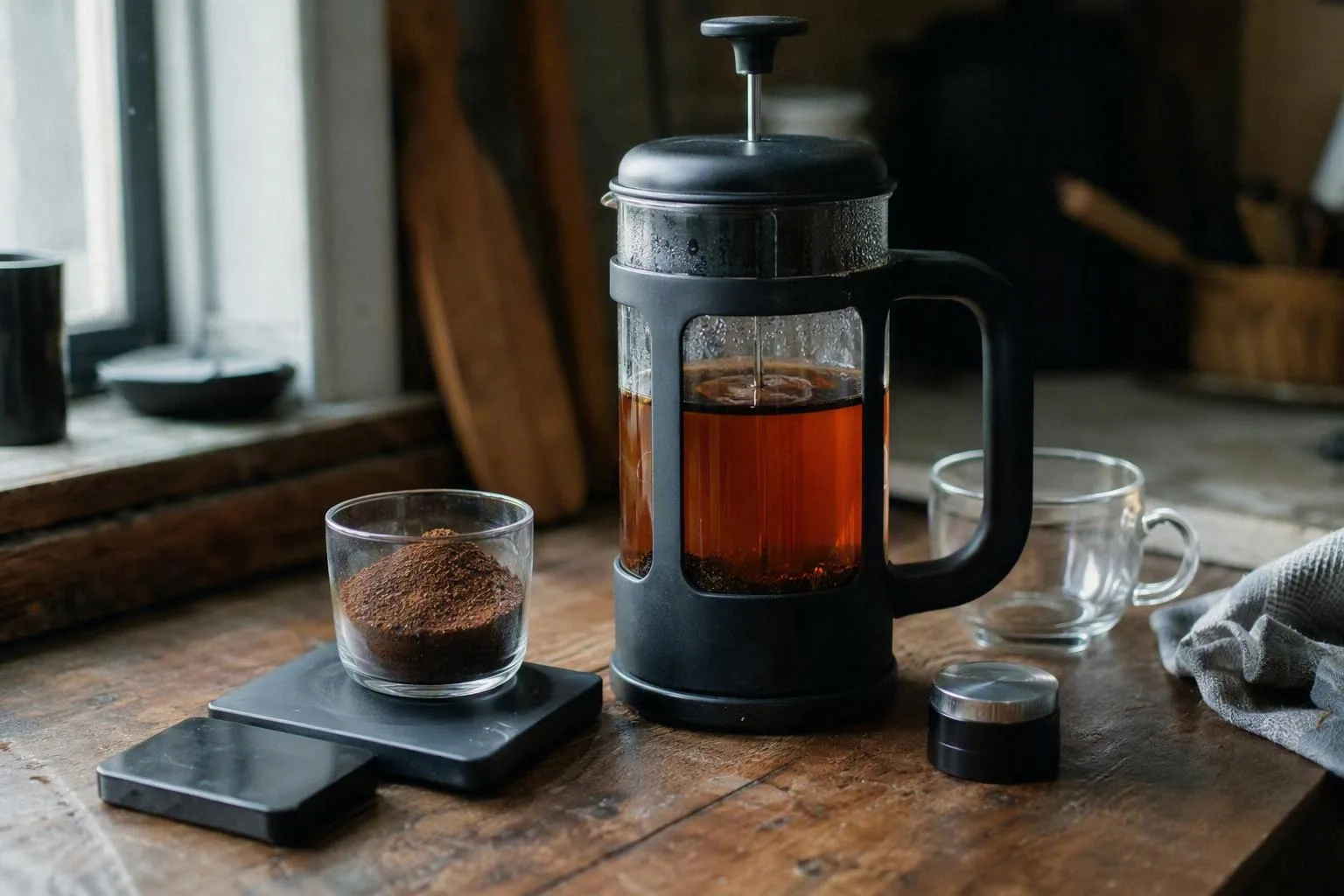
At 1:15, 30 g of coffee meets 450 g of water—but ratio is not clarity
A brew ratio is the mass of coffee compared with the mass of water. In this notation, 1:15 means 1 g of coffee for every 15 g of water, so 30 g of coffee and 450 g of water make a 1:15 brew. Weigh both ingredients; a measuring jug is not accurate enough for a small change in ratio.
Ratio mainly changes strength, meaning how concentrated the finished drink tastes. Extraction is different: it describes how much soluble material the water pulls from the grounds. Sediment is a third issue again. You can brew a strong, well-extracted cup with a gritty texture, or a clean-looking cup that tastes thin because too little coffee was extracted.
That separation is the key to this recipe. Use 1:15 as a substantial starting point, then work on particle size and handling if the cup is cloudy or muddy. The coffee to water ratio calculator is useful when you want to scale the same starting point without doing the multiplication at the counter.
For example, 20 g of coffee at 1:15 needs 300 g of water. The ratio gives you a repeatable amount of water; it does not tell you how gently to stir or whether the metal mesh is carrying a layer of fines into the mug.
Set the three variables before you plunge: 93–96°C water, medium-coarse grounds, and a 4-minute steep
Start with water around 93–96°C. The relevant temperature is the water during contact with the coffee, not merely the number shown by a kettle before you pour. A cold glass press can pull that temperature down quickly, so rinse the press with hot water first and discard the rinse.
Use a medium-coarse grind, but do not interpret coarse as visibly huge chunks. The target is a bed of distinct particles with limited powder and no large proportion of hard boulders. Going finer increases exposed surface area and usually increases extraction, but it also creates more fines, which are the smallest particles most likely to remain suspended or pass through a metal filter.
Roast level changes how this baseline behaves. A lighter roast commonly needs more heat, more contact, or a slightly finer grind to avoid a sharp under-extracted cup. A darker roast often gives up soluble material more readily, so the same four-minute steep can taste heavy or drying if the grind is too fine or the water is too hot.
French press coffee usually does not need a separate pour-over-style bloom. A bloom is a short pre-wet period before the main pour; it matters more in a percolation brew where trapped gas can interrupt water passing through a bed. In an immersion brewer, adding nearly all the water promptly already surrounds the grounds. If very fresh coffee floats or leaves dry pockets, a short pre-wet is useful, but it is an option rather than a mandatory coffee bloom ritual.
For formal background, the useful reading topics are Specialty Coffee Association guidance on brewing variables and peer-reviewed coffee research on grind-size distribution. Use that vocabulary to describe the problem, then let a controlled brew decide which adjustment suits your beans and press.
The 30 g / 450 g brew: a timed recipe from first pour to a 20–30-second plunge
The sequence below keeps the variables visible. Do not change the ratio, grind, steep time, and stirring pattern on the same test brew, or you will not know which change affected the cup.
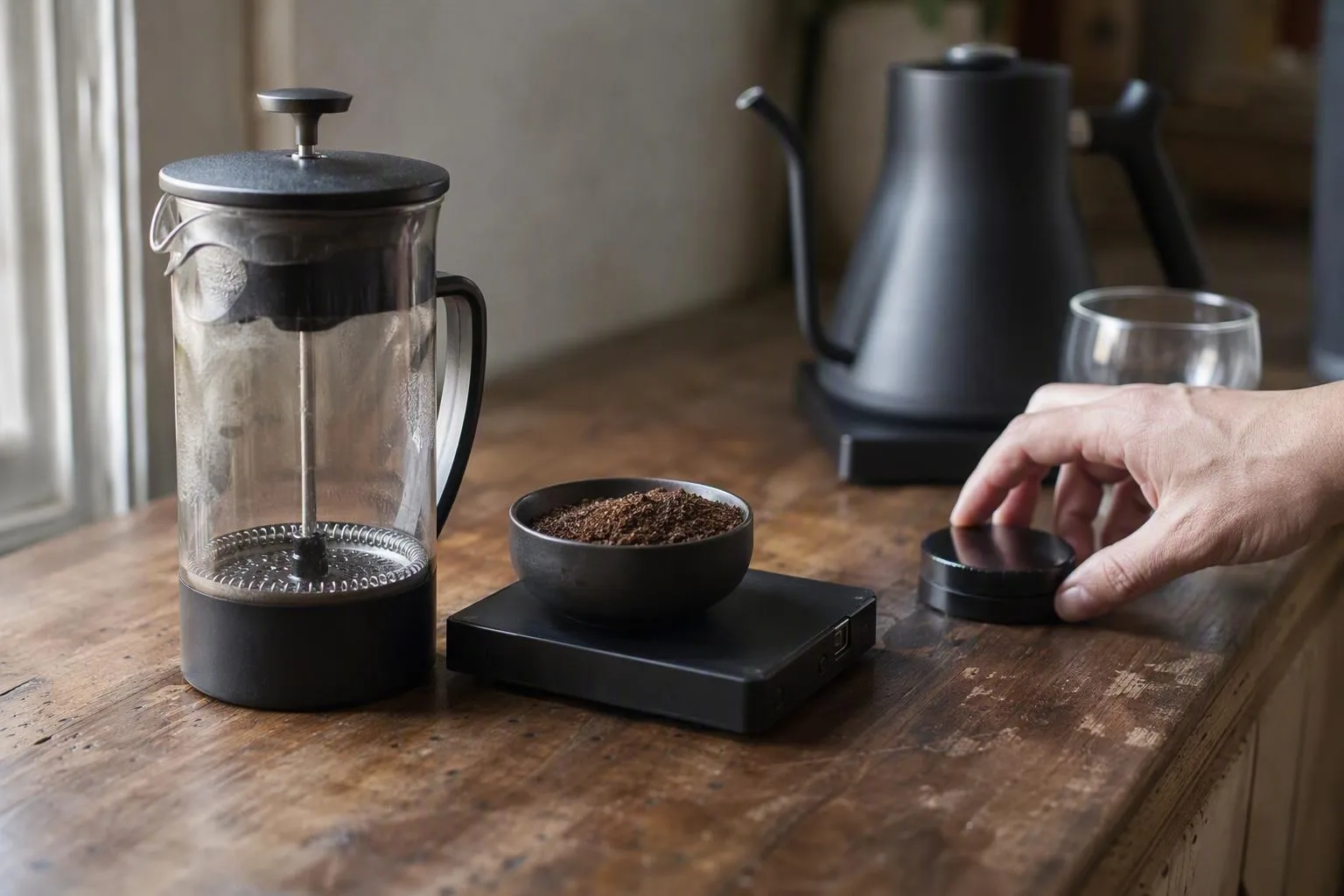
- Weigh the coffee. Measure 30 g of beans and grind them medium-coarse. If the grounds contain a visible dusting of powder, note that before you brew; it will help explain sediment later.
- Heat the water. Bring 450 g of water to 93–96°C. If the press has been sitting on a cool counter, fill it with hot water, swirl, and discard that water before dosing.
- Add the water promptly. Put the grounds in the press, set it on the scale, tare it, and pour all 450 g within roughly 10–15 seconds. A steady full pour is easier to repeat than a thin stream.
- Wet the bed with restraint. Stir two or three gentle turns with a spoon or chopstick. The goal is to break up dry islands, not whip the surface into a vortex.
- Cover and wait. Put the lid on and start the timer from the first water. Let the coffee steep until 4:00. Keep the plunger above the liquid rather than pressing early.
- Plunge slowly. At 4:00, press down over about 20–30 seconds. If the plunger suddenly meets strong resistance, stop forcing it, lift it slightly, and continue with less pressure.
- Decant completely. Transfer the brewed coffee to a separate jug or server, including the last liquid. Let it settle for one or two minutes before pouring into cups.
If the grounds resist wetting because the coffee is very fresh, pre-wet them with roughly 50–60 g of the total water, wait 30–45 seconds, then add the remainder. Start the four-minute timer with that first water. This gives gas a chance to escape without turning the whole recipe into a long, separate bloom stage.
The finished surface may carry a thin layer of foam or small particles. That is not automatically a fault. Taste the coffee after the short settling period, then taste it again as it cools; the second check often makes dryness and sharpness easier to separate.
Cleaner means less sediment, not less extraction: the fines-and-mesh explanation
Fines are small particles created during grinding. They have a large surface area relative to their mass, so they can release soluble material quickly and remain suspended in the liquid. A metal mesh filter catches larger particles, but it is not a paper filter and does not remove every fine.
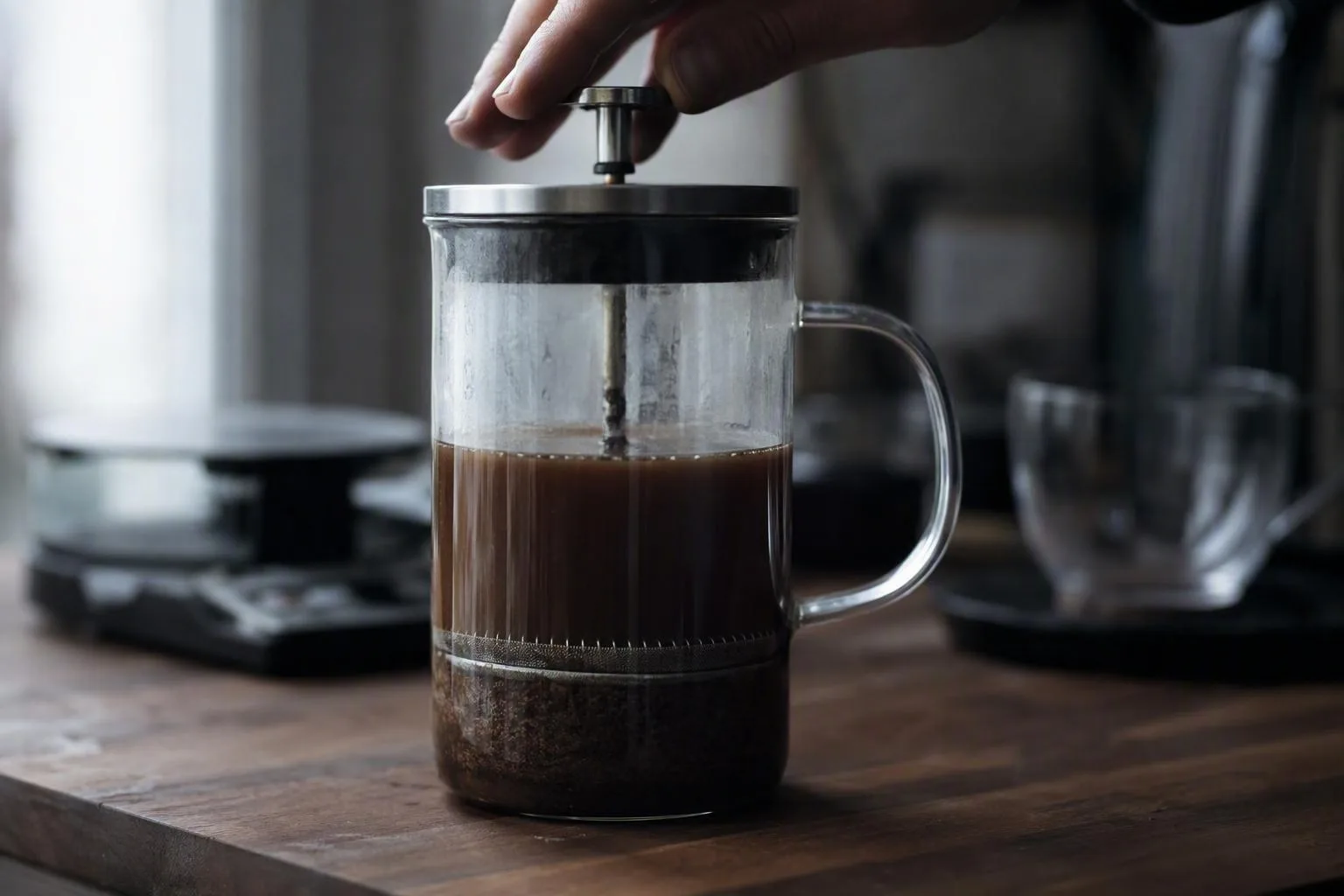
Stirring affects what happens next. Gentle agitation wets the bed; aggressive stirring keeps more fines moving through the liquid and can leave a thicker layer of sludge above the mesh. A grind that is too fine makes the problem worse because the fines extract quickly during the same four-minute immersion while the larger particles may still be lagging behind.
That mixed particle population explains why a French press can taste both harsh and hollow. The powder may be over-extracted while the boulders contribute less, so the cup carries bitterness or dryness alongside a thin, sharp centre. Changing the ratio cannot correct that uneven extraction.
Plunging is another clarity control. A forceful push can compress the bed and drive cloudy liquid through the mesh. A controlled 20–30-second plunge creates less turbulence, although it cannot remove fines that are already small enough to pass through.
Decanting is the final step. Leaving brewed coffee on the grounds inside the press keeps water and coffee in contact, so extraction can continue and the flavour can move toward bitterness or astringency. The counter-intuitive rule is simple: a cleaner cup often comes from better handling after the brew, not from adding more water before it.
Use the cup as a diagnostic: sour, bitter, thin, or muddy at 1:15
Use the table as a checking order, not as a reason to make three changes at once. Under-extraction means the water has not removed enough of the coffee’s soluble material; over-extraction means the brew has pulled an excessive or unpleasant balance of soluble compounds. Both can appear in the same press when the grind contains very different particle sizes.
| What you taste | Likely mechanism | First change to test |
|---|---|---|
| Sour, sharp, or lemon-like | Under-extraction from low temperature, short contact, or particles that are too large | Grind one step finer. If the next cup is still sharp, raise the water by 1–2°C. |
| Bitter, harsh, or drying | Over-extraction, often amplified by fines, high heat, or a long steep | Grind one step coarser. If needed, lower the water by about 2°C or shorten the steep by 30 seconds. |
| Thin but balanced | Extraction is acceptable but the drink is not concentrated enough | Keep the brew path and move from 1:15 to 1:14, using 30 g coffee and 420 g water. |
| Muddy or silty | Fines are suspended or pushed through the mesh by agitation and pressure | Stir less, then keep the slow plunge. If needed, move one step coarser. |
| Sour and muddy together | Uneven extraction: fines are extracting quickly while larger particles lag behind | Reduce agitation first, then test a slightly coarser grind on the next brew. |
Change one variable at a time. If you grind finer, keep 30 g, 450 g, 93–96°C, and 4:00 unchanged. If you lower the temperature, do not also shorten the steep. The point is not laboratory precision; it is giving your palate one clear cause to evaluate.
Let the cup cool slightly before the second diagnosis. Many home brewers find it easier to separate sourness, sharpness, dryness, and thinness once the drink is no longer at its hottest. If the flavour changes from sweet to drying as it cools, check fines and contact time before blaming the ratio.
Consider a 30 g dose brewed with 450 g of 94°C water for four minutes. If it tastes sour and leaves sludge, the answer is not automatically more water or less coffee. Reduce the stirring to one gentle turn, keep the ratio, plunge slowly, and then test a coarser grind. That sequence changes the particle path before it weakens a brew that may already be extracted properly.
When 1:15 loses: choose 1:14, 1:16, or post-brew dilution for a specific problem
For troubleshooting a French press, 1:15 is the better starting point because it gives you a substantial cup without hiding extraction defects behind excessive dilution. It is not a sacred number. Choose the alternative based on what is wrong with an otherwise controlled brew.
- Choose 1:14, or 30 g to 420 g, when the cup tastes balanced but genuinely weak. You are adding coffee relative to the water, so strength rises while the four-minute extraction path stays similar.
- Choose 1:16, or 30 g to 480 g, when the cup tastes correctly extracted but too intense. More water lowers concentration; it does not remove the sediment created by fines.
- Choose dilution after brewing when the cup is extracted well but needs less intensity. Add roughly 20–40 g of hot water to the decanted coffee and taste again. This lowers strength without extending the grounds’ contact time.
Do not use 1:16 to repair sour under-extraction, and do not use 1:14 as the first response to muddy coffee. Ratio is the strength dial. Grind distribution, agitation, plunging, and decanting are the clearer route to a cleaner texture.
Save this decision rule: keep 1:15 while you diagnose extraction and sediment; move to 1:14 for a balanced but weak cup, 1:16 for a well-extracted cup that is too intense, and dilution when you want to change strength without changing contact time.
Three practical questions about this recipe
How do I scale a 1:15 French press recipe for a smaller or larger batch?
Multiply the coffee dose in grams by 15. Twenty grams needs 300 g of water, while 40 g needs 600 g. Keep the 93–96°C starting range and four-minute time, then adjust only if the deeper or shallower bed extracts differently in your press.
Can I use pre-ground coffee in a French press?
Yes. Choose the coarsest practical option. If it looks noticeably finer than medium-coarse, use gentler agitation and test a slightly shorter steep, around 3:30 to 4:00, because the extra fines can increase bitterness and sediment.
How long can French press coffee sit in the press after plunging?
Decant it immediately rather than leaving it on the grounds. If you need to hold it, transfer it to a separate insulated vessel. The separation stops the brewed coffee from continuing to sit against the coffee bed.
The 1:15 ratio makes French press coffee easier to diagnose, not magically cleaner. Start with 30 g, 450 g, 94°C water, four minutes, two gentle turns, and a slow plunge. Then change the one dial that matches what the cup is actually telling you.
Frequently Asked Questions
How do I scale a 1:15 French press recipe for a smaller or larger batch?
Multiply the coffee dose in grams by 15: 20 g coffee uses 300 g water, while 40 g uses 600 g water. Keep the 93–96°C temperature and 4-minute starting time, then adjust only if the different bed depth extracts noticeably differently.
Can I use pre-ground coffee in a French press?
Yes, but choose the coarsest practical pre-ground option. If it looks noticeably finer than medium-coarse, use gentler agitation and test a slightly shorter steep—about 3:30 to 4:00—because extra fines can increase bitterness and sediment.
How long can French press coffee sit in the press after plunging?
Decant it immediately after the slow plunge rather than leaving it on the grounds. If you need to hold it, transfer it to a separate insulated vessel; continued contact with the grounds can push extraction toward bitterness and astringency.