French Press Coffee How to Make in 6 Simple, Measured Steps
The reliable answer to french press coffee how to make is not a scoop count: use 30 g of coffee, 500 g of water, and a four-minute immersion. If the cup tastes sour, bitter, thin, or muddy, change one dial at a time—and pour it out of the press before the grounds keep extracting.
This six-step recipe gives you a stable starting point rather than a magic formula. It separates strength from extraction, keeps agitation under control, and makes the final decant part of the brew instead of treating it as an afterthought.
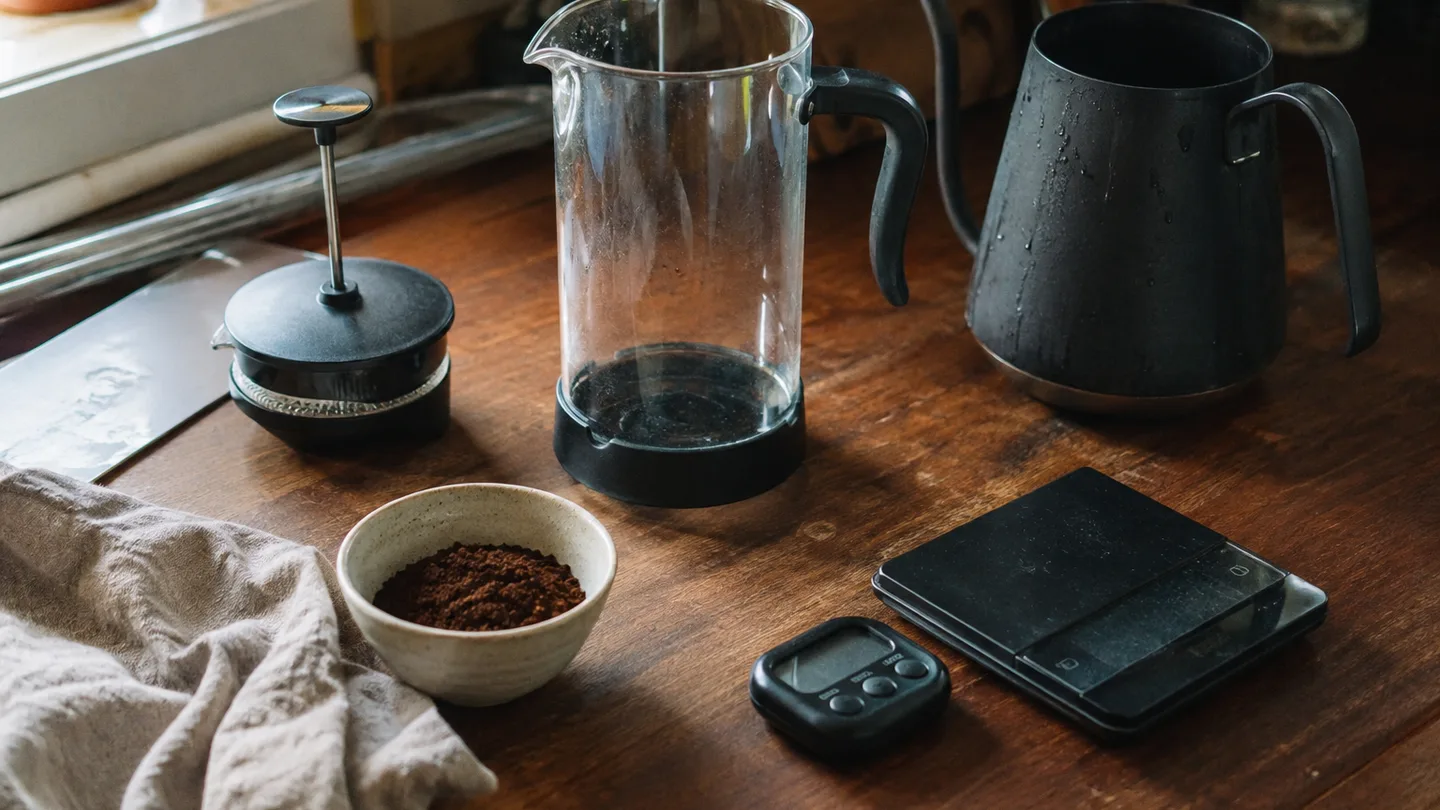
Lock in the baseline: 30 g coffee, 500 g water, and 92–96°C
Start with 30 g of ground coffee and 500 g of water. The brew ratio is the water weight divided by the coffee weight, so 500 ÷ 30 gives 1:16.7. That is a practical french press coffee ratio because it sits near the middle of a useful 1:15–1:17 range: concentrated enough to taste clearly, but not so strong that small extraction errors become hard to diagnose.
Ratio mainly changes concentration, or how strong the finished drink feels. Grind size, water temperature, agitation, and contact time change extraction: how much soluble material moves from the coffee into the water. Adding less water can make a well-extracted brew taste stronger; it cannot reliably fix a sour brew caused by grounds that are too coarse or a steep that is too short.
Use a medium-coarse grind. You want a mixture that looks more like coarse sand than powder, with few very large pebble-like pieces and limited dust. Water at 92–96°C is a sensible starting range for immersion brewing. Darker roasts generally suit the lower end because roast development makes them easier to extract, while lighter, denser beans often need the upper end.
Preheat the press before you brew. A cool glass carafe absorbs heat from the first pour, so the coffee slurry can begin below the temperature shown on your kettle. Fill the press with hot water, put the lid on, wait while you prepare the coffee, then empty it completely.
- Coffee: 30 g, ground medium-coarse
- Water: 500 g at 92–96°C
- Immersion: 4:00 after the full pour
- Finish: settle briefly, plunge gently, and decant
If you want a second way to check the arithmetic, compare this baseline with Specialty Coffee Association brewing guidance, then adjust for your beans and press rather than treating any standard as a commandment.
The six-step recipe, timed from the first pour to the final decant
Use the steps as one continuous workflow. Start the main timer after all the water is in the press, not when the kettle first touches the grounds. French press coffee does not need a separate coffee bloom—the short pre-wet-and-wait stage used in many pour-over recipes—because the grounds are immersed at once; the useful control is complete wetting without aggressive stirring.
1. Weigh 30 g of coffee and 500 g of water
Put the empty press on a scale, tare it, add 30 g of coffee, and tare again. Pour until the display reads 500 g. That gives you a 1:16.7 ratio every time, while tablespoons only estimate volume; bean density and the shape of the grind can make the same spoonful weigh noticeably different amounts.
For a smaller mug, use 20 g of coffee and 320 g of water. That keeps the basic ratio at 1:16 without requiring you to change the rest of the method.
2. Grind medium-coarse, avoiding the boulder setting
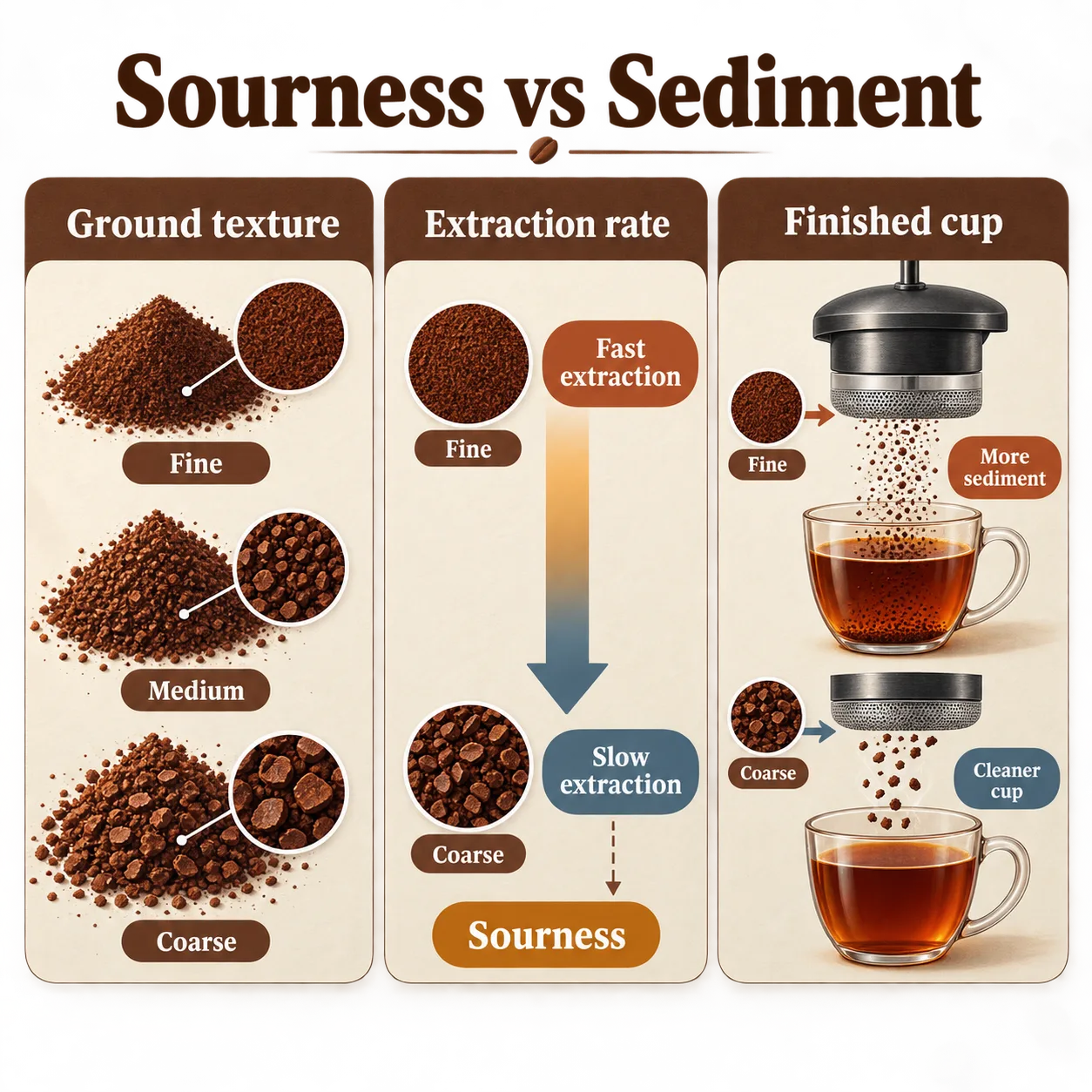
Set the grinder in the medium-coarse part of its range, but do not jump to the very coarsest setting simply because a French press uses a mesh filter. Grounds that are too fine expose more surface area, extract quickly, and let more small particles travel through or around the mesh. The result can be a cup that is both harsh and gritty.
At the other extreme, very coarse particles extract more slowly. With a fixed four-minute immersion, they can leave the drink thin, sharp, or hollow. A coffee grind size chart can help you translate descriptions between grinders, but the cup is the final test. Change one small grinder step at a time and keep the ratio, water temperature, and timer fixed.
3. Preheat the press and heat water to 92–96°C
Fill the empty carafe with hot water, fit the lid, and leave it for a moment. Empty it just before adding the coffee. Heat fresh water to 92–96°C; use the lower end for a darker roast and the upper end for a lighter roast that tastes dense or difficult to extract.
If you do not have a thermometer, let freshly boiled water stand for roughly 30–60 seconds before pouring. Treat that as a fallback, not a precise temperature reading: the pause changes with kettle size, water volume, room temperature, and how long the lid is open.
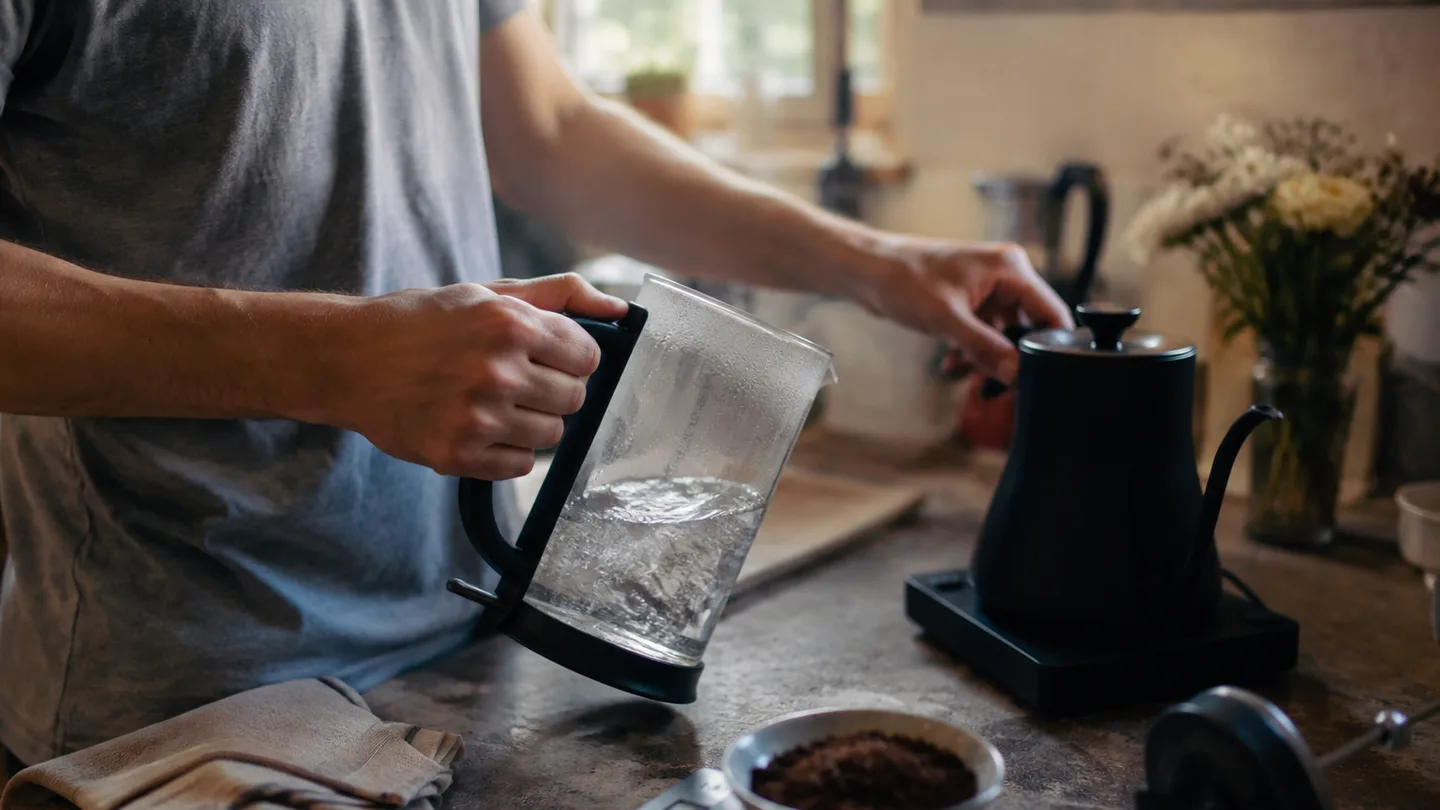
4. Pour all 500 g, stir for 5–10 seconds, and start the 4:00 timer
Add the grounds to the preheated press. Pour all 500 g of water in one controlled pour, making sure no dry pocket remains on the surface or around the edges. Stir gently for 5–10 seconds, just long enough to wet the full bed, then place the lid on without pressing the plunger and start the timer when the pour ends.
More movement is not automatically better. Aggressive stirring increases agitation, which can lift fines into the liquid and create a rougher mouthfeel. A weak first pour has the opposite problem: dry pockets stay trapped in the coffee bed, so some particles extract less than their neighbours.
5. At 4:00, break the crust and let the grounds settle for 30–60 seconds
At four minutes, the surface will usually have a floating crust of grounds and foam. Remove the lid or lift the plunger slightly, then break that crust with the back of a spoon or a gentle paddle movement. Do not whip the coffee. The goal is to release the trapped aroma and let the particles begin settling, not to add another round of turbulence.
Wait 30–60 seconds before pressing. Larger particles can sink during this pause, which makes it easier to plunge without disturbing the whole bed. A two- to five-minute settling period can produce a cleaner-feeling cup, but the coffee remains in contact with water during that time, so extraction also continues; if you use the longer pause, a slightly coarser grind may be needed.
6. Plunge over 20–30 seconds and decant immediately
Press the plunger slowly over 20–30 seconds. Keep it level and use light, steady force. If the filter suddenly meets strong resistance, stop forcing it; a hard plunge can disturb the settled grounds, suspend fines, and push some of them around the filter edge.
Pour the coffee into your mug or a separate serving vessel as soon as the plunger reaches the bottom. The press is an immersion brewer, so leaving the coffee above the grounds gives extraction more time to continue. This is one reason a brew can taste balanced in the first cup and dry or bitter in the last few servings.
Read the cup before changing the recipe: a fault table for sour, bitter, thin, and muddy coffee
Taste the coffee after it has cooled for a few minutes, then make one change on the next brew. Keep the dose, water weight, temperature, and four-minute timer fixed unless the table specifically tells you to change the ratio. That discipline matters: if you alter grind, heat, and steep time together, the next cup may improve without telling you why.
| What you taste | Likely mechanism | First change to make |
|---|---|---|
| Sour, sharp, or lemon-like | Likely under-extraction: the particles have not released enough soluble material. | Grind one small step finer and keep the 4:00 steep and ratio unchanged. |
| Bitter, dry, or astringent | Likely over-extraction from excessive surface area, heat, agitation, or contact time. | Grind one small step coarser while keeping the timer at 4:00. |
| Clean but weak | The extraction may be acceptable, but the drink is too dilute for your target strength. | Move from 1:16.7 toward 1:15: use 30 g coffee with about 450 g water. |
| Muddy or gritty | Suspended fines are creating sediment; excess stirring, a very fine grind, or a forceful plunge can contribute. | Reduce agitation first, then plunge gently. If the grit remains, coarsen one step. |
Sourness and sediment are different problems. A cup can be gritty yet under-extracted, because fine particles are present while the larger particles are still too coarse or the temperature is too low. Do not reach for cooler water simply because the texture is muddy; that may reduce extraction and leave you with a cup that is both gritty and sour.
Here is a useful decision rule. If the coffee is muddy but tastes sweet and balanced, leave the extraction dial alone and work on agitation, grind distribution, and the plunge. If it is muddy and bitter or dry, coarsen the grind one step. If it is sour and gritty at the same time, repeat with the same grind but a gentler five-second stir and slower plunge; if the sediment improves while the sourness remains, then make the finer-grind adjustment.
Suppose a 30 g brew tastes sharp after four minutes, but the bottom of the mug contains a layer of sludge. Changing to a much coarser grind may reduce the sludge while making the sharpness worse. The better sequence is to reduce disturbance first, observe the flavor, and only then adjust particle size. The surprising lesson is that a muddy French press is often a filter-handling problem, not a reason to abandon immersion brewing.
Scale the same brew to one mug or a full press without changing the four-minute steep
Scale the recipe with this simple rule: water weight = coffee dose × 15–17. The ratio changes the drink’s concentration, while the grind and contact conditions remain the main extraction controls. Once you start testing different doses, the coffee to water ratio calculator can do the arithmetic without making you recalculate every batch.
- One mug: 20 g coffee and 320 g water gives 1:16.
- Medium batch: 30 g coffee and 500 g water gives about 1:16.7.
- Larger batch: 45 g coffee and 720 g water gives 1:16.
Keep the steep near four minutes when the batch changes. Immersion extraction depends mainly on particle size, temperature, agitation, and contact time, so doubling the dose does not automatically mean doubling the timer. A larger press may need more thorough preheating because the carafe and lid can absorb heat, and the upper end of the temperature range can help if the slurry cools quickly, but make those changes only after tasting.
Pour the finished coffee away from the grounds, even if you are not serving it immediately. A French press is a brewer, not a storage vessel. The repeatable sequence is simple: weigh, grind, preheat, pour and stir, settle, plunge, then decant.
For the particle-size mechanics behind the grind advice, technical research on coffee particle-size distribution is the useful rabbit hole. The practical goal remains modest: produce fewer fines, disturb them less, and make the next cup different for one clear reason.