What Are the Disadvantages of a French Press? 5 Real Trade-Offs
A French press can taste muddy around minute four, even when 30 g of coffee and 480 g of water are weighed exactly. If you are asking, What are the disadvantages of a French press coffee maker?, the short answer is that its simplicity comes with built-in compromises: more material reaches the cup, the endpoint is less precise, and the whole batch is harder to separate from the grounds.
Those are not necessarily recipe failures. They are the five trade-offs created by immersion brewing through a metal mesh: sediment, less flavor separation, a delayed stopping point, wet cleanup, and a serving size that is harder to adjust. A 1:15–1:17 french press coffee ratio gives you a sensible test range, but no ratio can remove the characteristics of the filter and brewing chamber.
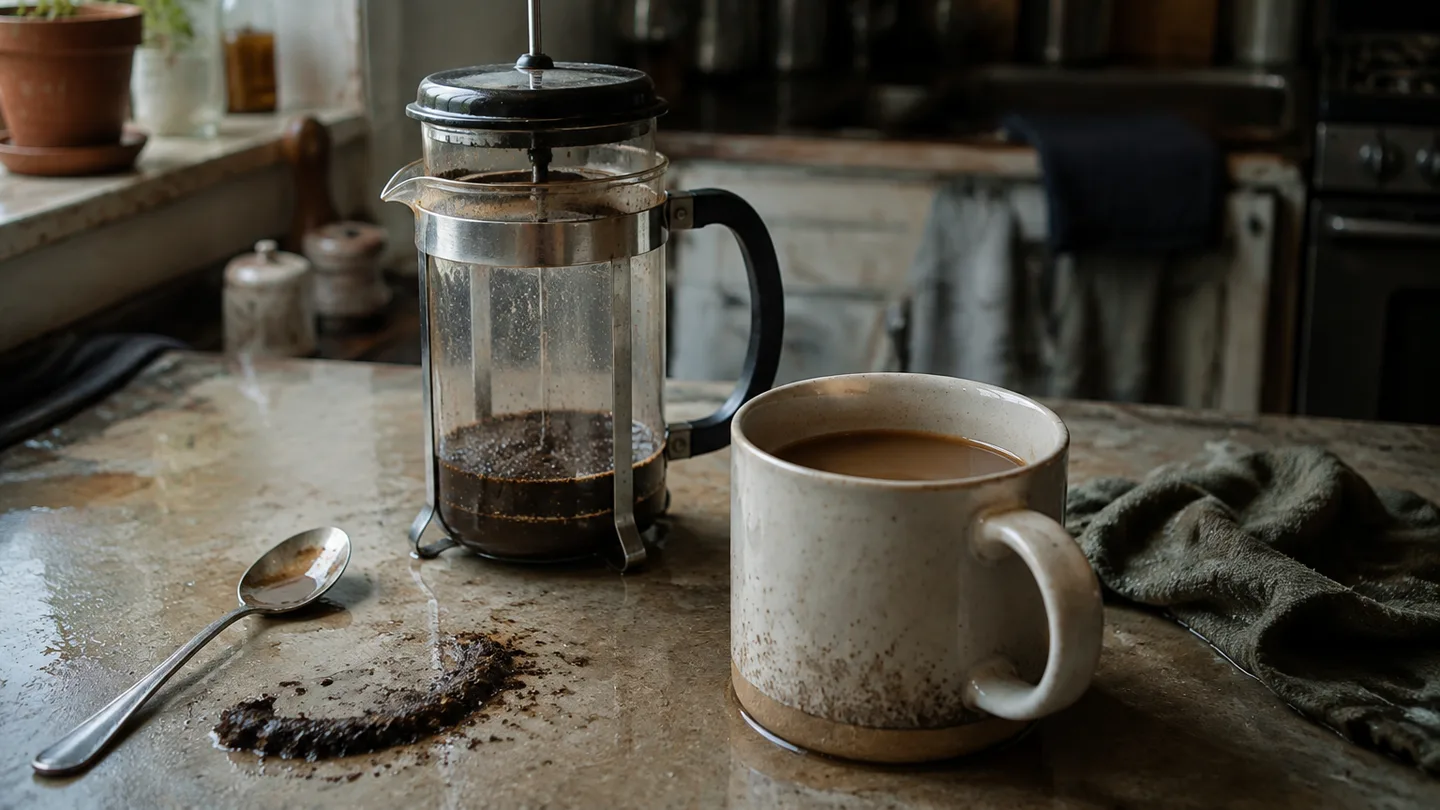
Five trade-offs at a glance: full body costs you clarity and convenience
Use the table as a diagnosis rather than a verdict. A French press can produce a rich, satisfying cup, but the symptom tells you which part of the design is doing the work.
| Cup symptom | Extraction mechanism | Practical consequence | First mitigation |
|---|---|---|---|
| Gritty, muddy finish | Fine particles pass through or around the mesh | Texture becomes rough and flavors can feel muted | Use a more even grind and plunge gently |
| Heavy but smooth cup | Metal mesh retains more coffee oils than paper | Body increases while acidity and flavor separation recede | Try a paper-filter method if clarity is the goal |
| Bitter or dry later serving | Grounds remain in the brewer after the nominal steep | The batch changes while it sits | Decant the full batch promptly |
| One strength does not suit everyone | Immersion makes one shared batch at one main ratio | Small or individually adjusted servings are awkward | Scale the dose carefully or brew separate batches |
| Wet, messy cleanup | Waterlogged grounds collect below the plunger | Emptying and rinsing take more attention than discarding a paper filter | Put grounds in the bin before rinsing |
The useful distinction is between a flaw you can tune and a trade-off you can only choose. Grind size, water temperature, and steep time are adjustable. A metal mesh will still pass more oils and some fine particles than paper, and a press will still leave the grounds in the same vessel until you decant.
Sediment is the first cost: why French press coffee can taste muddy, heavy, or muted
Metal mesh makes two separate decisions before coffee reaches your cup. It holds back most of the larger grounds, but it does not create the same fine barrier as paper. It also allows much of the coffee oil carried in the slurry to remain in the drink.
For a controlled test, use 30 g of coffee, 480 g of water, a coarse-but-even grind, water around 92–96°C, and a four- to five-minute steep. The grind setting will vary by grinder and bean, so judge it by the particles and the cup rather than by the word coarse on a dial.
At the end of the steep, press slowly. A fast plunge moves the mesh through the slurry with more force, which can stir up the fine particles gathered near the bottom. Let the plunger settle instead of pumping it, then pour the batch away from the grounds.
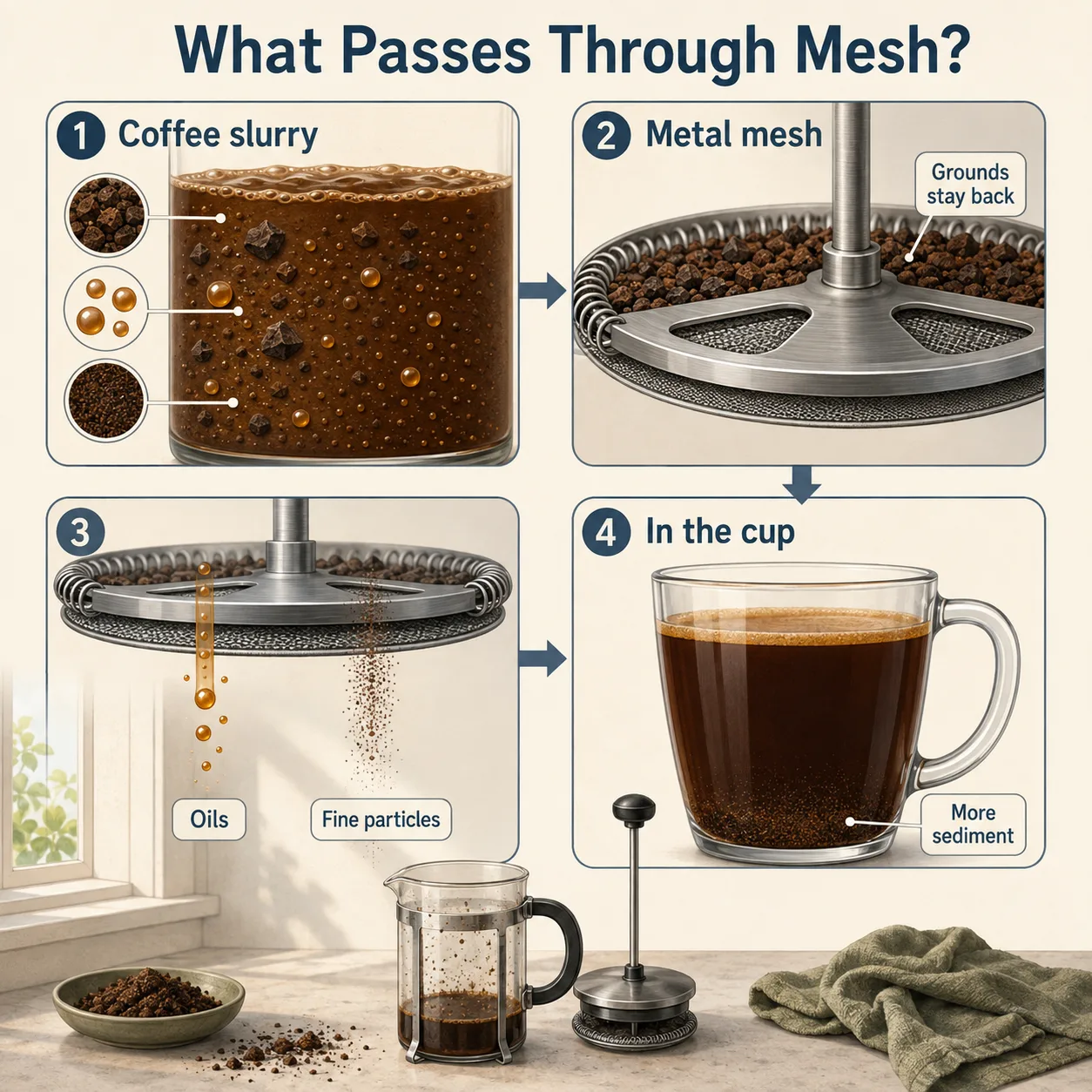
There are two cup problems that often get called muddy, but they are not identical. A gritty cup feels silty on the tongue, leaves dust at the bottom, and may become rougher as the drink cools. That points toward suspended fines: small fragments have stayed mobile long enough to pass through the mesh or remain in the liquid above it.
A heavy but smooth cup has a different texture. It coats the mouth without obvious grit, and delicate acidity or separate flavor notes seem less distinct. The likely mechanism is the oil load permitted by the metal filter, not necessarily an excessive amount of sediment.
The common mistake is treating grind coarseness as a substitute for particle distribution. Going one small step coarser can reduce the number of very small particles produced by the brew, but going much coarser can leave the larger particles under-extracted. That can turn muddy coffee into a sour or thin cup without solving the uneven grind underneath.
Change one thing first. If the coffee is gritty, inspect the grind and reduce agitation before making a large grind change. If it is smooth but too heavy, changing the grind may not address the main issue; a paper-filter brewer changes the filtration mechanism itself.
- Gritty and dusty: suspect fines and their movement through the slurry.
- Heavy but smooth: suspect oil-rich texture and reduced separation.
- Sour, thin, and gritty at once: suspect an uneven grind, where some particles over-extract while larger pieces under-extract.
A paper filter generally wins when your priority is clean flavor separation. It catches suspended particles and retains more oils, so the cup usually feels lighter and gives acidity, sweetness, and individual notes more room to stand apart. The metal mesh wins when texture is part of the point.
That is the extraction logic behind pour over coffee vs french press: paper percolation gives you a cleaner boundary between brewed liquid and spent grounds, while immersion through mesh keeps more of the brew material in play. A pour over coffee filter is not automatically better, but it is better suited to a cup where clarity matters more than weight.
The 4–5 minute timer does not stop extraction: contact time is harder to control than it looks
The familiar four-minute instruction can create false confidence. It tells you when to begin the separation, not the exact moment the coffee stops changing. During the steep, every ground is surrounded by the full water volume; after plunging, most grounds sit below the screen, but the coffee is still in the same vessel with the compressed bed and suspended particles.
Plunging therefore reduces contact and movement rather than switching extraction off like a light. The longer the finished coffee remains above the grounds, the more opportunity there is for the batch to shift as it cools. The change may be subtle with one bean and obvious with another, but the workflow is the same: press gently and decant the entire batch promptly.
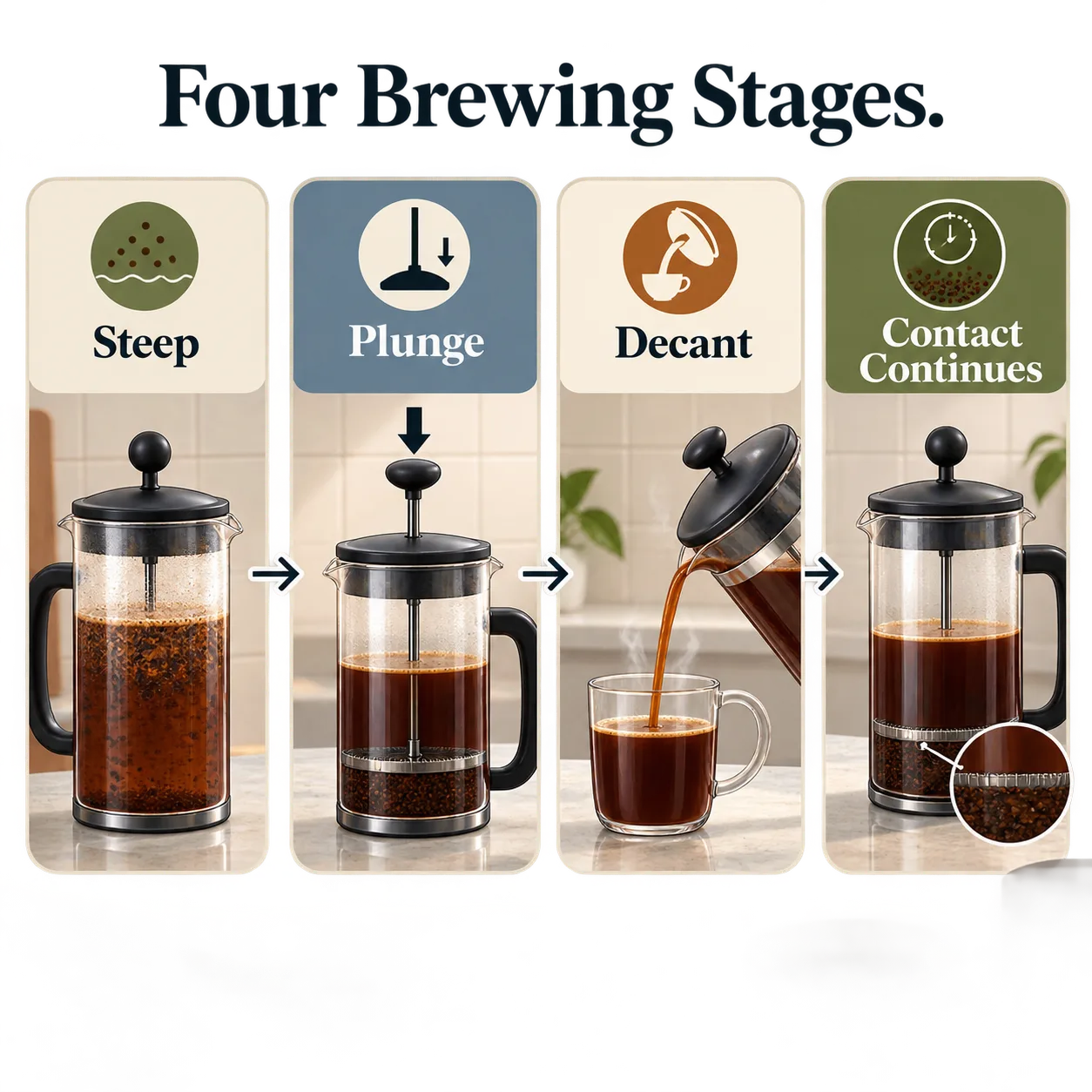
If you are troubleshooting, make the timer your first correction because it changes the broadest part of the immersion process without altering the recipe completely. Keep the dose, water temperature, and grind fixed while you test it.
- Bitter or drying: shorten the steep by roughly 30–45 seconds. If the cup becomes noticeably cleaner, the original contact time was too long for that grind and bean combination.
- Sour or thin: extend contact by roughly 30–60 seconds, or move one small grind step finer. Do not change both at once, because you will not know which adjustment supplied the extra extraction.
- Clean but weak: keep the time stable and move the ratio slightly stronger, such as from 1:17 toward 1:15. This changes concentration rather than using extra steeping to chase intensity.
If the search in your head is why is my coffee bitter, do not assume the answer is simply too much coffee. A bitter or dry result can come from a combination of fine particles, high agitation, long contact, and a hot slurry. Shortening the steep is a cleaner first test than changing dose, grind, and temperature together.
Water around 92–96°C is a starting range, not a guarantee of a particular extraction. A small press loses heat differently from a large one, and the result changes with preheating, the lid, the room, the batch size, and how quickly you pour after adding water. The practical goal is repeatability: use the same temperature routine while you change one other variable.
Pour-over brewing gives you more moment-to-moment control because flow rate and drawdown, the time water takes to pass through the coffee bed, shape the contact pattern during the brew. That control comes with its own learning curve. The French press removes pouring technique from the equation, but it also removes some of the fine-grained correction points.
So the press is not inherently inconsistent. Its main controls are simply broad and delayed. A small mistake in grind distribution or steep time affects the whole batch, which matters more when two people are drinking from it than when you are adjusting a single cup.
The cleanup and serving tax: wet grounds, fixed batch sizes, and a second cup that changes
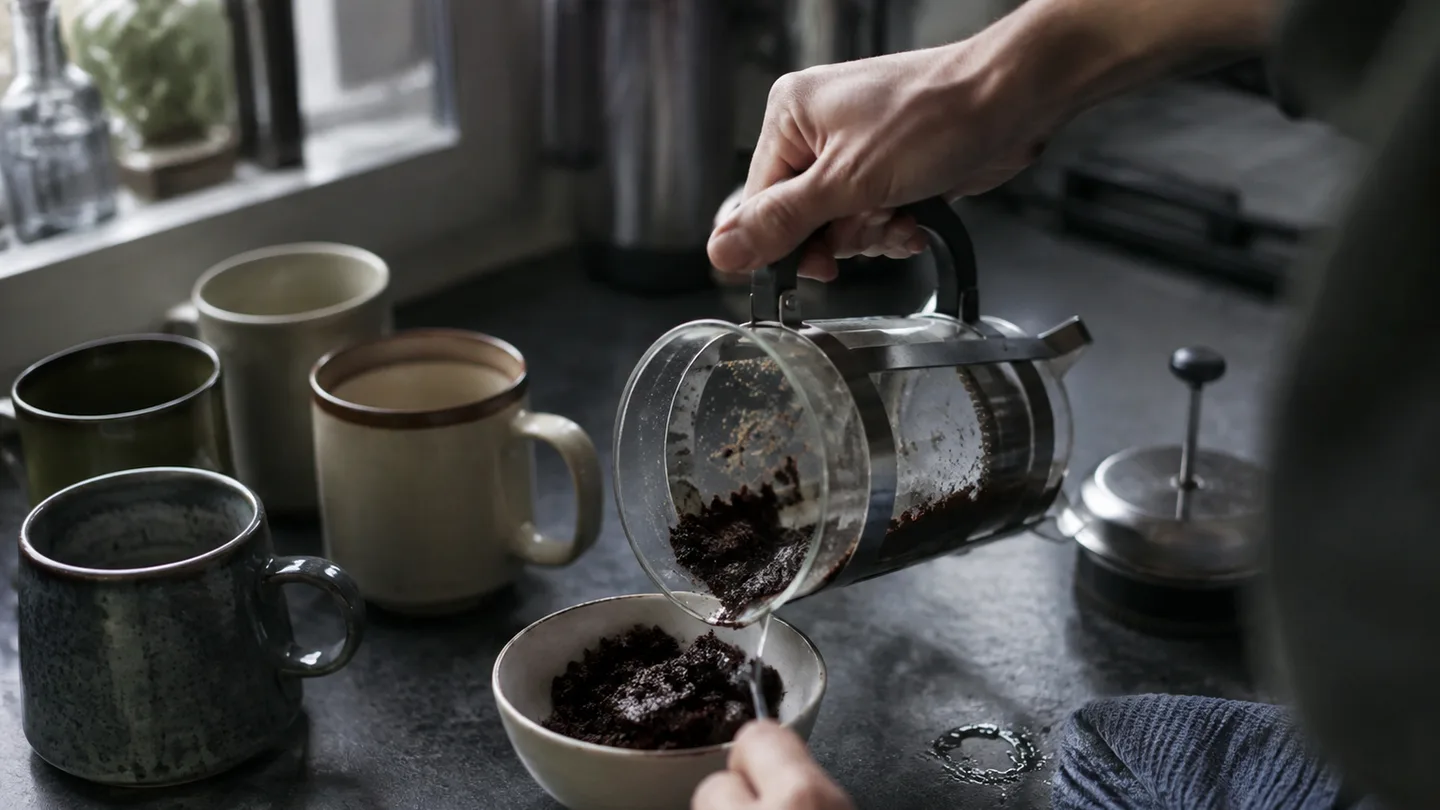
The press becomes least convenient after the coffee is brewed. Spent grounds hold a lot of water, so they leave a sludge rather than a dry puck or a paper packet. Empty the grounds into a bin or compost container before rinsing; pushing a dense mass through a sink drain creates an avoidable plumbing problem.
Rinse the plunger, screen, and glass chamber. If your press has a filter assembly that can be separated, take it apart often enough to flush particles from the mesh. Trapped fines and old oil can affect the next brew, especially if the next coffee is lighter and more delicate than the previous batch.
Serving size creates a different limitation. At a 1:16 ratio, 500 g of water calls for 31.25 g of coffee, so rounding to 31 g is a reasonable starting dose. The finished drink will weigh less than the water you poured because some water remains held by the grounds and filter bed.
That means a press labelled for a certain volume does not necessarily deliver that same volume of drink. A nominal 500 ml chamber may be a poor fit if one person wants a small cup, or if two people want noticeably different strengths. You can divide the batch, but you cannot change the extraction history of each portion after brewing.
The second serving also changes while it waits. Coffee left in the press cools beside the spent grounds, and the later pour can taste flatter, heavier, or more bitter than the first. Decanting into a separate server does not make the coffee identical from start to finish, but it removes the largest avoidable source of continued contact.
A coffee to water ratio calculator helps scale the 1:15–1:17 range to the amount your press can realistically brew. It solves the arithmetic, not the design trade-offs. You still have wet grounds to empty, oils in the cup, a fixed batch, and a less exact endpoint than a flow-through paper brewer.
Choose the French press for low-attention batch brewing and a heavier texture. It is a strong fit when several people want similar cups and you would rather steep than manage a controlled pour. Choose paper filtration when you want clean separation, a clearly defined endpoint, flexible small servings, or drier spent-coffee disposal.
For a useful test tonight, weigh 30 g of coffee and 480 g of water, use water near 93°C, steep for four minutes, press slowly, and decant everything. Taste the first and last portions separately. If the last portion is heavier, the endpoint and serving workflow are the problem; if every portion is gritty, investigate fines and agitation; if every portion is smooth but muted, the mesh-and-oil trade-off is doing exactly what the design permits.
The French press is not a failed paper brewer. It is a deliberate exchange: fewer pouring decisions in return for more sediment, more body, and less separation after the brew is finished. Once you see that exchange clearly, you can decide whether the texture is worth the cleaning and whether another method gives you the control your cup is missing.
For formal terminology around ratio, temperature, and extraction, the Specialty Coffee Association brewing standards are a useful reference point. For the particle behavior behind sediment and filtration, consult technical research on coffee particle size and filtration rather than relying on grind labels alone.