Pour Over Coffee vs French Press: Which Should You Choose?
At 20 g of coffee and 320 g of water, a pour over and French press can share a 1:16 ratio on paper and still taste like different drinks: one clean and lifted, the other rounder and more sedimented. Choose pour over if you want clarity and a dialed-in single mug; choose French press if you want body, a shared batch, and fewer consequences from an uneven pour.
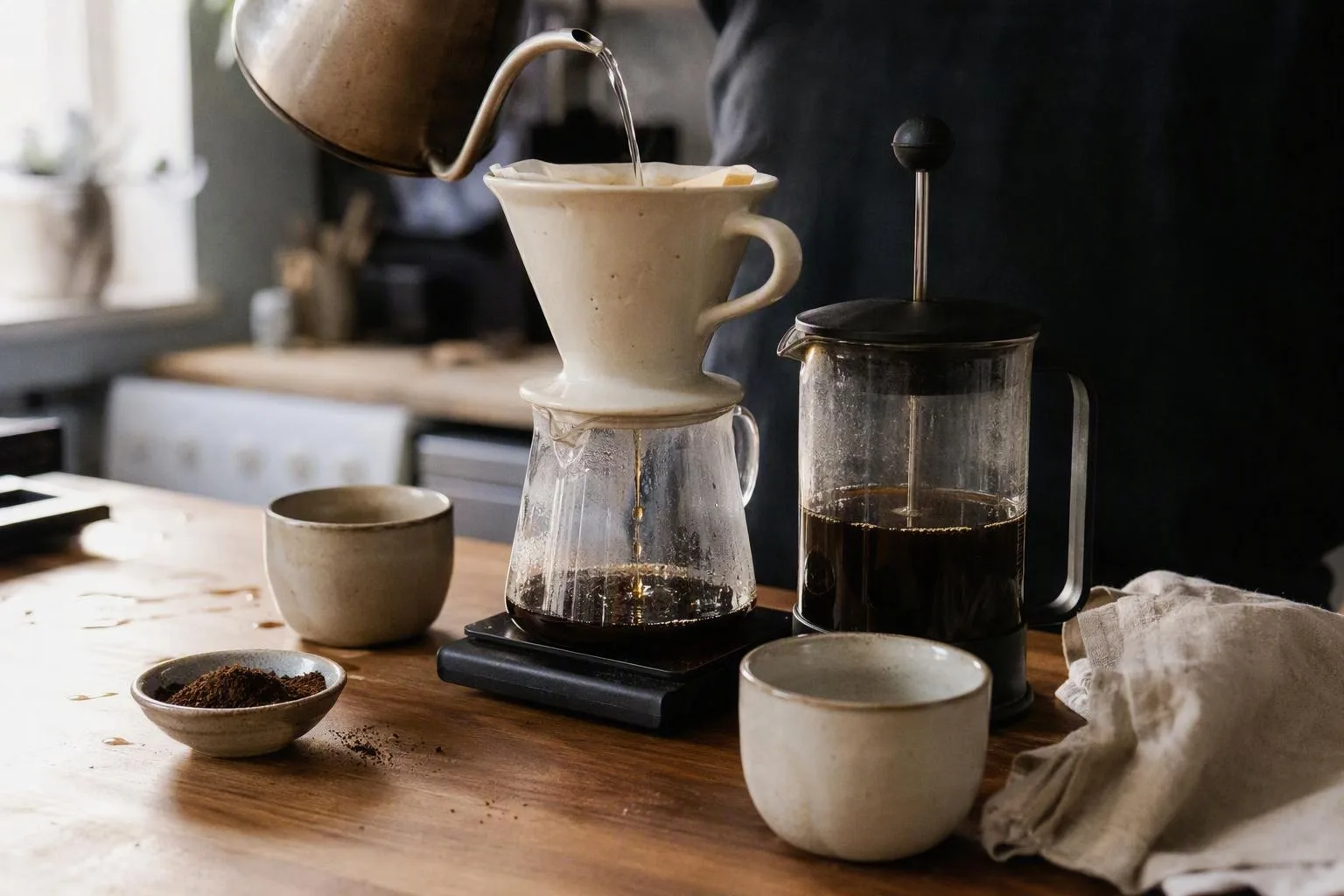
The useful distinction is flow through a coffee bed versus a timed steep. Start pour over around 1:15–1:17 and French press around 1:12–1:15, then adjust grind size and contact time rather than treating either ratio as a guarantee.
Start with the cup you want: clarity at 1:15–1:17 or body at 1:12–1:15
A 1:16 ratio means one part dry coffee to 16 parts water by input. It mainly sets beverage strength: more water makes the drink weaker, while more coffee makes it stronger. It does not, by itself, tell you whether the coffee was extracted evenly.
For a 250–350 g mug, pour over is a useful starting point at 20 g coffee and 300–340 g water, with a total brew time around 2:30–4:00. French press can start at 20 g and 240–300 g water, steeped for about 4:00. Bean density, roast level, grinder quality, and brewer shape can move those numbers, so use them as coordinates rather than rules.
The real split is flow-through extraction versus a 4-minute steep
Extraction is the process in which water dissolves and carries flavor compounds out of ground coffee. In percolation, water passes through a coffee bed and exits through a filter. In immersion, the grounds sit in the same water, so the whole slurry shares a contact time.
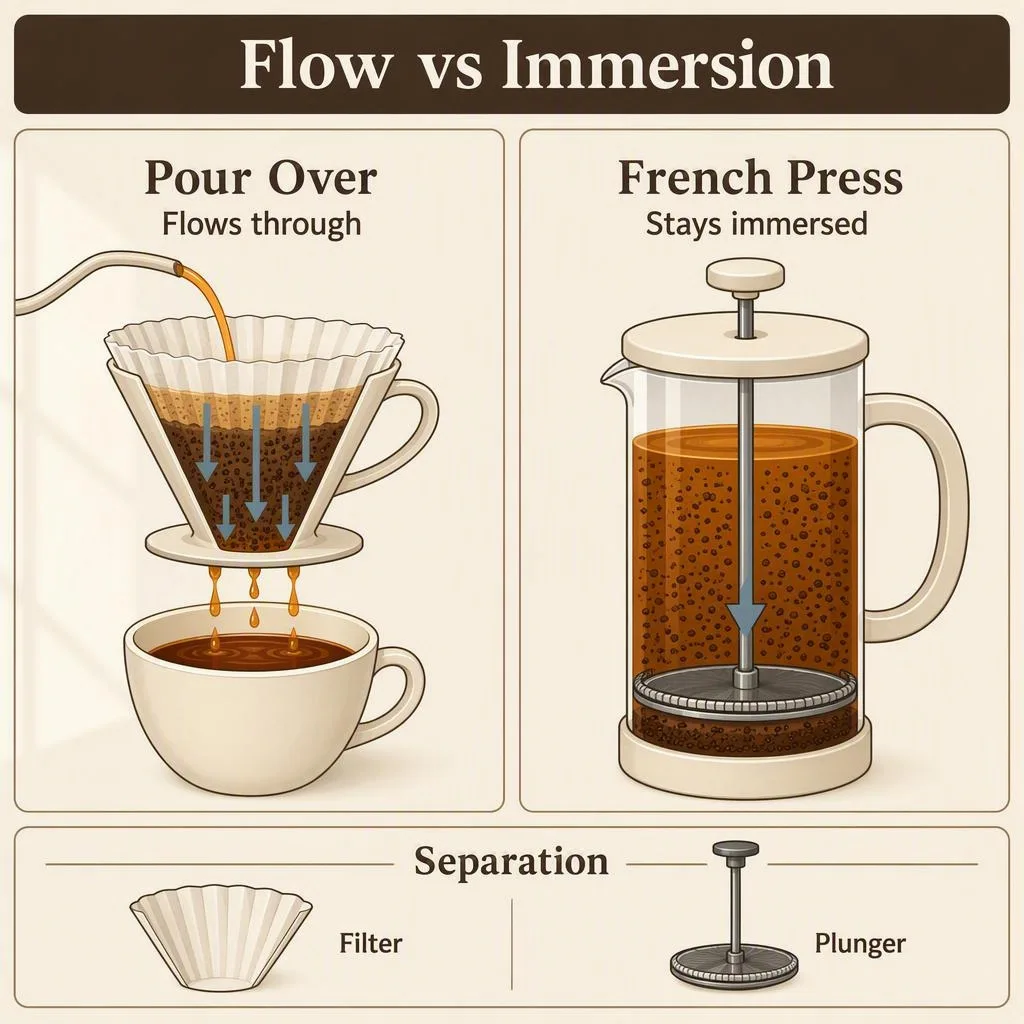
Pour over is percolation: the bed resists the water, and flow rate changes how long each area stays wet. Your pour pattern adds agitation and can move fine particles downward. If water finds a weak path through the bed, channeling can leave that path overworked while other grounds remain under-extracted.
French press is immersion. Grind size, water temperature, how completely you wet the grounds, the length of the steep, and the delay before decanting do most of the work. Pouring still matters, but a gentle pour that wets the full dose is less mechanically demanding than maintaining an even percolation bed.
Ratios set strength; grind size sets how quickly the bed gives up solubles
Keep the dose fixed while learning a method. The table gives practical starting points, not a promise that every coffee will taste balanced at the same setting.
| Method | Starting recipe | Grind starting point | First variable to watch |
|---|---|---|---|
| Pour over | 20 g coffee, 300–340 g water, 1:15–1:17 | Medium-fine | Drawdown speed and bed evenness |
| French press | 20 g coffee, 240–300 g water, 1:12–1:15 | Medium-coarse to coarse | Steep length and sediment |
Grind finer and the coffee particles present more surface area, so water can remove soluble material more quickly. Grind coarser and the path into the particle is longer. The label on a grinder is only a starting point; the particle distribution matters because fines can migrate into a pour-over bed or pass through a mesh filter.
A 90–96°C water baseline is sensible for this comparison. I would use the hotter end for a dense, light-roasted coffee that resists extraction and the cooler end for a dark roast that already gives up soluble material readily. If the same recipe behaves differently after a water change, check water chemistry guidance for coffee brewing: dissolved minerals and alkalinity are part of the extraction system, not background decoration.
To scale the dose without doing the arithmetic each time, use a coffee to water ratio calculator. Keep the ratio constant during the first comparison, then change one control at a time.
Paper, mesh, and the particles you actually drink
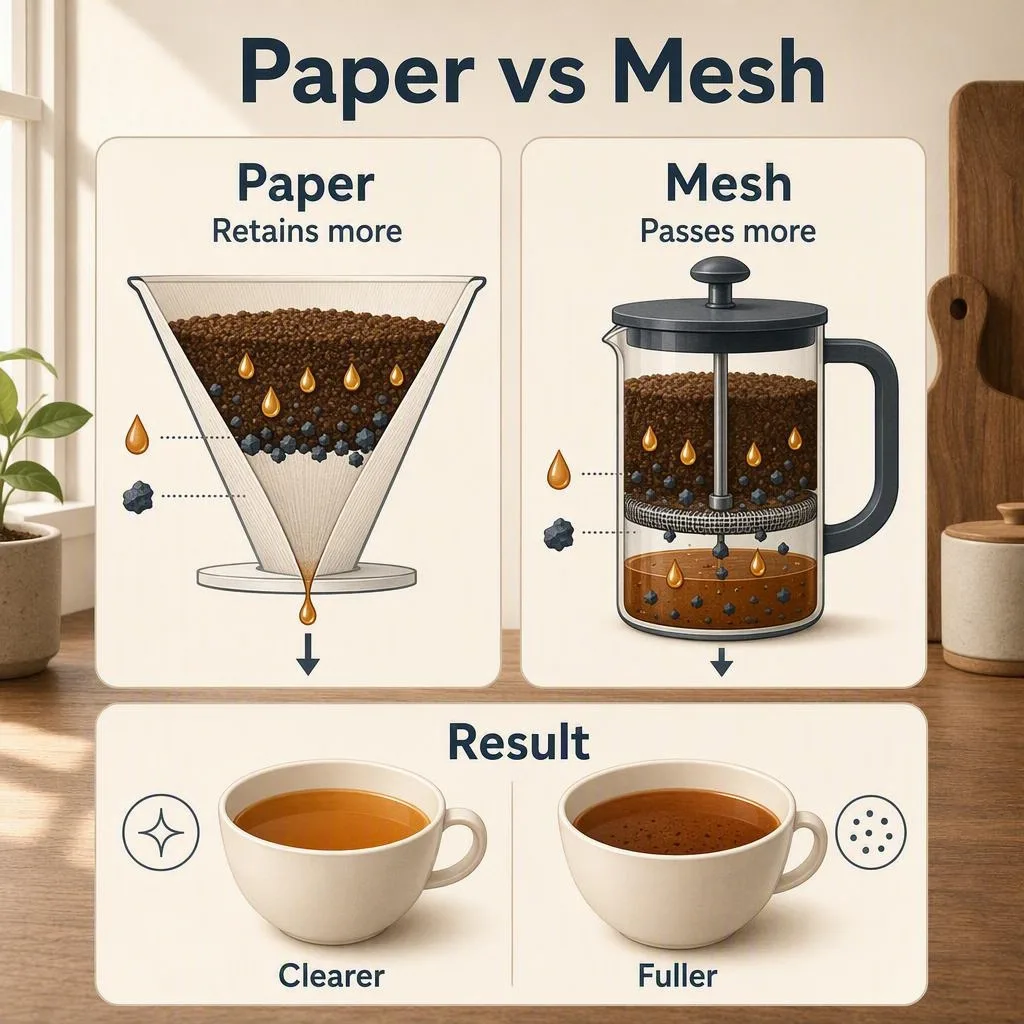
Paper and mesh answer the clarity question at the filter. A paper filter retains much of the fine particulate and a substantial share of coffee oil, while dissolved flavor compounds pass into the cup. That combination tends to make acidity, sweetness, and finish feel more separated.
A French press mesh screen allows more oil, colloids, and small suspended particles through. Colloids are tiny particles that remain dispersed in liquid, and they add weight even when you cannot see obvious grit. A coarse grind cannot guarantee a clean cup because every grinder produces some fines, and the mesh aperture differs from one press to another. There is no universal particle cutoff to apply to every French press.
A taste symptom is a direction, not a verdict: diagnose sour, bitter, thin, and muddy
Use the cup as a direction for your next test, not as proof that the method is wrong. Change one variable first, and record what happened.
| Cup and condition | Likely direction | First adjustment | Mechanism |
|---|---|---|---|
| Sour, sharp, or vegetal; pour-over drawdown much faster than your normal 2:30–4:00 | Under-extraction | Grind finer | More surface area and bed resistance extend useful contact |
| Bitter, dry, or astringent; very slow drawdown or French press steep well past 4:00 | Over-extraction or uneven extraction | Grind coarser; reduce agitation | Less exposed surface or movement reduces excessive dissolution and fines migration |
| Weak but clean; flavor is tidy but disappears quickly | Over-dilution | Move from 1:17 toward 1:15 | More coffee per unit of water raises beverage strength |
| Muddy French press; visible sediment and a heavy finish | Fines migration or delayed decanting | Pour gently, plunge slowly, decant promptly | Less disturbance keeps fine particles from remaining suspended and extracting after the target time |
Dark-roast bitterness complicates the diagnosis. Roast-derived bitterness can remain even after you improve the brew, so do not keep grinding coarser indefinitely if the coffee tastes dry but the drawdown and steep are already controlled.
Why pour over exposes pouring errors while French press absorbs them
A pour-over bloom is the initial wetting phase before the main pour. A 30–45 second bloom gives the grounds time to absorb water and release trapped gas; the following pulses then determine agitation and flow. The coffee bloom guide is useful if you want to isolate this step rather than change the whole recipe.
An aggressive pour can push fines toward the bottom of the bed, increasing resistance and causing a stall. An excessively gentle or uneven pour can leave dry pockets, so some coffee contributes less flavor than the rest. A French press recipe is less dependent on maintaining a bed: wet the full dose, steep for roughly 4:00, plunge gently, and decant promptly. It can still taste harsh if the grounds sit in the beverage after brewing.
A 20 g / 320 g side-by-side test that gives both methods a fair chance
Put both brewers on a scale, use the same coffee and water, and hold the starting ratio at 1:16. This does not make the methods identical; it makes the first difference easier to interpret.
- Weigh and heat. Use 20 g of the same coffee for each brewer and 320 g of water at 93°C. Keep the water source and serving vessels the same.
- Set the grinds. Use a medium-fine pour-over grind and a medium-coarse or coarse French press grind. Those settings compensate for the different ways water meets the grounds.
- Brew. Bloom the pour over for about 40 seconds, then pour in controlled pulses and finish within your established 2:30–4:00 window. In the press, wet every ground, steep to 4:00, plunge gently, and decant the whole batch.
- Taste deliberately. Taste both at approximately the same drinking temperature. Write down sweetness, acidity, body, dryness, finish, and visible sediment before deciding which cup you prefer.
- Run the native-ratio test. Brew the pour over near 1:15 and the French press near 1:12–1:15. If the second comparison feels much stronger, the first test exposed a strength difference that the shared 1:16 ratio had concealed.
If one cup is sour and fast while the other is bitter and slow, do not average the recipes together. Adjust each method in its own direction, because grind size and flow resistance are method-specific controls.
Choose by serving size, clarity, cleanup, and repeatability—not by method loyalty
The practical winner changes with the job. This is the decision table I would use before choosing a brewer for the morning.
| Situation | My pick | Reason |
|---|---|---|
| One 250–350 g mug with a clean, layered profile | Pour over | Paper filtration and controlled flow make clarity easier to pursue |
| About 500–800 g for a shared serving | French press | The batch steeps together with fewer individual pouring decisions; actual capacity depends on the brewer |
| Lower sediment and simpler grounds removal | Pour over | My cleanup call is paper: the grounds and filter lift out together instead of requiring a screen and slurry rinse |
| Noticeable body under milk or sugar | French press | My serving judgment is that its retained oil and suspended particles preserve more weight under additions |
| Precise cup-to-cup tuning | Pour over | Flow, pulse size, grind, and ratio give you more separate controls |
French press wins when low intervention, shared serving, and body are the priority. Pour over wins when clarity, lower sediment, and deliberate extraction control matter more.
Neither method is universally superior. Choose pour over for control and clarity; choose French press for body and forgiveness. The fair 20 g test above will show whether your coffee and grinder support that expected difference.
Four questions that change the starting recipe
Do you need to bloom French press coffee?
Usually no separate bloom is necessary because immersion wets the grounds together. A gentle 30–45 second pre-wet can help with very fresh coffee, but complete wetting and a stable 4:00 steep matter more than making the bloom elaborate.
Can you use a paper filter with a French press?
Yes, if a correctly sized filter fits without interfering with the plunger. It will retain more oil and fines and add flow resistance, moving the drink toward pour-over clarity rather than classic French press texture.
Which has more caffeine, pour over or French press?
The method name alone does not determine the amount. Coffee dose, bean type, serving size, and how much material dissolves are the useful comparison points, so compare equal coffee masses and beverage volumes.
Is pour over or French press better for dark-roasted coffee?
Both can work. Start near the cooler end of the 90–96°C range, avoid unnecessarily fine grinding, and do not extend the steep just to chase strength; use the ratio to control strength instead.
Frequently Asked Questions
Do you need to bloom French press coffee?
Usually no separate bloom is necessary because immersion wets the grounds together, but a gentle 30–45 second pre-wet can help release trapped gas from very fresh coffee; complete wetting and a stable 4:00 steep matter more.
Can you use a paper filter with a French press?
Yes, if the filter fits safely, but it changes the method by removing more oils and fines and adding flow resistance, so the result moves toward pour-over clarity rather than classic French press body.
Which has more caffeine, pour over or French press?
Neither method inherently has more caffeine; coffee dose, bean type, serving size, and extraction determine the amount, so compare equal coffee masses and beverage volumes rather than method names.
Is pour over or French press better for dark-roasted coffee?
Both work, but dark roasts generally need less aggressive extraction: start near the cooler end of the 90–96°C range and avoid unnecessarily fine grinding or extended steeping, with pour over offering more control and French press offering more body.